

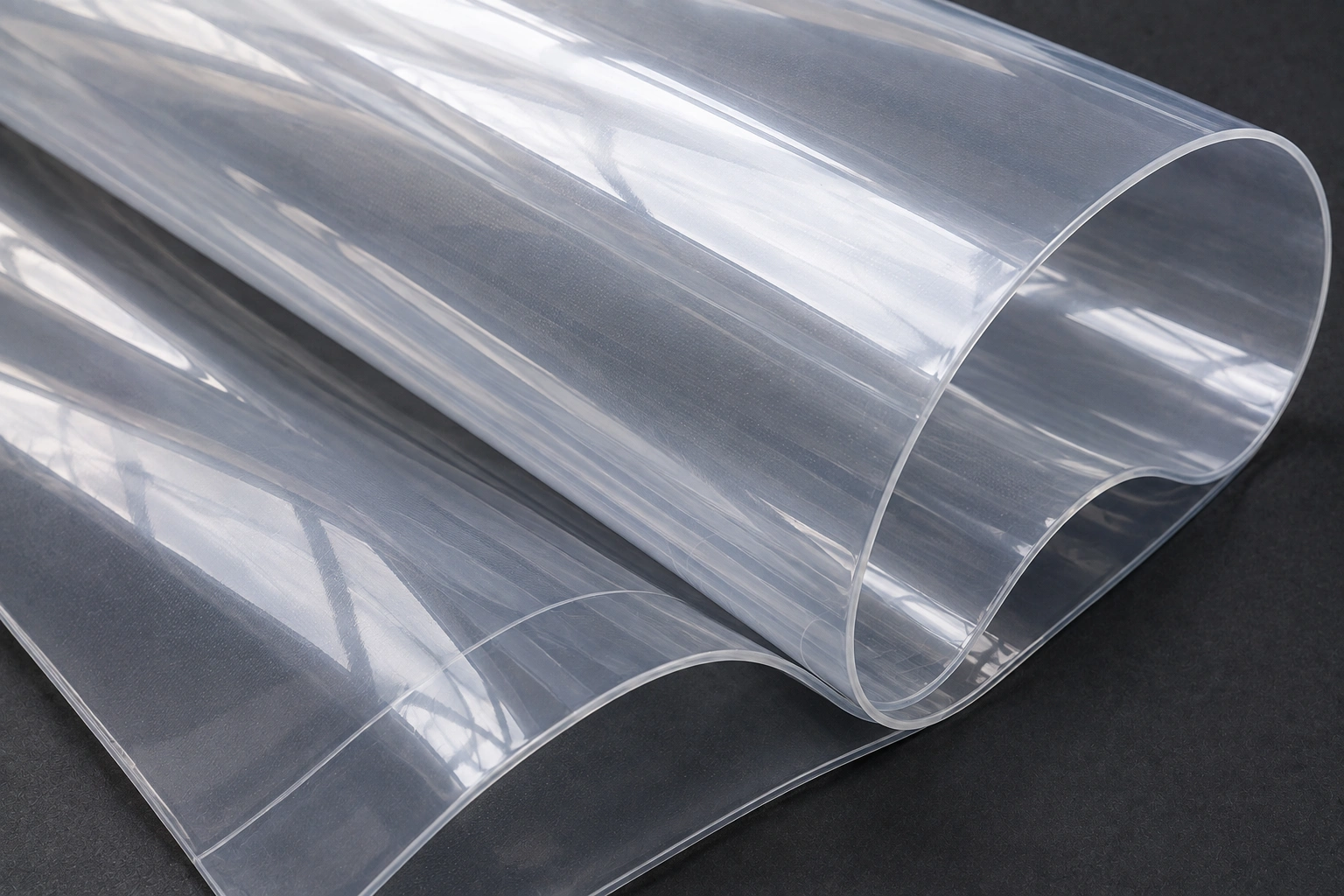
ETFE Film Membrane
Lightweight transparent building envelopes for high-performance architectural applications. ETFE is not a coated fabric — it is an extruded fluoropolymer film, typically 0.1–0.3 mm thick, used as single-layer tensioned panels or multi-layer air-inflated cushions where daylight close to that of glass matters, at a fraction of the weight.
Reviewed by Mohd. Talib, Senior Design Manager · Last updated: 14 September 2026
- Extruded film — not a woven fabric
- Visible-light transmission ~88–95% for clear film
- Inert surface, sheds dirt in rain, self-extinguishing
- Single-layer film or inflated cushions
What ETFE is — and why it is not a fabric
ETFE — ethylene tetrafluoroethylene — is a fluoropolymer from the same family as PTFE. In architecture it is used as a thin, extruded, highly transparent film. There is no woven cloth inside it and no separate coating on it, so it behaves and is detailed differently from every coated textile membrane.
A film, not a coated textile
PVC-coated polyester, PVDF-lacquered PVC and PTFE-coated glass fibre are all woven fabrics: a structural cloth carries the load and a polymer coating seals and protects it. ETFE has no cloth. It is a single polymer film, so it has almost no tensile stiffness of its own and cannot span far on its own. It is used one of two ways — tensioned as a single skin over a closely-spaced support net or frame, or built into an air-inflated cushion.
Why architecture uses it
The film is close to glass in visual clarity, weighs a small fraction of glass or of a coated fabric, is chemically inert, has a smooth surface that sheds most dirt in rain, and is stable under sunlight. Those properties make it the usual choice where a roof or facade needs to be genuinely transparent and very light — and a poor choice where the priority is diffuse light, acoustic mass, privacy, colour or lowest cost.
Physical characteristics (typical ranges)
- Film thickness
- ~100–300 µm (0.10–0.30 mm); foil commonly 0.10–0.20 mm
- Weight
- ~0.15–0.35 kg/m² per layer
- Visible-light transmission
- ~88–95% for a thin clear film; less for printed, tinted or multi-layer
- Reaction to fire
- Commonly EN 13501-1 B-s1,d0 / DIN 4102 B1 — combustible, self-extinguishing, low smoke, no flaming droplets (verify the exact product)
- Design service life
- Commonly quoted at 25–30+ years for a well-specified, well-installed system
Every figure above is a typical industry range for the material class. Actual values are set by the specific film product, the system design and the project exposure — take them from the manufacturer’s datasheet for the film and build being specified.
| ETFE film | Woven coated fabric (PVC / PVDF / PTFE) | |
|---|---|---|
| Construction | Extruded polymer film, no reinforcement | Woven scrim carrying the load, sealed in a coating |
| Load path | Needs a close support net, a frame, or air pressure in a cushion | The fabric itself spans in tension between supports |
| Transparency | Near-glass clear (or controlled translucency by printing) | Translucent to opaque; diffuse light only |
| Weight per layer | ~0.15–0.35 kg/m² | ~0.8–1.5 kg/m² |
| Joining | Heat-welded film-to-film; clamped film-to-frame | RF / hot-wedge welded seams; clamped or roped edges |
| Acoustic mass | Very low — little sound reduction | Low, but higher than film |
| Puncture resistance | Low — kept out of reach, patch-repaired | Moderate — more robust to impact and foot traffic |
| Colour | Clear, or a printed frit pattern | Full colour range (PVC/PVDF); white/off-white (PTFE) |
| Running services | Cushions need a continuous air supply and its power | None |
| Typical role | Transparent, lightweight building envelope | Shade, weather roof, opaque architectural membrane |
For the cross-material picture — PVC, PVDF, PTFE, ETFE and HDPE side by side — see the tensile fabric & membrane materials guide. For ETFE delivered as a finished structure, see ETFE tensile structures.
The main ways ETFE is built
ETFE is a component, not a finished roof. How it is arranged — how many layers, tensioned or inflated, printed or clear — is chosen for the span, the daylight target, the solar load and the budget.
Tensioned single skin
One film layer pre-tensioned over a closely-spaced cable net or a rigid frame. Lightest and most economical, best transparency, no running services.
Limited span between supports; no insulation; needs close support geometry.
Two-layer cushion
Two films clamped in an aluminium perimeter and inflated. Becomes a stiff curved panel that spans further, with an insulating air gap.
Needs a continuous air supply, blowers and monitoring.
Three- and multi-layer cushion
Extra layers add insulation and create chambers for solar control. A printed middle layer can be moved by changing chamber pressures to open or close the shading.
More air management, more cost, slightly lower light transmission.
Mechanically-supported film
Single-skin film restrained on a dense grid of arches, ribs or cables rather than inflated — used for barrel vaults and feature roofs.
Support structure is more visible; detailing at every rib.
Printed / fritted ETFE
A ceramic-style dot or line pattern printed onto one or more layers to cut light and solar gain by a controlled amount, add privacy, or carry a graphic.
Reduces daylight by design; pattern is permanent on that layer.
Movable-layer solar control
A three-layer cushion with complementary frit patterns on the middle and outer layers; shifting the middle layer aligns or offsets the dots to vary shading through the day.
Most complex option; controls, sensors and commissioning.
Multi-chamber cushion
A single large cushion divided into independently-pressurised chambers for larger panels, staged inflation, or zoned solar control.
Air routing and control logic scale with the number of chambers.
Single-layer film is the lightest and cheapest but spans the least and adds no insulation. A cushion spans further, insulates and can carry solar control, but adds the air-management system and its running cost. Most large ETFE roofs are cushion systems; many facades, rooflights and canopies are single-skin.
The ETFE cushion is a system, not a sheet
A pneumatic cushion only works as a set of parts kept in balance: the film layers, the clamped aluminium edge, and a small air plant that keeps them inflated, dry and monitored. Remove any one and the panel is no longer a structural element.
Why the air is dried
Incoming air is dehumidified before it enters the cushion so moisture does not condense on the inside of the cold outer layer and drip or fog the panel.
Why pressure is low
Nominal pressure is only a few hundred pascals — enough to pre-stress the film and give the panel stiffness, low enough that leakage and energy use stay small. The system raises it temporarily under load.
Why there is redundancy
A standby blower, and often dual power feeds, mean a single failure does not deflate the roof. Monitoring raises an alarm on pressure loss so a fault is fixed before it matters.
What a cushion is not
It is not a sealed bag — it leaks slowly by design and is continuously topped up. It is not self-supporting without air. And it is not an insulated glazing unit — the air gap helps but the U-value is modest.
Cushion sizes vary widely with the design — panels are often in the range of a few metres wide and up to tens of metres long, set by the framing grid, the film width and the structural analysis. There is no standard cushion size.
ETFE cushions, in the field
How an ETFE roof carries load — and where the span comes from
The ETFE never carries the span. It is the lightweight, transparent cladding on a structure of steel, aluminium or a pre-tensioned cable net, and it transfers wind, rain and snow into that structure through its edges.
Single-skin film
Pre-tension holds the film taut; a close grid of cables or ribs keeps deflections and flutter within limits. Support spacing is small because the film has little stiffness.
Cushion
Internal pressure pre-stresses the layers so the cushion acts as a stiff curved panel spanning the framing grid. Under wind or snow the air system raises pressure to keep it stable.
Form-finding & geometry
Cushion curvature, panel shape, edge conditions and drainage falls are worked out together so the film stays in tension everywhere, water runs to designed low points, and no layer goes slack.
What is not published here
Design pressures, membrane stresses, cable forces and deflections are all project-specific and come from a structural analysis to the applicable code — not from a generic figure on a web page.
How ETFE performs: light, heat, weather, fire, sound
ETFE has real strengths — transparency, weight, chemical stability — and real limits. None of the figures below is a guarantee; each depends on the film product and the system built.
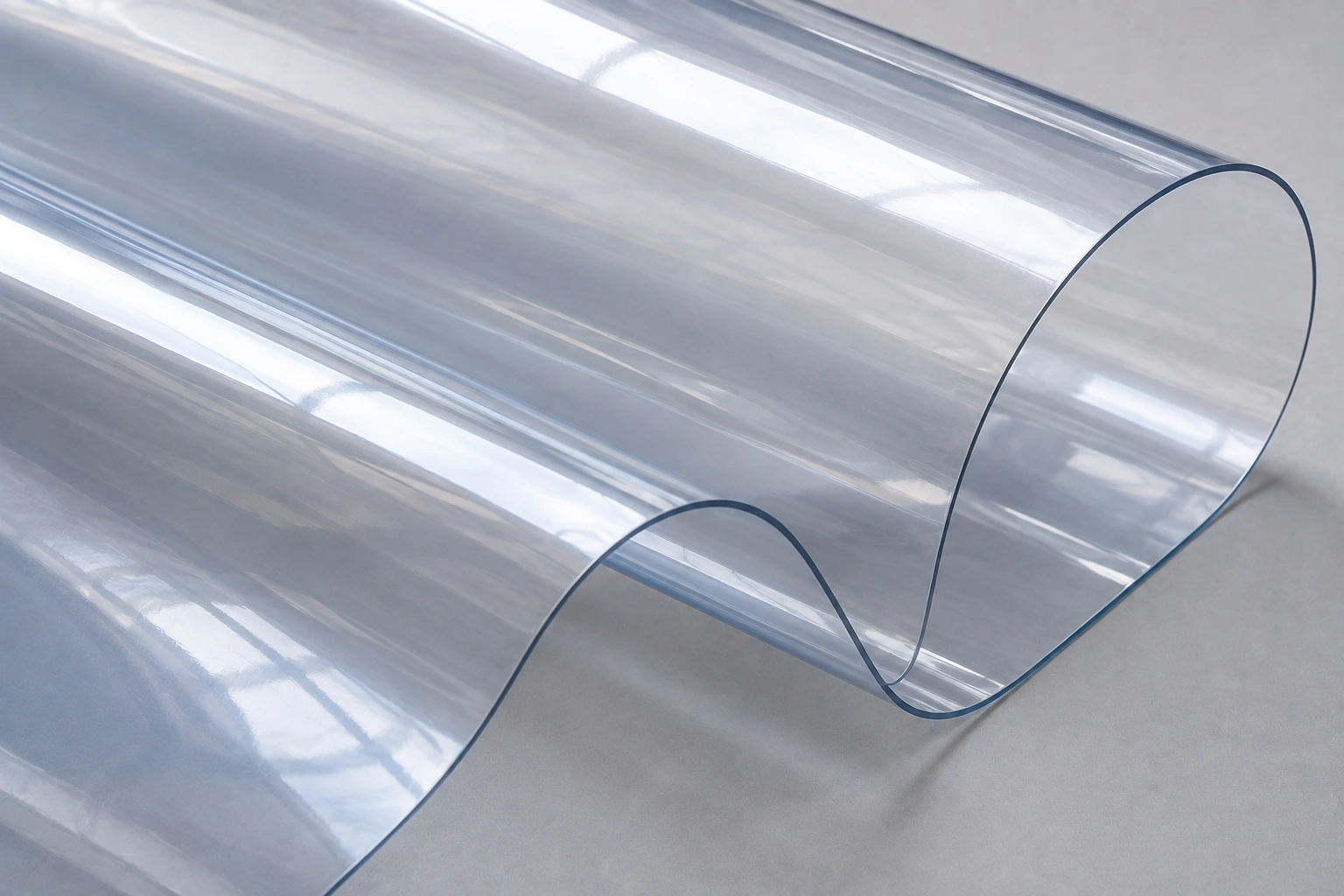
Transparency & daylight
A thin clear ETFE film transmits roughly 88–95% of visible light — a bright, near-glass interior. It also passes a large share of UV, which suits planting but not spaces where UV must be excluded. Printing a frit pattern, adding layers or tinting reduces transmission on purpose, for glare and solar control. The exact optical performance is a property of the specified film and build.
Solar & thermal
A clear ETFE roof lets solar energy in as well as light, so on its own it does not keep a building cool. Solar control is designed in: a frit pattern on one or more layers, extra layers, a low-solar-transmission grade, or a movable printed middle layer in a cushion that opens and closes the shading. The building’s cooling and ventilation strategy is designed around the roof, not left to the film.
Weather, UV & cleaning
ETFE is stable under sustained sunlight — accelerated weathering tests show it retains the large majority of its tensile strength after exposure equivalent to many years outdoors. The smooth, low-friction surface means rain washes off most airborne dirt, so cleaning is infrequent. It is low-maintenance, not maintenance-free: accessible areas still need periodic inspection and an occasional manual wash, and access is designed in for the parts that need it.
Fire
ETFE is combustible but flame-retardant. Products are commonly classified around EN 13501-1 B-s1,d0 (minimal contribution to fire, low smoke, no flaming droplets) or DIN 4102 B1. In a fire it softens, shrinks away from the heat and vents — releasing heat and smoke upward rather than spreading flame across the surface or dripping burning material. It is not non-combustible; where a non-combustible (A-class) reaction is required, PTFE-coated glass fibre is the membrane to use. Always verify the exact product classification against the project’s fire strategy.
Acoustics
A taut, low-mass film gives almost no sound insulation and a lively acoustic under rain and inside large volumes. Multi-layer cushions help only marginally. ETFE is not an acoustic solution — if noise matters, the space needs project-specific acoustic design (absorptive surfaces, volume, layout), not a change of membrane.
Durability & service life
Design service lives of 25–30 years and beyond are commonly quoted for well-specified, well-installed systems, and the polymer itself is inert and UV-stable. Real life depends on the film thickness and product, the system design, the exposure, handling during install, cleaning and maintenance, and mechanical damage. Any single lifespan number is only meaningful tied to a named product, a specification and an exposure.
Sustainability — honestly
ETFE’s low weight can cut the amount of primary steel a suitable design needs, it daylights deep spaces and reduces lighting energy, it uses very little material per square metre, and it lasts a long time. ETFE is also recyclable, and offcuts and end-of-life film can be recovered by the industry. It is not “100% sustainable” — it is a fluoropolymer with an energy-intensive production, cushions consume power continuously, and the whole-life picture depends on the specific project.
ETFE vs PVC, PVDF and PTFE — by application, not “better”
There is no membrane that wins everywhere. ETFE is a specialist film for transparency and light weight; the coated fabrics are the practical, economical choice for most shade and weather roofs. The table is ETFE-forward; the decision matrix below turns it into a recommendation per application.
| Factor | ETFE film | PVC-polyester | PVDF-lacquered PVC | PTFE-glass |
|---|---|---|---|---|
| Material class | Extruded fluoropolymer film | Coated woven fabric | Coated woven fabric | Coated woven fabric |
| Carries its own span | No — net, frame or air | Yes | Yes | Yes |
| Light transmission | ~88–95% (clear) | ~5–15% | ~5–12% | ~10–20% |
| Light quality | Clear / view-through | Diffuse | Diffuse | Diffuse, bright white |
| Weight per layer | ~0.15–0.35 kg/m² | ~0.8–1.3 kg/m² | ~0.9–1.4 kg/m² | ~1.1–1.6 kg/m² |
| Colour options | Clear or printed frit | Full range | Full range | White / off-white |
| Reaction to fire | B-s1,d0 (combustible, self-extinguishing) | B-class, self-extinguishing | B-class, self-extinguishing | A2-class, non-combustible |
| UV & weathering | Outstanding | Good | Very good | Outstanding |
| Surface / cleaning | Sheds dirt in rain | Needs cleaning; can hold dirt | Good self-cleaning | Excellent self-cleaning |
| Acoustic mass | Very low | Low | Low | Low–moderate |
| Impact / puncture | Low — keep out of reach | Moderate | Moderate | Moderate; brittle to sharp folds |
| Insulation option | Yes — multi-layer cushion air gap | Add-on liner | Add-on liner | Add-on liner |
| Running services | Cushions need continuous air + power | None | None | None |
| Design service life | 25–30+ yr (system-dependent) | ~15–20 yr | ~20–25 yr | 30+ yr |
| Fabrication | Heat-welded film + aluminium framing | RF/wedge welded, quick | RF/wedge welded, quick | Specialist welding, careful handling |
| Relative material cost | High (system cost higher again) | Low | Medium | High |
| Best at | Transparent, ultra-light envelopes | Everyday canopies & shade at low cost | Long-life commercial & civic work | Large permanent white roofs, non-combustible |
| Weakest at | Cost, acoustics, impact, opacity | Longevity, self-cleaning | Upfront cost vs PVC | Transparency, sharp detailing, cost |
Ranges are typical industry figures for the material class. See the dedicated pages: PTFE-coated fibreglass, PVC-coated polyester, PVDF-lacquered PVC.
Which membrane suits which application
| Application | ETFE | PVC / PVDF | PTFE-glass |
|---|---|---|---|
| Transparent roof / view-through | Excellent | No | No |
| Atrium / courtyard roof | Excellent | Good | Good |
| Stadium roof / large span | Good (on cable net) | Conditional | Excellent |
| Shopping mall skylight | Excellent | Good | Good |
| Airport terminal roof | Good | Conditional | Excellent |
| Botanical / planting house | Excellent | No | Conditional |
| Swimming pool enclosure | Excellent | Good | Good |
| Sports hall / indoor courts | Good | Good | Excellent |
| Entrance canopy / porte-cochere | Conditional | Excellent | Good |
| Covered walkway | Good | Excellent | Good |
| Car parking shade | Not first choice | Excellent | Good |
| Temporary / short-term shelter | Not first choice | Excellent | Conditional |
| Permanent architectural facade | Excellent | Good | Good |
Choose ETFE when
The space must be genuinely transparent or view-through; weight must be minimal (long span on a light structure, or a retrofit onto an existing frame); daylighting a deep or enclosed volume is a priority; a striking, light-filled architectural effect is the intent; and there is budget and infrastructure for a cushion’s air system if one is used.
Choose another membrane when
The roof should be opaque or a specific colour; diffuse, glare-free light is wanted (PTFE, PVC); acoustic performance or impact resistance matters; the budget is tight or the structure is temporary (PVC); a non-combustible A-class reaction is required (PTFE-glass); or there is no appetite to run and maintain an air-management system.
From brief to installed roof
An ETFE system is engineered, welded and framed as a set of tightly controlled steps. The film is precise and unforgiving of handling errors, so the sequence matters.
Brief & feasibility
Daylight target, solar and thermal goals, span, structure type, budget and fire strategy — and an early, honest call on whether ETFE or a coated fabric is the right material.
Structural analysis & form-finding
Design loads to the applicable code, cushion geometry and curvature, panel layout, edge conditions, drainage falls, and the primary steel or cable-net design.
Cutting patterns & frit design
The 3D geometry is developed into flat cutting patterns for each film layer. Any frit pattern — density, gradient, graphic — is set here, per layer.
Film cutting & welding
Layers are cut and joined by heat welding — film-to-film — into panels, with the keder edge formed for the clamp. QA checks every weld.
Panel / cushion assembly
Layers are combined into cushions, edge cords fitted, inflation valves and sensor points set, and each panel is inspected and rolled for transport.
Framing & primary structure
Aluminium perimeter extrusions and gaskets are installed on the completed primary structure; tolerances are checked before any film is opened.
Film handling & fixing
Panels are unrolled, offered up, and the keder edge is drawn into the extrusion — film-to-frame — and clamped. Clean, dry, low-wind conditions; no walking on the film.
Inflation & commissioning
Cushions are inflated to design pressure, geometry and tension checked, the air plant, sensors, alarms and adaptive-pressure logic tested, and the monitoring system handed over with a maintenance plan.
Welding / joining
Two distinct joints. Film-to-film seams are made by heat welding in the workshop to build panels. Film-to-frame connections are mechanical — a keder cord welded into the film edge is captured in an aluminium extrusion and clamped with a gasket. The frame joint is where nearly all site work and nearly all leaks are controlled.
Structural framing
An aluminium extrusion with EPDM gaskets almost always forms the film edge and the primary weather line. The span behind it varies with the project — steel trusses, a space frame, or a pre-tensioned cable net. No single primary material is always required; the film simply needs a stiff, accurately-set perimeter to clamp to.
Printing & patterns
Frit is printed as dots, lines or gradients, or as a full graphic, onto a chosen layer. It trades daylight and solar gain for glare control, privacy, thermal comfort and architectural identity — and, in a movable-layer cushion, for adjustable shading.
Installation conditions
ETFE is installed dry, in low wind, with the film protected from tools, footwear and sharp edges at all times. For cushions the air supply, ducting, control panel and power are commissioned as part of the works, not as a follow-on trade.
Maintaining an ETFE roof
The film needs little. A cushion system also has mechanical plant that must be inspected and serviced. Neither is maintenance-free.
- Visual inspection of the film for punctures, abrasion, ponding and slack areas — typically annually and after severe weather.
- Seam & edge check — welded seams, keder edges and clamp bolts for movement or damage.
- Gaskets & seals at the aluminium extrusion for perishing or displacement.
- Drainage — designed low points, gutters and outlets kept clear so water runs away as intended.
- Air-supply unit (cushions) — blowers, filters, the air dryer and non-return valves serviced to schedule.
- Standby & power — the backup blower and any dual power feed tested under load.
- Sensors & controls — pressure sensors calibrated, alarms and adaptive-pressure logic verified.
- Cleaning — occasional manual wash of accessible areas with water and a soft method; rain does most of the work.
- Records — pressure logs and inspection findings kept so trends are visible before they become faults.
Small punctures
Repaired in place: a matching ETFE patch is welded over the sound film. A cushion can often stay in service while the repair is scheduled, on raised pressure.
Larger damage
A failed seam, widespread abrasion or a degraded panel is handled by replacing the panel or the whole cushion — the framing stays.
Plant & components
Blowers, dryers, sensors, gaskets and valves are consumable and replaced individually over the life of the roof.
End of life
ETFE is recyclable; removed film and offcuts can be recovered rather than landfilled. The aluminium framing is straightforward to recycle.
What drives the cost of an ETFE system
There is no universal rate per square metre. An ETFE roof is priced as a system — film, framing, primary structure, air plant, engineering and install — and each ETFE project is estimated individually.
Upfront
A single-layer ETFE skin is the most economical ETFE option. A cushion roof costs more — the multi-layer panels, the aluminium framing and the air plant — and typically sits above a comparable PVC or PTFE roof of the same area. The primary structure is often the largest single line, as with any long-span roof.
Life-cycle
Against the higher upfront cost: a long design life, low cleaning cost, patch-repairability, reduced lighting energy from daylighting, and lighter primary steel in suitable designs. Against it: continuous blower power for cushions, periodic plant servicing, and eventual panel replacement. Whether ETFE is cheaper over the life of a building depends entirely on the project.
See the tensile structure cost guide for how membrane, steel and installation split in a typical quote.
Where ETFE is used in architecture
ETFE appears where a building envelope needs to be transparent and very light — usually large public buildings and daylit interiors.
Stadium & arena roofs
ETFE cushions cladding a cable-net or steel roof over the pitch and stands, for a bright, lightweight cover.
Airport terminals
Large daylit concourse roofs where weight on a long span is critical.
Atria & courtyards
Roofing an open volume with near-glass daylight at a fraction of the weight — see custom fabric structures and auditorium roofs.
Shopping centres
Skylights and full roofs bringing daylight deep into retail floors.
Botanical & leisure
Planting houses, zoo enclosures and pool halls that need light, UV and a warm, humid-tolerant envelope.
Facades & feature roofs
Panels in a facade grid, or a barrel-vault rooflight, where transparency is the architectural idea.
Walkways & canopies
A bright, transparent cover over a pedestrian route — see walkway structures.
Public realm
Winter gardens, transport interchanges and civic spaces where a light-filled sheltered volume is wanted.
Where Ekra Decor fits
Ekra Decor designs, fabricates and installs tensile membrane structures on one in-house basis — engineering, workshop and site under one team — and delivers ETFE film and cushion systems on that same basis, engineered to the project.
Our built daylight and skylight work to date has used translucent PTFE and PVC membranes rather than ETFE — for example the faceted atrium skylights in Guwahati. We do not present those as ETFE projects. If your project calls for an ETFE film or cushion roof, we take it from brief and feasibility through structural engineering, fabrication, installation and the air-system commissioning and monitoring handover.
Typical ETFE technical data
Industry-typical ranges for the material class. Confirm every value against the datasheet for the specific film and system — and do not combine figures from different products.
| Property | Typical value | Unit | Basis |
|---|---|---|---|
| Film thickness | 100–300 | µm | Product-specific |
| Weight | 0.15–0.35 | kg/m² per layer | Product-specific |
| Visible-light transmission (clear) | 88–95 | % | Thin clear film; product-specific |
| Reaction to fire | EN 13501-1 B-s1,d0 / DIN 4102 B1 | class | Verify per product |
| Cushion nominal pressure | ~250–450 | Pa | Indicative; project-set, raised under load |
| Air unit coverage | up to ~1,400 | m² per unit | Indicative; design-dependent |
| Design service life | 25–30+ | years | Well-specified, well-installed system |
| Tensile / tear strength, elongation | Manufacturer specified | — | Datasheet per product & thickness |
| Solar / thermal transmission, U-value | Project specified | — | Depends on layers, frit, build-up |
Sources for the ranges above include published ETFE-system design guidance from membrane manufacturers and specialist contractors. They are given as orientation for early design — not as specification values.
ETFE film & cushions — FAQ
The questions specifiers and clients ask about ETFE.
ETFE — ethylene tetrafluoroethylene — is a fluoropolymer, related to PTFE. In architecture it is used as an extruded film, typically 100 to 300 microns thick: a thin, highly transparent sheet, not a woven or coated textile.
No. ETFE is a film — a homogeneous extruded sheet with no woven base and no coating layers. It is convenient to group it with architectural membranes, but it is a different class of material from PVC-coated polyester, PVDF-lacquered PVC or PTFE-coated fibreglass.
A tensile fabric is a woven cloth carrying the load, sealed in a polymer coating. ETFE is a thin film with no load-carrying weave, so it is either tensioned single-skin over a closely-spaced support net or frame, or built into an air-inflated cushion. It is far lighter and far more transparent, but it has little acoustic mass and lower puncture resistance.
A pneumatic panel: two or three layers of ETFE film clamped in an aluminium perimeter extrusion and kept inflated by a small, continuous, low-pressure air supply. The inflation makes the panel rigid, adds an insulating air gap, and lets it span between framing members that single-skin film could not.
Low-pressure air — nominally a few hundred pascals — pre-stresses the film layers so the cushion behaves as a stiff, curved panel. Redundant blowers, dried air to prevent condensation, pressure sensors and a monitoring unit keep it inflated; if wind or snow load rises, the system can raise the pressure to suit. A fail-safe holds the panel serviceable if the supply stops.
Clear single-layer ETFE is close to glass in visual transparency. It can also be made translucent or partly opaque by printing a frit (dot) pattern onto one or more layers, which is done for solar control, glare control, privacy or appearance.
A thin clear film transmits roughly 88 to 95 percent of visible light, and a large share of UV. Printed, multi-layer or tinted panels transmit less, by design. The exact figure is product and system specific — take it from the datasheet for the film and build specified.
Clear ETFE transmits a significant amount of UV — useful for planting, less so where UV must be kept out. UV-filtering grades and frit patterns reduce transmission. The film itself is UV-stable and does not degrade quickly under sunlight.
The film is water-resistant. A watertight roof is the whole system — welded film seams, the clamped aluminium edge, gaskets, correct falls and drained low points. A cushion also relies on its air seal. Design and detailing keep an ETFE roof dry, not the film alone.
Yes, when engineered for it. A single-skin film needs close support; a cushion resists wind through its inflation pressure, which the air system can raise under load. The wind pressures come from the applicable code and a project-specific analysis, not from a generic figure.
ETFE cushions are commonly used to clad very large spans — stadiums, airports, atria — but the span is carried by a primary structure of steel or a pre-tensioned cable net. The ETFE is the lightweight, transparent cladding on that structure, not the span itself.
Design service lives of 25 to 30 years and more are commonly quoted for well-specified, well-installed systems, and the film is inert and UV-stable. Actual life depends on the product, the film thickness, the system design, the exposure, handling and maintenance — a single universal number is not meaningful.
The smooth, low-friction surface sheds most dirt in rain, so cleaning is infrequent — periodic inspection and an occasional manual wash of accessible areas with water and a soft method. Access is designed in for the areas that need it. It is low-maintenance, not maintenance-free.
No. The film needs periodic inspection for punctures, abrasion and seam condition; a cushion system also needs its blowers, filters, sensors, controls and air seals inspected and serviced. The effort is modest but it is not zero.
Small punctures and local damage are usually repaired in place by welding a matching ETFE patch over the sound film. Larger damage, a failed seam or a degraded panel is handled by replacing the panel or the cushion. Frame, gasket and air-system components are replaced individually.
There is no fixed rate. Cost depends on the film specification and thickness, the number of layers, single-skin versus cushion, the aluminium framing, the primary steel or cable-net, edge details, form complexity, span, any print or solar-control layer, the air-management equipment, and the engineering, fabrication, installation and access. Each ETFE project is priced individually.
PTFE-coated glass is an opaque-to-translucent woven membrane, non-combustible, that carries its own span in tension. ETFE is a transparent film that needs a support net or an air supply. Choose PTFE for a diffuse-light or opaque long-life roof and a non-combustible reaction; choose ETFE where near-glass transparency and minimum weight are the priority.
PVC and PVDF membranes are the everyday coated fabrics — opaque, any colour, low cost, quick to fabricate. ETFE is a specialist film system for transparency and light weight, at a higher cost and with an air system to run for cushions. For a shade canopy, a car park or a budget-led roof, a coated fabric is the practical choice.
Yes, for the right application. The film is UV-stable and copes with heat; the design must handle the monsoon (falls, drainage, seam quality), the solar gain of a clear roof (frit or multi-layer solar control), and, for cushions, a reliable power supply for the blowers. It is used for daylit atria, facades and large public roofs, not for everyday shade.
Yes. A ceramic-style frit pattern — usually dots or lines — is printed onto the film. It reduces light and solar transmission in a controllable amount, cuts glare, adds privacy, and is also used for graphics and architectural identity. A movable printed middle layer in a cushion can vary the shading.
Yes — ETFE cushions on a cable-net or steel roof are a common stadium solution where a bright, lightweight, partly-transparent roof is wanted over the pitch and stands. The ETFE is the cladding; the roof structure and the daylight/turf-growth strategy are engineered around it.
Single-layer ETFE is one tensioned film over a close support net or frame — lightest, most economical, best transparency, but limited span between supports and no insulation. A cushion is a multi-layer inflated panel — stiffer, spans further, adds an insulating air gap and a solar-control option, but needs the air-management system and its running cost.
Planning an ETFE structure?
Send the application, the span and the daylight target. An engineer reviews it and advises single-layer film or a cushion system, with an honest call on whether ETFE or a coated fabric is the right material.
Let’s Build Your Structure
Speak directly with our structural engineering team to discuss your project dimensions, material options, or to schedule a free on-site technical inspection across India.
Direct Phone & WhatsApp Hotlines
+91 98102 37952 (Delhi HQ) / +91 93159 45187 (Bangalore) / +91 82879 92289 (Engineering)
Official Email Address
Delhi Factory & Administrative HQ
No. 367 Badam Singh Market, Rangpuri, Near Shiv Murti, NH-8, New Delhi 110037
Bangalore Regional Office
93/5, Kada Agrahara Village, Dodda Gubbi Post, Bangalore, Karnataka - 560077, India
Chattarpur Office
House No. 488, 3rd Floor, Khasra No. 60, 100 Futa Road, Opposite Delhi Jal Board, Near Diwan Bajaj Showroom, Chattarpur Pahari, New Delhi - 110074, India
Request Itemized Price Quote
Fill in your requirements below for an instant engineering assessment & 3D estimate.