

/diu-2200sqm.webp)
Outdoor Gazebo Structure Manufacturer
Weather-durable gazebo canopies for outdoor spaces — parks, poolsides, event lawns, promenades and public plazas — a tensioned membrane on a galvanised steel frame, engineered for the local wind and the monsoon. Built by Ekra Decor since 1998.
- Built for wind and the monsoon
- Corrosion-aware for exposed and coastal sites
- Open, self-draining forms
- Engineered to IS 875, IS 800 & IS 456
Engineering Trusted by India’s Leading Names
28+ years delivering tensile structures for corporate campuses, industrial groups, and institutional developments — built with fabric technology from the world’s leading membrane manufacturers.
 TATA Motors
 L&T
L&T
 Reliance
 Adani
Adani
 Mahindra
 Godrej
 DLF
DLF
 ITC Ltd
 Maruti Suzuki
 GMR Group
 JSW Steel
 Prestige Group
 Sobha
Sobha
 Siemens
 Tata Chemicals
 Tata Tele Business Services
 Power Grid Corporation
 Emaar MGF
 National Law University Delhi
 UPES Dehradun
 Vasant Valley School
 Aditya Birla Group
 Amity University
 Vikram Solar
 Tractors India
 Mazda Colours
 Millennium Structurals
 Sehwag International School
 BSBK Pvt. Ltd.
 17 Miles Hotel
 Rich Harvest School
 The Imperial New Delhi
 Moore Constructions
 Mehra Construction
 Ramprastha
 Minda NexGenTech (UNO Minda)
 Yashmay Public School
 Gyan Mandir Foundation
 Omega Developers
 SPEC
SPEC
 Serge Ferrari
 Mehler
 Heytex
 Versaid
 Pait
Pait
Standing up to years in the open
A gazebo lives outdoors with no shelter, so wind, monsoon rain, UV and — near water — salt or chlorine all have to be designed for. This is exactly where a cheap kit gazebo fails and an engineered one does not.
Wind
The structure is sized for the site’s basic wind speed under IS 875 Part 3. A gazebo is a small sail, but its mast base and anchorage still have to hold in a gust — the usual failure point on flat-pack gazebos.
Rain
The membrane drains to defined low points and off the structure, with no flat spots to pond. A peak or ridge shape sheds a monsoon downpour cleanly instead of collecting it.
UV
Architectural fabric with a PVDF or PTFE topcoat holds its colour and strength for 15 to 30 years. An uncoated cover chalks and tears in two or three — see fabric materials.
Poolside and coastal
Chlorine and salt attack fittings. Stainless bolts and cables, and extra galvanising on the steel, keep the structure from corroding behind the membrane.
Maintenance
An annual check of the fittings and cable tension, and a wash to keep the fabric performing. That is the whole routine.
Related: tensile gazebos, outdoor tensile structures. Send your location for a wind-zone design.
Gazebo canopy forms
Outdoors, the form has to shed water fast and stand up to wind from any direction. Conical and tiered-dome shapes do both.
Conical
The membrane is pulled up to a central high ring on a single mast, shedding water outward. The iconic gazebo shape — strong, self-draining, and striking from any angle.
Hypar / saddle
Four points, two high and two low, twist the fabric into a double-curved surface. A more contemporary look, efficient over a square footprint.
Tiered dome
Radial ribs form a dome, often stepped with a gap between tiers for light and ventilation. Suits a larger function or event space.
Multi-peak
A cluster of small cones covers a wider area while keeping the peaked character — used over banquet frontages and large lawns.
Related: engineered gazebo tensile structures, outdoor tensile structures and custom fabric structures.
What is specified on a gazebo canopy
For an exposed or coastal outdoor site the specification steps up — a heavier galvanising, stainless fittings, and a UV- and salt-stable membrane.
| Element | Options |
|---|---|
| Exposure | Coastal and open sites get heavier galvanising, stainless cables and fittings, and a PVDF or PTFE membrane chosen for UV and salt |
| Form | Conical, hypar, tiered dome, or multi-peak — chosen from the footprint and the setting |
| Membrane | PVC-coated polyester for most work; PVDF for a longer-lasting finish and colour hold; PTFE-glass for a permanent, non-combustible roof |
| Colour | Across the PVC and PVDF ranges; PTFE-glass is essentially white |
| Frame | Galvanised steel mast, rings and perimeter; painted or stainless-detailed where exposed |
| Sides | Open on all sides by default; screens or roll-down blinds can be added |
| Drainage | Off the cone or dome to defined low points, piped away where needed |
| Foundations | Pad footings to IS 456, sized for wind uplift and mast compression |
| Lighting | Uplighting onto the membrane for a soft glow after dark; wiring concealed in the mast |
| Scope | Survey, 3D design, fabrication, installation and tensioning — one in-house team |
General membrane figures — life, translucency, fire class — are manufacturer values for the material type, set out on the membrane materials page.
Membrane options
Outdoor gazebos on exposed sites use PVDF or PTFE for their resistance to UV and, near the coast, salt. PVC is fine for a sheltered inland garden.
PVC-coated polyester
The most economical choice and the widest colour range; blocks the rain, hail and almost all UV. PVC fabric →
PVDF-lacquered PVC
The same base with a tougher top-coat that stays cleaner under dust and pollution. PVDF fabric →
PTFE-coated glass
Non-combustible and near self-cleaning, with the longest service life. PTFE fabric →
A full comparison of the fabrics — translucency, fire class, typical life — is on the membrane materials page.
How it is engineered and built
The governing load
An outdoor gazebo on an open site takes the full wind from every direction. The form is pre-stressed so the membrane stays taut, the pitch is set to shed the monsoon quickly, and the mast, cables and foundations are sized for the site’s design wind pressure under IS 875 Part 3.
Steel & foundations to code
The frame is designed to IS 800 and the footings to IS 456, checked for uplift and overturning. Galvanising to IS 4759 / IS 2629 for corrosion protection.
Built off-site, raised fast
Steel is cut, welded and galvanised in the workshop and the membrane is cut and welded into panels, while the footings are cast on site. On-site work is then quick and low-disruption.
One accountable team
Survey, 3D design, fabrication, installation and tensioning are all Ekra Decor’s own team, with a handover pack of drawings, load report, stability certificate and material certificates.
What drives the cost
Cost is not a fixed rate per square foot — two structures of the same size can differ widely. The main factors:
An exposed or coastal site carries a corrosion-specification cost over a sheltered inland one. Send your site for a design direction and an itemised quote; see the cost guide.
Looking after the structure
- Cleaning — a periodic wash; PVDF and PTFE surfaces largely self-clean in rain.
- Membrane & seams — check the fabric for abrasion or coating wear, especially at the peak rings and corner plates.
- Cable tension — a first re-tension after the initial season, then a periodic check of the cables and turnbuckles.
- Steel & connections — inspect the galvanising and the mast and ring connections.
- Drainage — keep the low points and any concealed downpipes clear.
Gazebo & conical structures we’ve built
Each project is documented with site photographs and recorded scope on its own page.
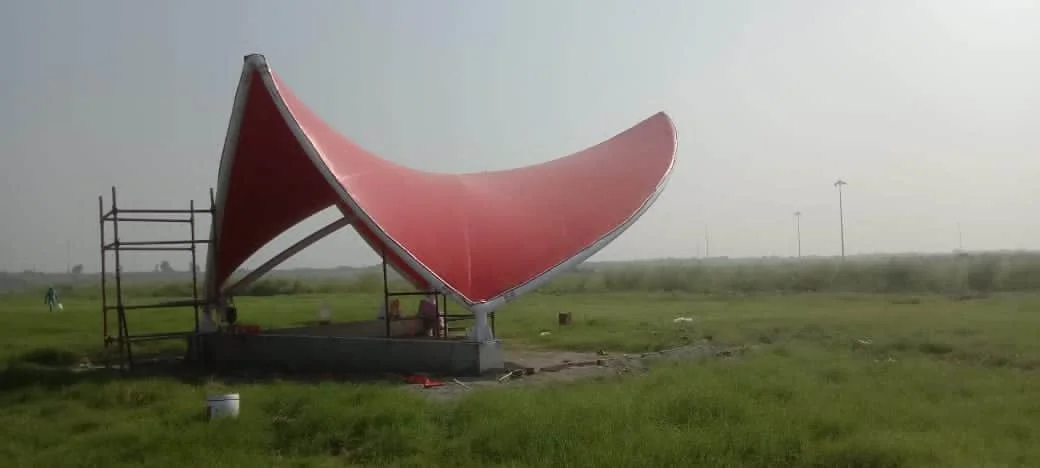 Industrial · Sail canopyNTPC GazeboPower-plant campus
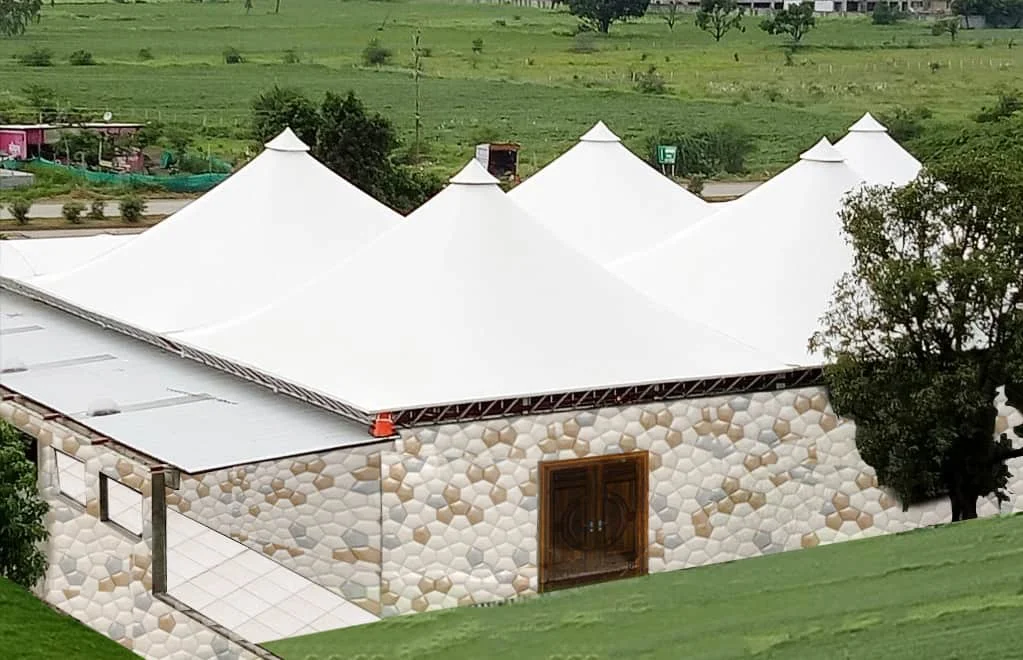 Hospitality · Conical structureBanquet HallIndore, MP
Public · Conical pavilionDiu PavilionDiu
Hospitality · Conical structureBanquet HallIndore, MP
Public · Conical pavilionDiu PavilionDiu
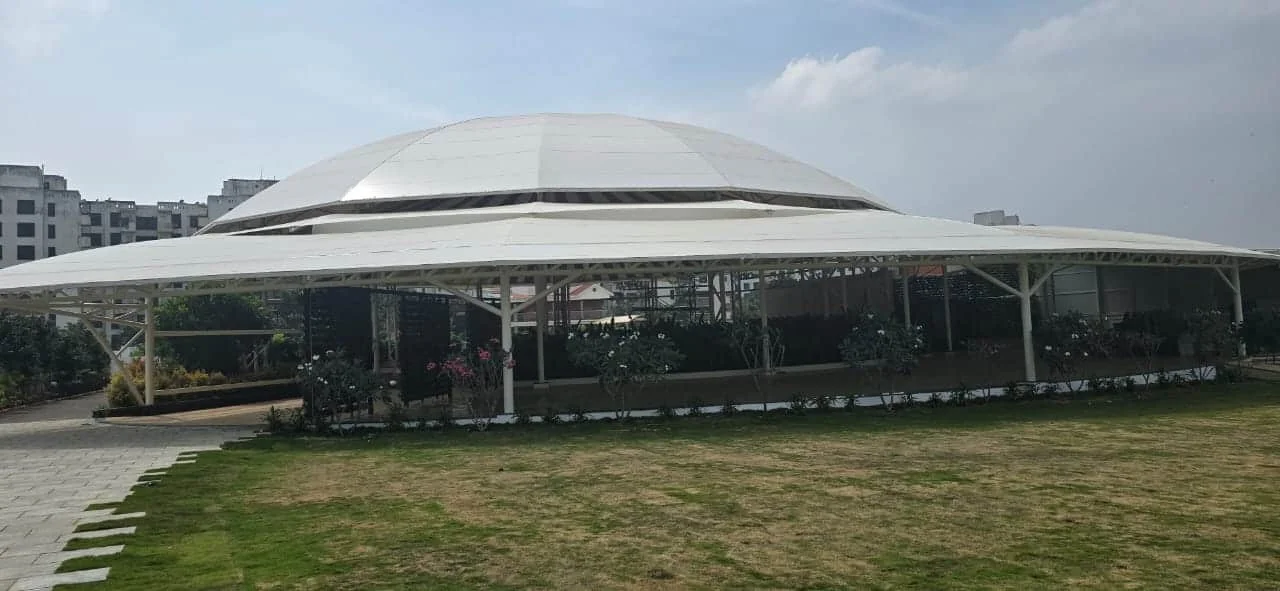 Hospitality · Tiered domeParty HallGarden venue
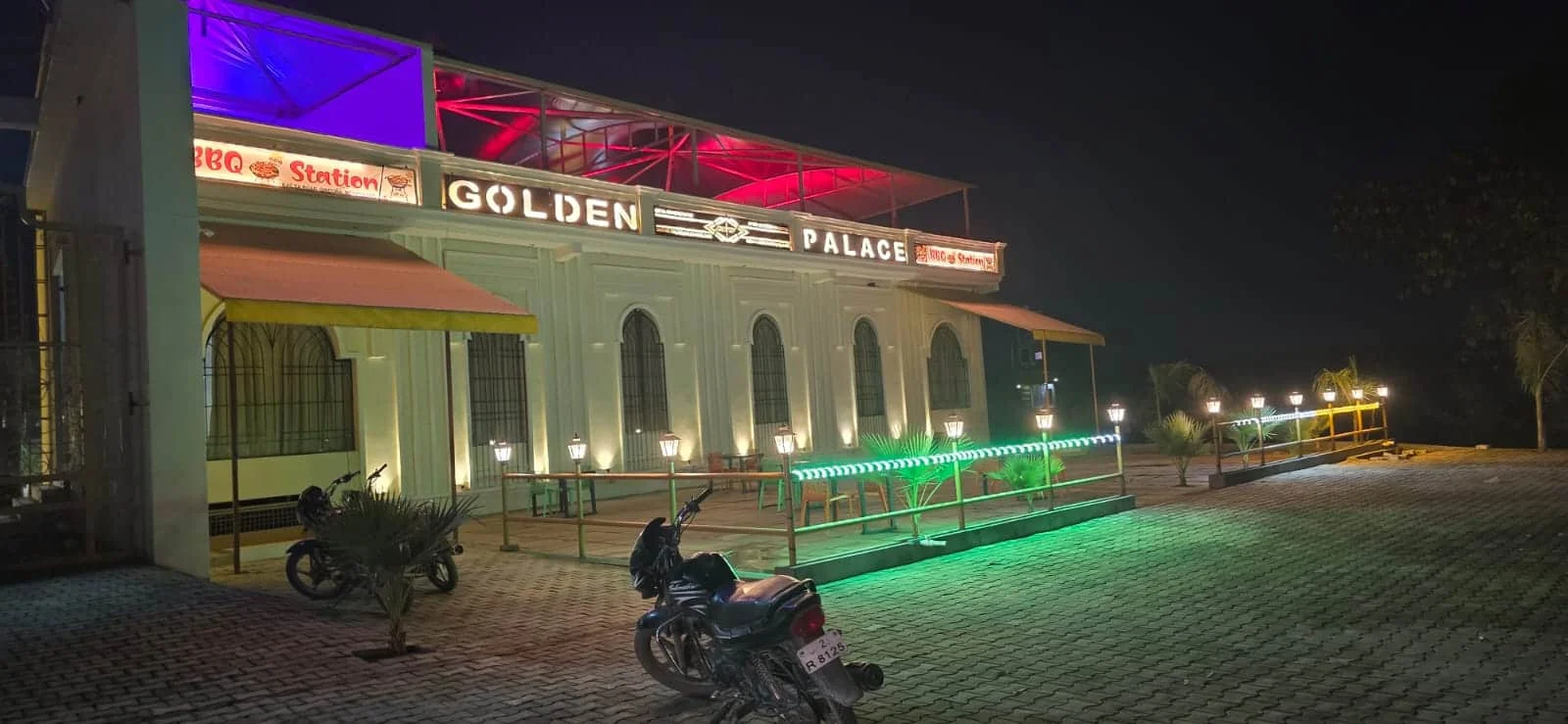 Hospitality · Event-area canopyGolden Event PalaceMoradabad, UP
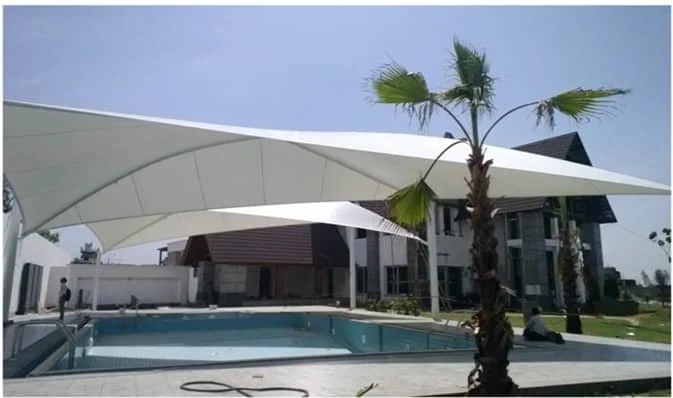 Residential · Pool sail canopySun ViewLudhiana, Punjab
Outdoor gazebo structure FAQ
The questions people ask about a gazebo canopy for an exposed outdoor site.
Yes, when engineered for it. Wind uplift is the governing load on a light roof. The form is pre-stressed so the membrane cannot lift, and the mast, cables and foundations are sized for the site’s design wind speed under IS 875 Part 3.
Yes, with the right specification: heavier hot-dip galvanising, stainless cables and fittings, and a PVDF or PTFE membrane chosen for its resistance to UV and salt.
The cone or dome is pitched to shed heavy rain quickly to defined low points, with no flat areas where water can collect. Drainage is designed into the form.
PVDF-lacquered PVC for most exposed sites; PTFE-coated glass where a permanent, self-cleaning, non-combustible roof is wanted. Plain PVC suits a sheltered inland garden.
The galvanised steel frame lasts decades. The membrane is the wearing part — manufacturers typically quote 15–20 years for PVC, longer for PVDF, and 25–30+ for PTFE, depending on climate and maintenance.
Periodic cleaning, a membrane and cable check, a first re-tension after the first season, and keeping the drainage clear. More frequent cleaning on a dusty or coastal site.
There is no fixed rate. Cost depends on the footprint, the form, the height, the membrane grade and any corrosion specification. Send your site for an itemised quote.
Send us your outdoor site
You get a form option, a specification for the exposure, and an itemised quote.
Let’s Build Your Structure
Speak directly with our structural engineering team to discuss your project dimensions, material options, or to schedule a free on-site technical inspection across India.
Direct Phone & WhatsApp Hotlines
+91 98102 37952 (Delhi HQ) / +91 93159 45187 (Bangalore) / +91 82879 92289 (Engineering)
Official Email Address
Delhi Factory & Administrative HQ
No. 367 Badam Singh Market, Rangpuri, Near Shiv Murti, NH-8, New Delhi 110037
Bangalore Regional Office
93/5, Kada Agrahara Village, Dodda Gubbi Post, Bangalore, Karnataka - 560077, India
Chattarpur Office
House No. 488, 3rd Floor, Khasra No. 60, 100 Futa Road, Opposite Delhi Jal Board, Near Diwan Bajaj Showroom, Chattarpur Pahari, New Delhi - 110074, India
Request Itemized Price Quote
Fill in your requirements below for an instant engineering assessment & 3D estimate.