

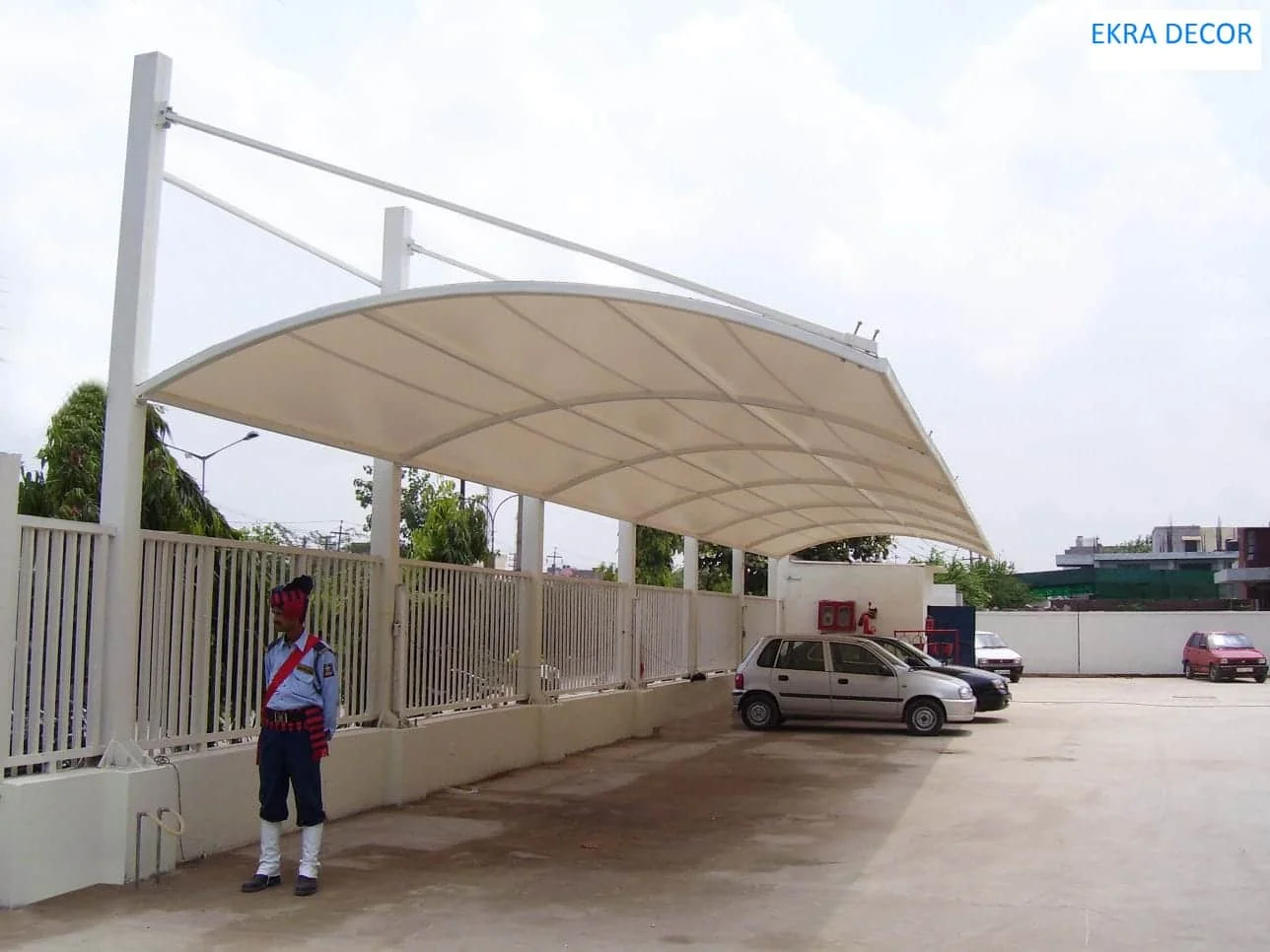
Tensile Structure vs Shade Sail vs Polycarbonate
Three common ways to cover an outdoor space, each with a clear sweet spot. Pick the wrong one and you either overpay or replace it early. A side-by-side comparison on span, waterproofing, daylight, lifespan, noise and cost.
Reviewed by Mukesh Mittal, Senior Structural Engineer · Last updated: 14 September 2026
- Tensile fabric: large spans, waterproof, 15–30 yr
- Shade sail: cheap, fast, shade-only, 8–12 yr
- Polycarbonate: small spans, noisy, 10–15 yr
- Each has a clear right use
Engineering Trusted by India’s Leading Names
28+ years delivering tensile structures for corporate campuses, industrial groups, and institutional developments — built with fabric technology from the world’s leading membrane manufacturers.
 TATA Motors
 L&T
L&T
 Reliance
 Adani
Adani
 Mahindra
 Godrej
 DLF
DLF
 ITC Ltd
 Maruti Suzuki
 GMR Group
 JSW Steel
 Prestige Group
 Sobha
Sobha
 Siemens
 Tata Chemicals
 Tata Tele Business Services
 Power Grid Corporation
 Emaar MGF
 National Law University Delhi
 UPES Dehradun
 Vasant Valley School
 Aditya Birla Group
 Amity University
 Vikram Solar
 Tractors India
 Mazda Colours
 Millennium Structurals
 Sehwag International School
 BSBK Pvt. Ltd.
 17 Miles Hotel
 Rich Harvest School
 The Imperial New Delhi
 Moore Constructions
 Mehra Construction
 Ramprastha
 Minda NexGenTech (UNO Minda)
 Yashmay Public School
 Gyan Mandir Foundation
 Omega Developers
 SPEC
SPEC
 Serge Ferrari
 Mehler
 Heytex
 Versaid
 PATI
PATI
Tensile fabric, shade sail or polycarbonate: which to use
There are three common ways to cover an outdoor space, and each has a clear sweet spot. Pick the wrong one and you either overpay or replace it early. The cheaper option again is a woven mesh — compared separately in tensile structure vs shade net.
Tensile fabric structure
An engineered steel frame with a tensioned membrane. It spans large distances with few or no columns, takes almost any shape, and can be fully waterproof (PVC or PTFE) or shade-only. A 15 to 30 year life. It has the highest up-front cost but the lowest cost per square metre once the area is sizable, so it is the choice for anything permanent and large.
Shade sail
A single tensioned membrane pulled between a few anchor points, with no frame. It is the cheapest and fastest option and the layout is flexible, but it is shade-only (knitted mesh), limited in size, and needs overlapping sails to cover a big area. An 8 to 12 year life, and it comes down before a cyclone. Good for play areas, small car parks and terraces.
Polycarbonate
Rigid twin-wall or solid sheet on a light frame. Cheap for a small span, lets through 30 to 90 percent of light, and the surface is hard. But it yellows and turns brittle in 10 to 15 years, is very loud under rain and hail, needs expansion joints, and only spans modest distances. Good for a lean-to, a balcony cover or a short walkway.
How to choose
Start with span and whether it must be waterproof. Big or column-free, or a roof that is part of the building → tensile fabric. Small area, shade only, tight budget → shade sail. Small span, some daylight, lowest cost → polycarbonate. Tell us the space and we will say which fits.
The three systems compared
Each system has a clear sweet spot. The honest comparison — and for the heavier alternative, see tensile vs metal sheet roofing:
| Property | Tensile fabric structure | Shade sail (HDPE mesh) | Polycarbonate sheet |
|---|---|---|---|
| Structure | Steel frame + tensioned membrane | A membrane between a few anchors, no frame | Rigid sheet on a light frame |
| Economical span | Large (30 m+) | Small; overlap for larger areas | Small–medium |
| Waterproof | Yes (PVC / PTFE) | No — shade only | Yes, until gaskets age |
| Daylight | Diffuse, 5–20% | Filtered, mesh-dependent | High (30–90%), can glare |
| Solar heat | Mostly reflected | Partly cut | Significant gain |
| Noise under rain | Quiet | N/A (rain passes through) | Loud |
| Design freedom | Free-form, any shape | Flexible layout, limited size | Flat / simple curves only |
| Typical life | 15–30 yr | 8–12 yr | 10–15 yr, yellows |
| Comes down for a cyclone | No — engineered to stay up | Yes — usually removed before a cyclone | Fixed — sheet stays |
| Up-front cost | Highest | Lowest | Low for a small span |
| Cost per m² at scale | Lowest | High for large areas | Rises with supporting frame |
| Best for | Anything permanent and sizeable | Play areas, small car parks, terraces | Lean-tos, terraces, short walkways |
Tensile fabric structure
- Structure
- Steel frame + tensioned membrane
- Economical span
- Large (30 m+)
- Waterproof
- Yes (PVC / PTFE)
- Daylight
- Diffuse, 5–20%
- Solar heat
- Mostly reflected
- Noise under rain
- Quiet
- Design freedom
- Free-form, any shape
- Typical life
- 15–30 yr
- Comes down for a cyclone
- No — engineered to stay up
- Up-front cost
- Highest
- Cost per m² at scale
- Lowest
- Best for
- Anything permanent and sizeable
Shade sail (HDPE mesh)
- Structure
- A membrane between a few anchors, no frame
- Economical span
- Small; overlap for larger areas
- Waterproof
- No — shade only
- Daylight
- Filtered, mesh-dependent
- Solar heat
- Partly cut
- Noise under rain
- N/A (rain passes through)
- Design freedom
- Flexible layout, limited size
- Typical life
- 8–12 yr
- Comes down for a cyclone
- Yes — usually removed before a cyclone
- Up-front cost
- Lowest
- Cost per m² at scale
- High for large areas
- Best for
- Play areas, small car parks, terraces
Polycarbonate sheet
- Structure
- Rigid sheet on a light frame
- Economical span
- Small–medium
- Waterproof
- Yes, until gaskets age
- Daylight
- High (30–90%), can glare
- Solar heat
- Significant gain
- Noise under rain
- Loud
- Design freedom
- Flat / simple curves only
- Typical life
- 10–15 yr, yellows
- Comes down for a cyclone
- Fixed — sheet stays
- Up-front cost
- Low for a small span
- Cost per m² at scale
- Rises with supporting frame
- Best for
- Lean-tos, terraces, short walkways
For polycarbonate on its own, see polycarbonate structures; for shade sails, shade sail structures.
Which one is right for your space
Match the system to the span, the waterproofing need and the design life.
Choose a tensile fabric structure if…
The span is large or column-free, the space must stay dry, you want a sculptural form, rain noise or solar heat matters, or you want a 20–30-year roof. It costs the most up front and the least per square metre once the area is sizeable.
Choose a shade sail if…
You want the cheapest, fastest option; the layout may change; a little rain is acceptable; and the area is small enough for one or a few overlapping sails. Expect to replace it in about 10 years.
Choose polycarbonate if…
The span is small and simple, the budget is tight, and rain noise and solar heat are not a concern — a lean-to, a balcony, a short walkway, a greenhouse.
Still not sure?
Send the span, the use and the site. We will tell you which system fits — including when it is not our own tensile work.
How it is engineered and built
The governing load
A tensile structure weighs almost nothing, so wind uplift is the governing load. The membrane is form-found into double curvature so it stays taut, and the frame and foundations are sized for the site’s design wind pressure under IS 875 Part 3.
Steel & foundations to code
The frame is designed to IS 800 and the footings to IS 456, checked for uplift and overturning. Galvanising to IS 4759 / IS 2629 for corrosion protection.
Built off-site, raised fast
Steel is cut, welded and galvanised in the workshop and the membrane is cut and welded into panels, while the footings are cast on site. On-site work is then quick and low-disruption.
One accountable team
Survey, 3D design, engineering, fabrication, installation and tensioning are all Ekra Decor’s own team, with a handover pack of drawings, load report, stability certificate and material certificates.
Tensile fabric structures we’ve built
Each project is documented with site photographs and recorded scope.
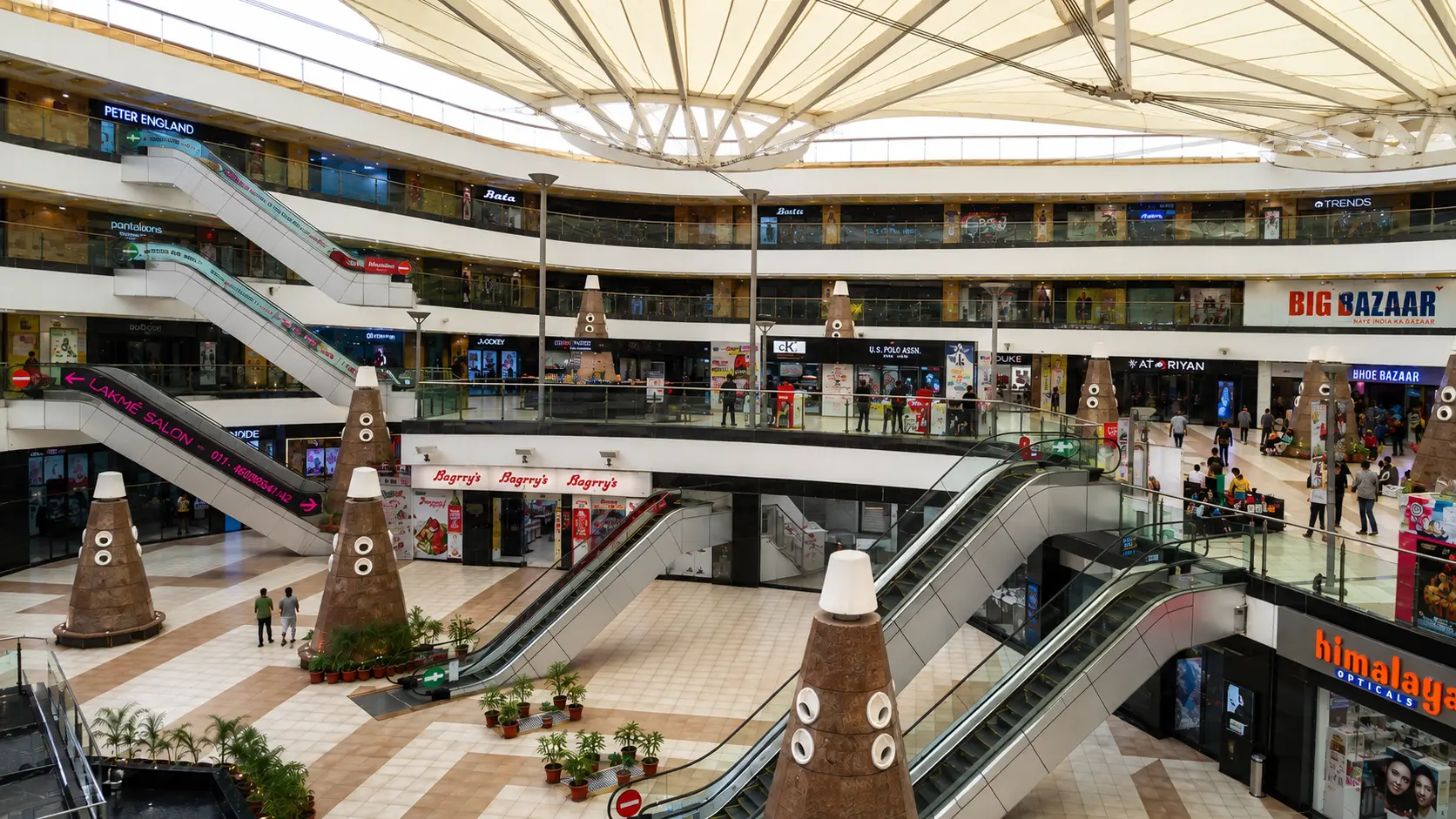 Retail · Courtyard roofVasant Square MallVasant Kunj, New Delhi
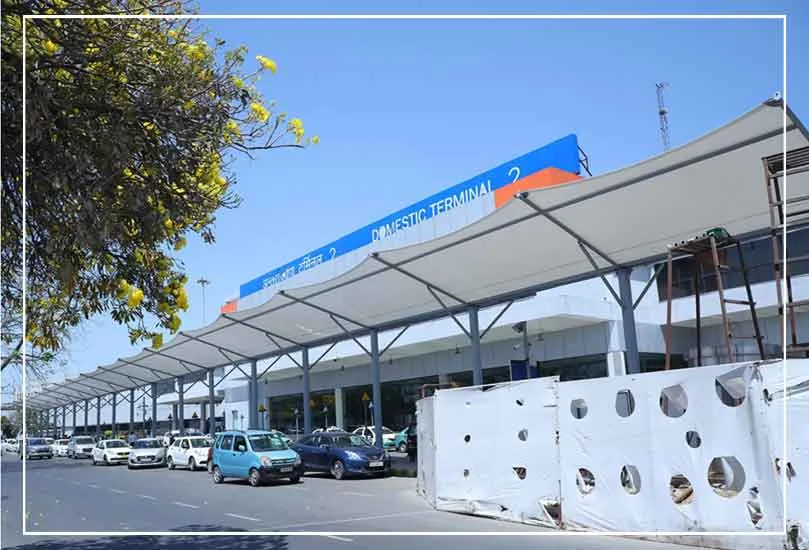 Transit · Walkway canopyIGI Airport, Terminal 2New Delhi
Industrial · Cantilever canopyManesar Car ParkingManesar, Haryana
Transit · Walkway canopyIGI Airport, Terminal 2New Delhi
Industrial · Cantilever canopyManesar Car ParkingManesar, Haryana
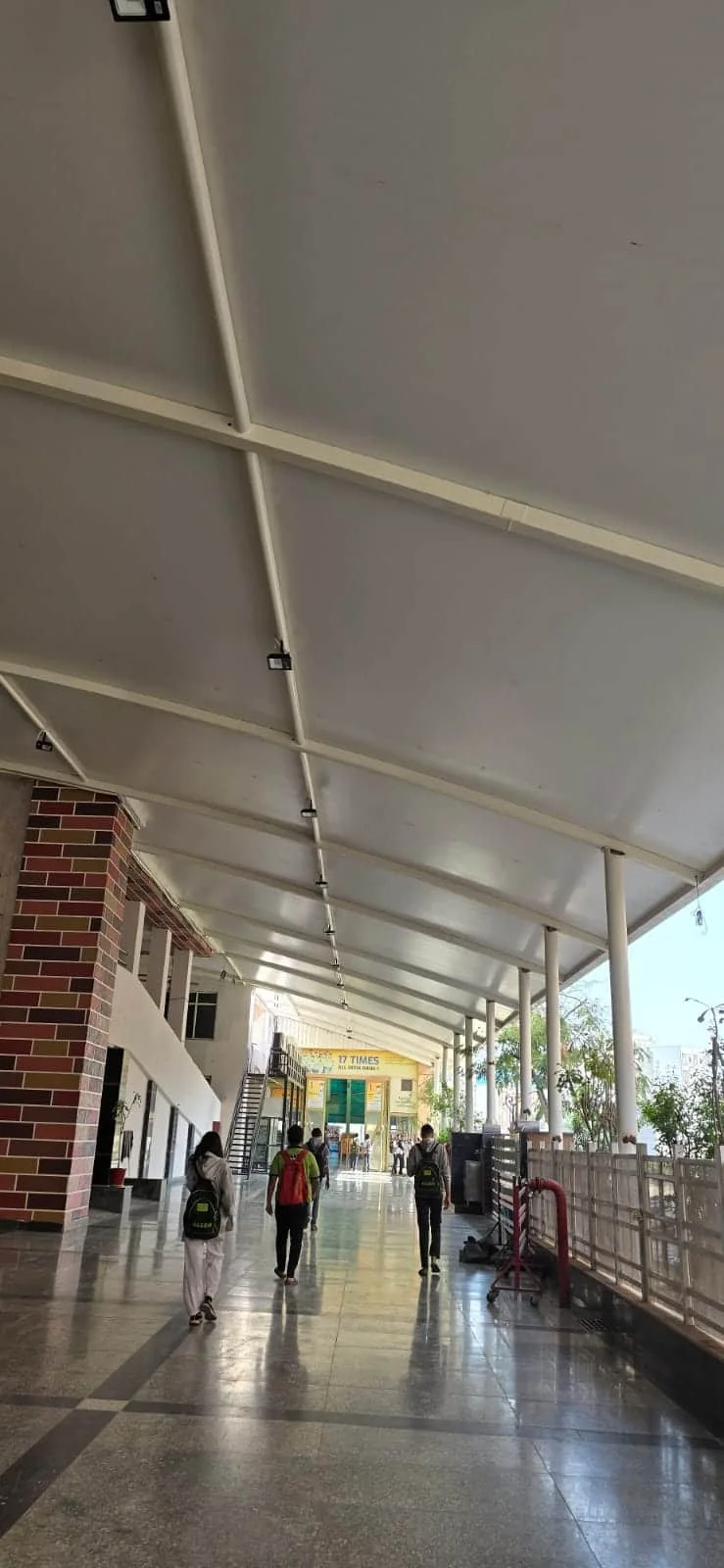 Education · Student walkwayAllen Career InstituteKota, Rajasthan
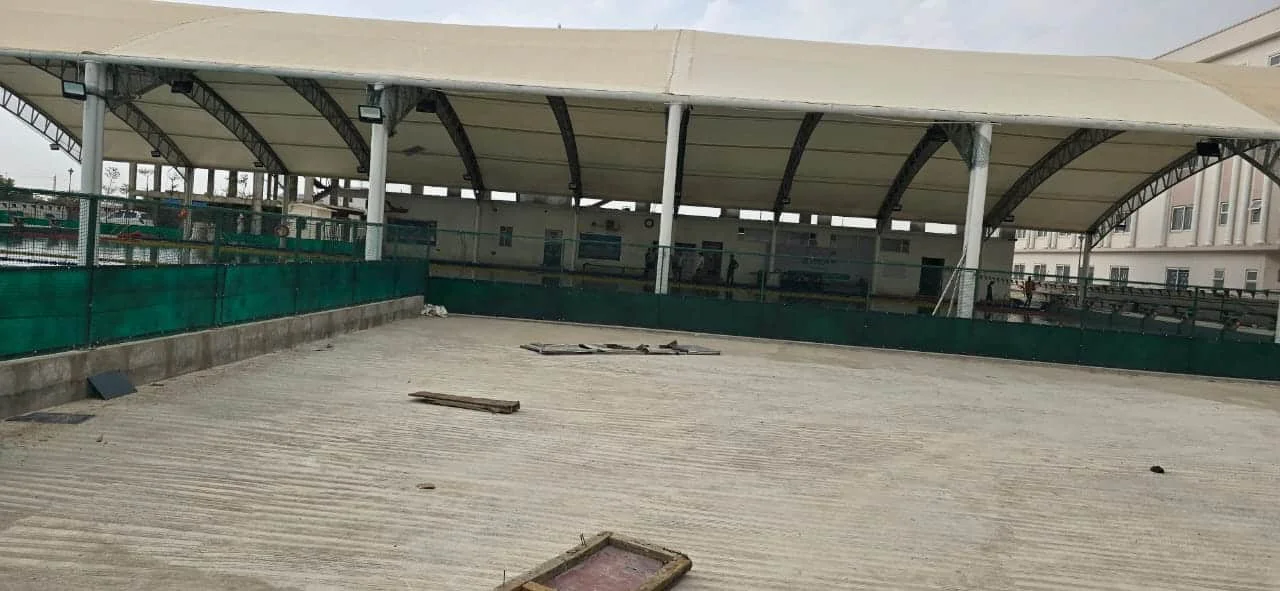 Sport · Pool deck roofChampions Aquatics AcademyBahadurgarh, Haryana
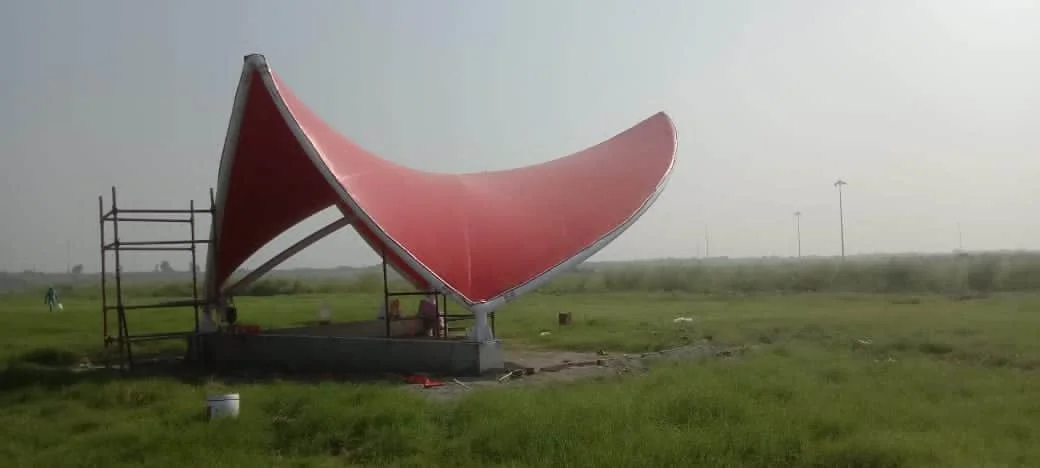 Industrial · Sail canopyNTPC GazeboPower-plant campus
Tensile vs shade sail vs polycarbonate FAQ
The questions people ask when choosing how to cover an outdoor space.
A shade sail has the lowest up-front cost, then polycarbonate for a small span. A tensile fabric structure costs the most up front but the least per square metre once the area is sizeable, and it lasts the longest.
A tensile fabric structure in PVC or PTFE, and polycarbonate (until its gaskets age). A knitted HDPE shade sail is not — rain passes through the mesh.
A tensile fabric structure — 15–30 years by membrane. Polycarbonate yellows and turns brittle over 10–15 years; an HDPE shade sail lasts about 8–12 years.
A tensile fabric structure. Polycarbonate is very loud under rain and hail. A shade sail has no rain noise because the water passes straight through.
Yes — a knitted shade sail is usually removed before a cyclone. A properly engineered tensile fabric structure is designed to stay up in the site's design wind.
A tensile fabric structure — column-free spans of 30 m and beyond are routine. Polycarbonate and shade sails are both limited to small or medium spans.
Yes. Send the span, the use and the site — we will tell you honestly which system fits, even when it is not our own tensile work.
Tell us the span and the use
You get an honest recommendation — and an itemised quote if a fabric structure is the right call.
Let’s Build Your Structure
Speak directly with our structural engineering team to discuss your project dimensions, material options, or to schedule a free on-site technical inspection across India.
- 28+Years experience
- Pan-IndiaTurnkey execution
- ISO9001:2015 certified
Request an itemised price quote
Fill in your requirements below for a free engineering assessment & itemised estimate.
* required — everything else is optional
Your details are used only to respond to this enquiry.
Chat with an Engineer on WhatsApp