

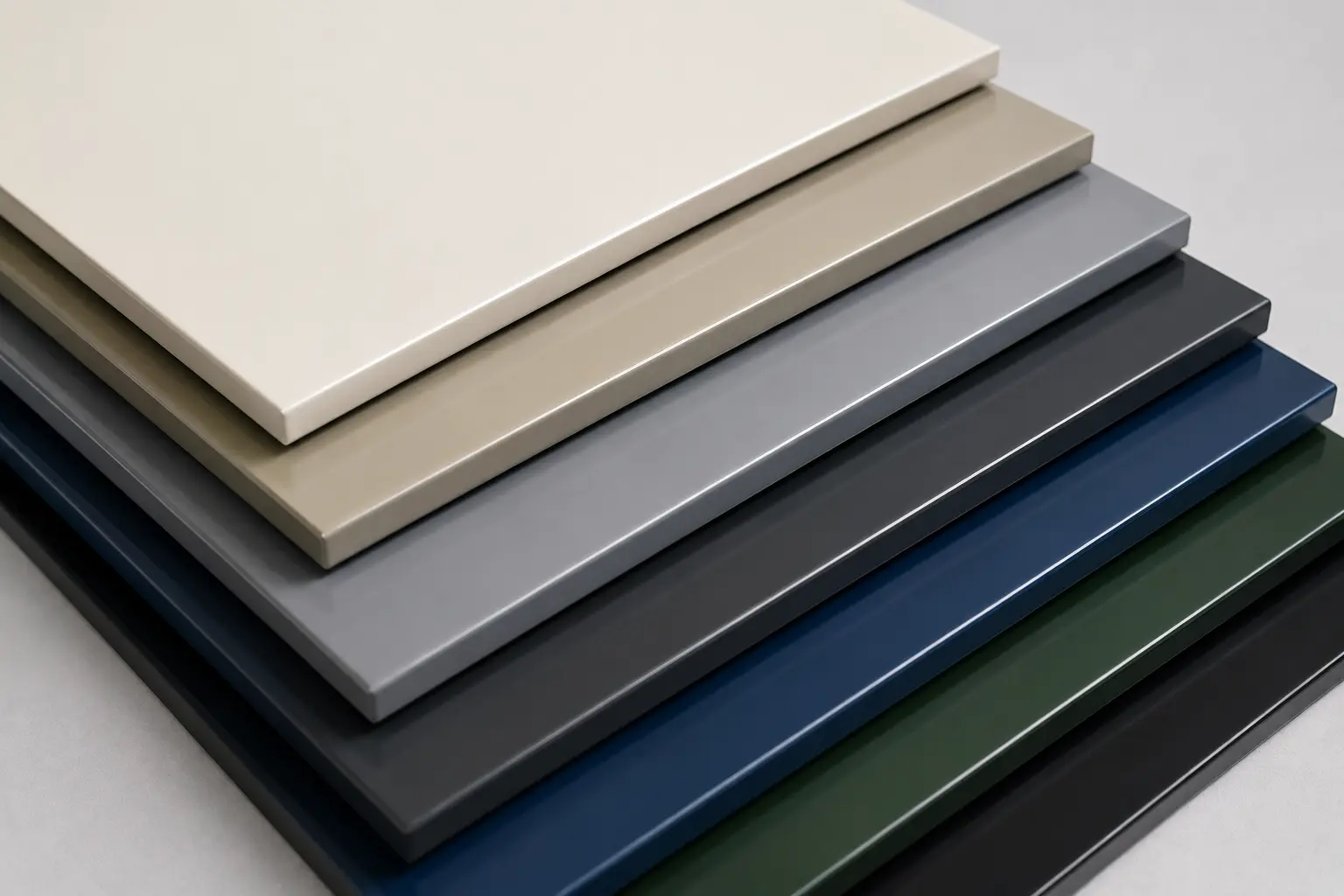
PVDF-Lacquered PVC Membrane
PVDF is a fluoropolymer lacquer applied over standard PVC-coated polyester — a few microns thick, not a separate fabric. The base cloth and the PVC do the structural work; the PVDF topcoat keeps the surface cleaner, holds colour and gloss longer, and pushes the design service life from ~15–20 years toward ~25 years. This page is about what the finish actually buys you, and when it is worth the uplift over a plain acrylic lacquer.
Reviewed by Mohd. Talib, Senior Design Manager · Last updated: 14 September 2026
- A fluorine top-coat over PVC-coated polyester
- Better self-cleaning & colour hold than acrylic
- Design life ~25 yr vs ~15–20 for plain acrylic
- The default for permanent commercial work
PVDF is a topcoat, not a base fabric
“PVDF membrane” is PVC-coated polyester with a polyvinylidene-fluoride lacquer on the outer face. The polyester weave carries the load; the PVC waterproofs and colours it; the PVDF is a few-micron fluoropolymer skin whose only job is to keep the surface clean, bright and protected for years longer than a plain lacquer would.
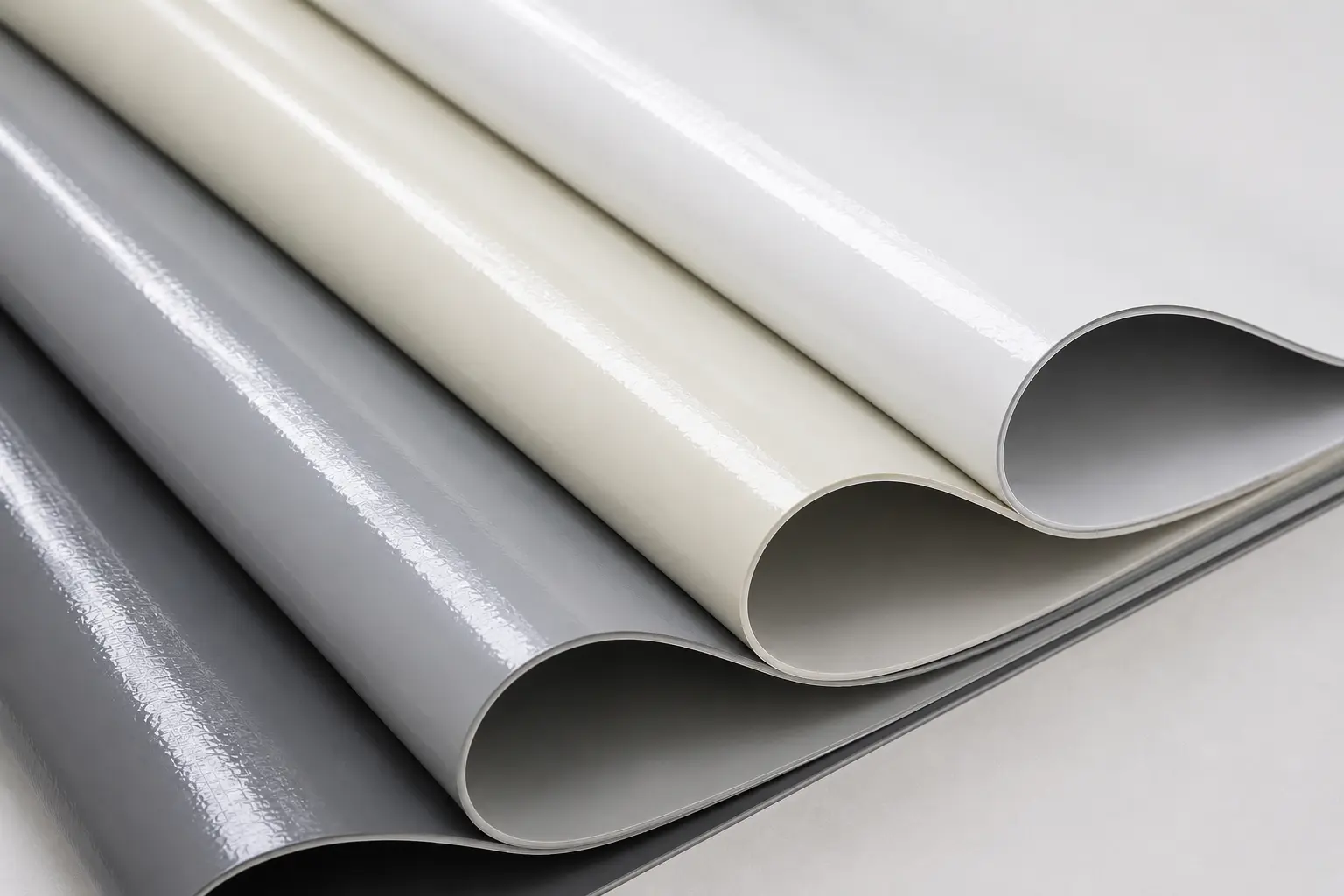
What the PVDF layer does
The fluoropolymer surface has very low surface energy, so dirt does not bond to it — rain lifts and carries most grime away. It is highly UV-stable, so it shields the PVC and its plasticiser (the plasticiser slowly migrating out is what actually ages and embrittles an old membrane). The result is a surface that stays cleaner and brighter, holds its colour and gloss, and lasts years longer before it needs attention.
What the PVDF layer does not do
It adds no strength — the polyester weave is unchanged. It does not change the fire class — the membrane is still B-class, self-extinguishing, not non-combustible. It does not make the membrane self-cleaning to the level of PTFE. And it does not extend the life of the base PVC indefinitely: once the plasticiser has gone, the fabric is old regardless of the topcoat.
How it is applied
PVDF is applied as a thin solvent-based lacquer over the finished PVC coating during manufacture and oven-cured. It is only a few microns thick, so it adds no meaningful weight or stiffness. White PVDF lacquers often carry titanium dioxide, which boosts UV blocking and brightness.
Where it sits in the range
PVDF-finished PVC is the practical middle of the membrane range: longer-lasting and cleaner than plain acrylic-lacquered PVC, far cheaper and more colourful than PTFE-coated glass, and not transparent like ETFE. It is the default for permanent commercial and civic work.
For the base fabric this finish sits on — the weave, the PVC coating, the Type I–V grades and the fabrication — see the PVC-coated polyester page. For the cross-material picture, the membrane materials guide.
PVDF vs an acrylic lacquer vs no lacquer
Every PVC architectural membrane has some surface finish. The choice between them is the single biggest lever on how long the roof stays presentable — and it is the whole reason this page exists.
| Finish | Unlacquered PVC | Acrylic lacquer | PVDF lacquer | PVF film |
|---|---|---|---|---|
| What it is | Bare PVC coating | Clear acrylic coat | Fluoropolymer lacquer | Laminated fluoropolymer film |
| Surface energy / dirt pick-up | High — holds dirt | Moderate | Low — sheds dirt in rain | Lowest of the PVC finishes |
| First surface problems | A few years | Around 5 years | 10–15 years, and renewable | Longest |
| System design life | Short | ~15–20 years | ~20–25 years, up to 30 in temperate exposure | Longest on a PVC base |
| Colour & gloss retention | Poor | Fair | Good — the fluoropolymer holds pigment | Very good |
| Weldability | Full | Full | Weldable grade, or strip the topcoat at the seam | Specialist welding |
| Renewable in service | — | Limited | Yes — re-lacquer resets the surface clock | No |
| Relative cost | Lowest | Low (the volume default) | Small uplift over acrylic | Highest of the PVC finishes |
| Typical use | Rare architecturally | Everyday canopies, shade, temporary work | Permanent commercial & civic projects | Premium long-life PVC work |
Figures are typical industry values and vary with product, exposure and maintenance. In hot, high-UV, polluted or coastal climates the gap between acrylic and PVDF is wider than in temperate ones — which is where the PVDF uplift most often pays back.
PVDF is worth the uplift when
The structure is permanent (10+ years); it is on a prominent or branded building where the surface must keep looking new; the site is hot, high-UV, dusty, polluted or coastal; the client wants a longer warranty; or a colour must hold true for the life of the roof.
A plain acrylic lacquer is enough when
The structure is temporary, demountable or short-life; the budget is tight; the membrane is not on public view; or the exposure is mild and a 15–20 year surface life meets the brief. Stepping the other way — to PTFE — is for a 25–30+ year life or a non-combustible fire class, which PVDF does not provide.
The weldability catch
PVC membrane panels are joined by melting the PVC coatings together. A fluoropolymer topcoat does not melt the same way — so PVDF changes how the seams are made, and it is worth understanding before specifying.
Weldable PVDF
A thinner or reformulated topcoat that retains enough surface weldability for high-frequency welding without preparation. Simplest to fabricate; slightly less durable than a full PVDF layer.
Standard (non-weldable) PVDF
The full-strength topcoat. The lacquer is ground or peeled back a few centimetres each side of every seam before welding, then the seam edge is sealed. More fabrication labour; the most durable finish.
What this means for design
Tell the fabricator early whether the priority is fabrication speed or maximum surface life — it sets which PVDF grade is ordered. It is not a field decision.
Repairs
Patch repairs follow the same logic: the topcoat is dressed back at the patch, the patch is welded to the PVC, and the finish is made good. Straightforward for a trained crew.
What the finish changes — and what it doesn’t
Because PVDF is only a surface layer, its effect is precise: it changes the things that depend on the surface, and leaves everything structural exactly as the base PVC fabric.
PVDF changes
- Soiling — the low-energy surface sheds airborne dirt in rain; the roof stays visibly cleaner between washes.
- Colour & gloss retention — the fluoropolymer holds pigment and finish, so the membrane fades and dulls far more slowly.
- UV protection of the PVC — it shields the coating and slows plasticiser loss, the mechanism that actually ages a membrane.
- Surface life — first surface problems move from ~5 years (acrylic) to ~10–15 years, and the lacquer can be renewed.
- System design life — from ~15–20 years toward ~25 years in temperate exposure.
- Cleaning effort — when a wash is needed it comes clean with water and mild detergent.
PVDF does not change
- Strength — the polyester weave and its rating are unchanged.
- Fire class — still B-class / self-extinguishing, not non-combustible. For A-class, use PTFE-glass.
- Light transmission — roughly the same diffuse ~5–12% as the base fabric.
- Acoustics — low mass, no sound insulation; rain is still audible.
- Base-PVC ageing — it slows plasticiser loss, it does not stop it; an old membrane is old regardless of topcoat.
- Handling — welds (with the grade caveat above), folds and repairs like any PVC membrane.
Net effect: for a modest cost uplift on a permanent project, PVDF buys a cleaner appearance for longer and pushes replacement out by roughly five to ten years. On a temporary or budget structure that trade rarely pays back.
PVDF-finished PVC vs plain PVC, PTFE and ETFE
PVDF is the upgrade path from plain PVC for a permanent project. It does not compete with PTFE on fire or life, or with ETFE on transparency — it competes with plain PVC on how long the roof looks good.
| Factor | PVDF-lacquered PVC | Plain (acrylic) PVC | PTFE-coated glass | ETFE film |
|---|---|---|---|---|
| Base structure | Woven polyester + PVC | Woven polyester + PVC | Woven glass fibre + PTFE | Extruded fluoropolymer film |
| Difference from plain PVC | Fluoropolymer topcoat | — | Different material entirely | Different material entirely |
| System design life | ~20–25 yr | ~15–20 yr | 25–30+ yr | 25–30+ yr |
| Self-cleaning | Good | Limited | Excellent | Good |
| Colour retention | Good | Fair | N/A (white) | N/A (clear) |
| Reaction to fire | B-class, self-extinguishing | B-class, self-extinguishing | A2 — non-combustible | B-s1,d0 — combustible |
| Colour range | Full range | Full range | White / off-white only | Clear or frit |
| Light transmission | ~5–12%, diffuse | ~5–15%, diffuse | ~7–20%, diffuse | ~88–95%, clear |
| Welding | Weldable grade or strip topcoat | Fast HF welding | Specialist heat welding | Film welding + framing |
| Relative cost | Small uplift over plain PVC | Lowest | Highest coated fabric | High (system higher again) |
| Choose it for | Permanent commercial / civic canopies that must stay clean and bright | Everyday, temporary or budget work | Permanent large-span or non-combustible roofs | Transparent, ultra-light envelopes |
Dedicated pages: PVC-coated polyester, PTFE-coated fibreglass, ETFE film. Full picture: membrane materials guide.
Choose PVDF-finished PVC when
You want a PVC membrane — colour, cost, weldability, easy repair — but the project is permanent and prominent, or the climate is harsh, and a plain acrylic finish would look tired in five to eight years.
Look elsewhere when
The structure is temporary or budget-led (plain PVC); a 25–30+ year life or a non-combustible A-class fire class is required (PTFE-glass); or the roof must be genuinely transparent (ETFE).
Looking after a PVDF membrane
Less than a plain PVC roof — the surface does more of the work — but the structure around it still needs the same checks, and the finish is not maintenance-free.
- Visual inspection for tears, abrasion, ponding and slack areas — annually and after severe weather.
- Seam check — welded seams and edge welds for any lifting or damage.
- Corners & clamps — corner plates, clamp bars and bolts for movement or loss of tension.
- Cables & prestress — edge and ridge cables, turnbuckles and the overall tautness.
- Cleaning — less often than plain PVC; water and mild detergent, no abrasives or solvents that could attack the lacquer.
- Drainage — valleys and low points kept clear.
- Finish condition — on older membranes, checking whether a PVDF re-lacquer is worthwhile to reset the surface life.
Minor damage
Patch-welded on site: the topcoat is dressed back, the patch welded to the PVC, the finish made good.
Larger damage
A failed seam or widespread abrasion is handled by replacing the affected welded panel, same as any PVC membrane.
Re-lacquering
A weathered but structurally sound PVDF membrane can often be re-lacquered in place — a real cost saving over replacement where the base PVC still has life.
End of life
Recycled through the same PVC take-back schemes as plain PVC-polyester; the thin fluoropolymer layer does not prevent it.
What PVDF adds to the cost
PVDF is a small uplift on the fabric line of a tensile-structure quote — and the fabric is usually a minority of the total, behind the steel and the installation.
Upfront
A modest premium over a plain acrylic-lacquered PVC of the same grade — a small percentage of the fabric cost, a smaller percentage of the whole structure. A standard (non-weldable) PVDF grade adds a little fabrication labour for the seam stripping.
Life-cycle
The payback is a cleaner appearance for longer and replacement pushed out by roughly five to ten years, plus the option to re-lacquer rather than replace. On a permanent building the whole-life case is usually clear; on a temporary one it is not.
See the tensile structure cost guide for how the fabric, steel and installation split in a typical quote.
Where a PVDF finish is specified
PVDF is the default membrane finish for permanent commercial and public projects — anywhere a plain PVC roof would look tired before its structural life is up.
Malls & atria
Daylit court roofs that must stay bright and clean for the life of the building — see tensile roofing structures.
Corporate & institutional canopies
Entrance and forecourt canopies where the finish has to keep looking new.
Public plazas & courtyards
Continuous cover on dusty urban sites — see outdoor tensile structures.
Landmark & designer car parks
Where colour hold matters — see designer car parking.
Coastal & high-UV sites
Where salt and sun would chalk a plain acrylic lacquer years sooner.
Sports & assembly venues
Clear-span roofs with a long, cleanable finish — see auditorium roofs.
Where PVDF fits in Ekra Decor’s work
PVDF-finished PVC is the finish Ekra Decor specifies on permanent commercial and civic canopies — the base PVC grade is set by the structural analysis, and the finish is chosen against the project’s life expectancy and exposure. On standard or short-life work a plain acrylic lacquer is specified instead.
Membrane and finish are selected per project, so the portfolio spans plain PVC, PVDF and PTFE. The structures on this site are documented by type and scope; we do not label a roof’s finish unless it is recorded for that project.
The base fabric: PVC-coated polyester → · Project portfolio →
Typical PVDF-finished PVC data
Industry-typical values. The structural figures are those of the base PVC fabric; only the surface properties differ. Confirm against the datasheet for the specific product and PVDF grade.
| Property | Typical value | Unit | Basis |
|---|---|---|---|
| PVDF lacquer thickness | A few | µm | Product-specific |
| Base fabric weight | ~700–1,400 | g/m² | Base PVC grade (Type I–V) |
| Strip tensile strength | ~3,000–9,000 | N/5cm | Base PVC fabric — unchanged by PVDF |
| Light transmission | ~5–12 | % | Colour-dependent, diffuse |
| Reaction to fire | DIN 4102 B1 / EN 13501-1 B-s2,d0–B-s3,d0 | class | Unchanged by PVDF; verify per product |
| Design service life | ~20–25 (up to ~30 temperate) | years | vs ~15–20 for acrylic lacquer |
| First surface maintenance | ~10–15 | years | vs ~5 for acrylic; re-lacquerable |
| Weldability | Weldable grade, or strip topcoat at seam | — | Specify the grade at design stage |
Sources for the ranges above include published data from PVC-fabric manufacturers and topcoat suppliers. They are orientation for early design, not specification values.
PVDF finish — FAQ
The questions specifiers and clients ask about the PVDF topcoat.
Neither exactly — it is a lacquer. “PVDF membrane” is standard PVC-coated polyester with a thin polyvinylidene-fluoride topcoat on the outer face. The polyester weave and the PVC coating are the fabric; the PVDF is a few-micron surface skin.
It gives the surface very low surface energy, so dirt does not bond and rain washes most of it off, and it is highly UV-stable, so it shields the PVC and slows the plasticiser loss that ages a membrane. The result is a cleaner, brighter surface that lasts years longer before it needs attention.
A plain acrylic-lacquered PVC membrane typically has a system design life of about 15 to 20 years and shows first surface problems around year five. A PVDF finish pushes the design life toward 25 years, up to about 30 in temperate exposure, with first surface maintenance nearer 10 to 15 years — and the lacquer can be renewed.
No. PVDF is only a surface layer. The strength is that of the base polyester fabric, unchanged, and the fire class is still B-class, self-extinguishing — not non-combustible. For a non-combustible A-class reaction you need PTFE-coated glass.
Largely, in the sense that rain removes most airborne dirt from the low-energy surface, so it stays visibly cleaner than plain PVC between washes. It is not self-cleaning to the level of PTFE, and it still benefits from an occasional wash.
Yes, but a fluoropolymer topcoat does not melt like PVC, so either a weldable PVDF grade is specified — a thinner or modified lacquer that still fuses — or a standard grade is used and the lacquer is mechanically stripped along each seam before welding. Both are routine; the choice is made at design stage.
Weldable PVDF is a thinner or reformulated topcoat that keeps enough surface weldability for direct high-frequency welding — simplest to fabricate, slightly less durable. Standard PVDF is the full-strength topcoat, stripped back at the seams before welding — more fabrication labour, the most durable finish.
PVDF is applied as a solvent lacquer over the finished PVC coating during manufacture and oven-cured. It is not a site-applied product on a new membrane. A weathered membrane can, however, be re-lacquered in service to reset the surface life.
No — it keeps the full PVC colour palette, and it holds those colours against fade better than an acrylic lacquer, so a coloured PVDF roof stays true for longer. White PVDF lacquers often contain titanium dioxide for extra UV blocking and brightness.
On permanent projects (10+ years), prominent or branded buildings, and hot, high-UV, dusty, polluted or coastal sites — anywhere a plain acrylic finish would look tired in five to eight years. On temporary, budget or low-visibility structures the uplift usually does not pay back.
Plain acrylic-lacquered PVC for temporary, demountable, budget or mild-exposure work where a 15 to 20 year surface life is enough. PTFE-coated glass for a 25 to 30+ year life or a non-combustible A-class fire class — neither of which PVDF provides.
Yes, through the same PVC-membrane take-back and mechanical-recycling schemes as plain PVC-coated polyester. The thin fluoropolymer surface layer does not prevent recycling.
It is well suited to it — the high UV, heat, dust and coastal salt found across much of India are exactly the conditions where a plain acrylic lacquer chalks and soils fastest, so the PVDF uplift pays back sooner here than in a temperate climate.
Less often than plain PVC. Annual visual and seam inspection, cables and clamps checked, and an occasional wash with water and mild detergent — no abrasives or strong solvents. On older membranes, a re-lacquer can be considered before the base PVC itself ages.
PVDF is polyvinylidene fluoride, a fluoropolymer — so yes, it is a type of plastic. On a tensile membrane it is not the fabric; it is a very thin surface lacquer or co-extruded layer applied over the PVC coating. Fluoropolymers are exceptionally stable against UV, weathering and chemical attack, which is why the topcoat protects the PVC underneath and keeps the surface releasing dirt.
Beyond tensile membranes, PVDF is widely used as an architectural coating on aluminium cladding and window profiles, as pipe and valve material for aggressive chemicals, as wire and cable insulation, in lithium battery binders and separators, and in filtration membranes. In every case the reason is the same: it is inert, UV-stable and long-lived. On a tensile fabric its job is to protect the PVC and hold the surface finish for years longer.
It costs more than a plain acrylic lacquer. It complicates welding — the topcoat is inert, so it has to be ground back or a weldable grade used at the seams. It does not raise the fire class or the strength; the membrane is still a PVC-class material, not PTFE or ETFE. And it protects the PVC without stopping the PVC itself from ageing eventually — it extends the life, it does not make the membrane permanent.
No. PVDF is not banned, and PVDF-finished architectural membranes are in normal use worldwide. There are ongoing regulatory discussions in the EU about restricting PFAS — a broad class of fluorinated substances — and fluoropolymers such as PVDF are part of that conversation, but cured fluoropolymer coatings are generally treated as a lower-concern “polymer of low concern” and no ban is in force. We will flag it if that position changes.
In its finished, cured form on a membrane, PVDF is chemically inert and stable — it does not off-gas, leach or support combustion on its own, which is part of why it is used on drinking-water pipe and food-contact equipment. The handling precautions that apply are at the coating-manufacture stage, not for the installed membrane. It should not be burned in an uncontrolled fire, as with any fluoropolymer.
PVDF as a polymer is serviceable from roughly −40 °C to about +150 °C continuous. On a tensile membrane, though, the limiting layer is the PVC underneath, not the PVDF: the practical service range of a PVDF-finished PVC membrane is roughly −30 °C to +70 °C, the same as plain PVC. The PVDF simply survives the top of that range with less surface degradation.
On membranes the variation is in how the fluoropolymer is applied and how much of it there is: a thin PVDF lacquer, a thicker lacquer, or a co-extruded PVDF layer, and versions formulated to stay weldable at the seams. Manufacturers give these their own trade names. More PVDF means better dirt release and a longer surface life, at more cost and more welding effort. The exact grade is specified against the project’s design life and site exposure.
Raw PVDF resin is traded by the kilogram, but that is a different industry — on a tensile membrane the PVDF is a fraction of a millimetre of surface lacquer, priced as part of the membrane, not separately. In practice a PVDF finish is a modest uplift over an acrylic-lacquered PVC of the same weight class, and it usually pays for itself over the structure’s life in slower ageing and less cleaning. See what determines the fabric price. (Note: “uPVC” — the rigid, unplasticised PVC used for pipes and window frames — is a different product from the flexible PVC coating on a membrane, and the two are not compared on price.)
Deciding between PVDF and a plain finish?
Send the project, the site conditions and the intended life. An engineer reviews it and advises whether the PVDF uplift is worth it here — or whether plain PVC or a step up to PTFE fits the brief better.
Let’s Build Your Structure
Speak directly with our structural engineering team to discuss your project dimensions, material options, or to schedule a free on-site technical inspection across India.
Direct Phone & WhatsApp Hotlines
+91 98102 37952 (Delhi HQ) / +91 93159 45187 (Bangalore) / +91 82879 92289 (Engineering)
Official Email Address
Delhi Factory & Administrative HQ
No. 367 Badam Singh Market, Rangpuri, Near Shiv Murti, NH-8, New Delhi 110037
Bangalore Regional Office
93/5, Kada Agrahara Village, Dodda Gubbi Post, Bangalore, Karnataka - 560077, India
Chattarpur Office
House No. 488, 3rd Floor, Khasra No. 60, 100 Futa Road, Opposite Delhi Jal Board, Near Diwan Bajaj Showroom, Chattarpur Pahari, New Delhi - 110074, India
Request Itemized Price Quote
Fill in your requirements below for an instant engineering assessment & 3D estimate.