

Tensile Membrane Fire Rating
What DIN 4102 B1, EN 13501-1 and NFPA 701 actually mean, which membrane is non-combustible, and what certificate to ask for.
What the classifications mean
Architectural membranes are specified against a fire classification like any other building material. These are the ones you will see.
| Membrane | Typical classification | In plain terms |
|---|---|---|
| PVC-coated polyester | DIN 4102 B1 / EN 13501-1 B-s2,d0 or B-s3,d0; usually passes NFPA 701 | Flame-retardant and self-extinguishing, but combustible. |
| PVDF-lacquered PVC | As the PVC base, typically DIN 4102 B1 | The lacquer is a surface finish; the fire behaviour is the base fabric's. |
| PTFE-coated glass fibre | Typically EN 13501-1 A2-s1,d0; passes NFPA 701 | Non-combustible. The usual answer over large public spaces. |
| ETFE film | Commonly around EN 13501-1 B-s1,d0 or DIN 4102 B1 | Low contribution to fire; tends to shrink away from heat rather than spread flame. |
Two things are worth understanding about these letters. B1 under DIN 4102 and the B classes under EN 13501-1 describe reaction to fire — how a material contributes to a fire — not fire resistance, which is about holding a compartment for a period of time. A membrane roof is not a fire barrier and should never be specified as one.
The second is that these are typical classifications for the material family, not a guarantee about the specific roll delivered to your site. The only thing that proves a classification is the test certificate for that product. We supply the certificate for whatever classification is specified; ask any supplier to do the same.
Which classification your building needs
This is decided by the occupancy and the authority, not by the fabric supplier.
Large public assembly
Airports, malls, stadiums, large atria. Non-combustible PTFE-coated glass is the usual specification, and often the only one accepted.
Schools, hospitals, hotels
Occupancy with sleeping or vulnerable users attracts stricter requirements. Confirm with the authority before specifying, not after.
Fuelling and industrial
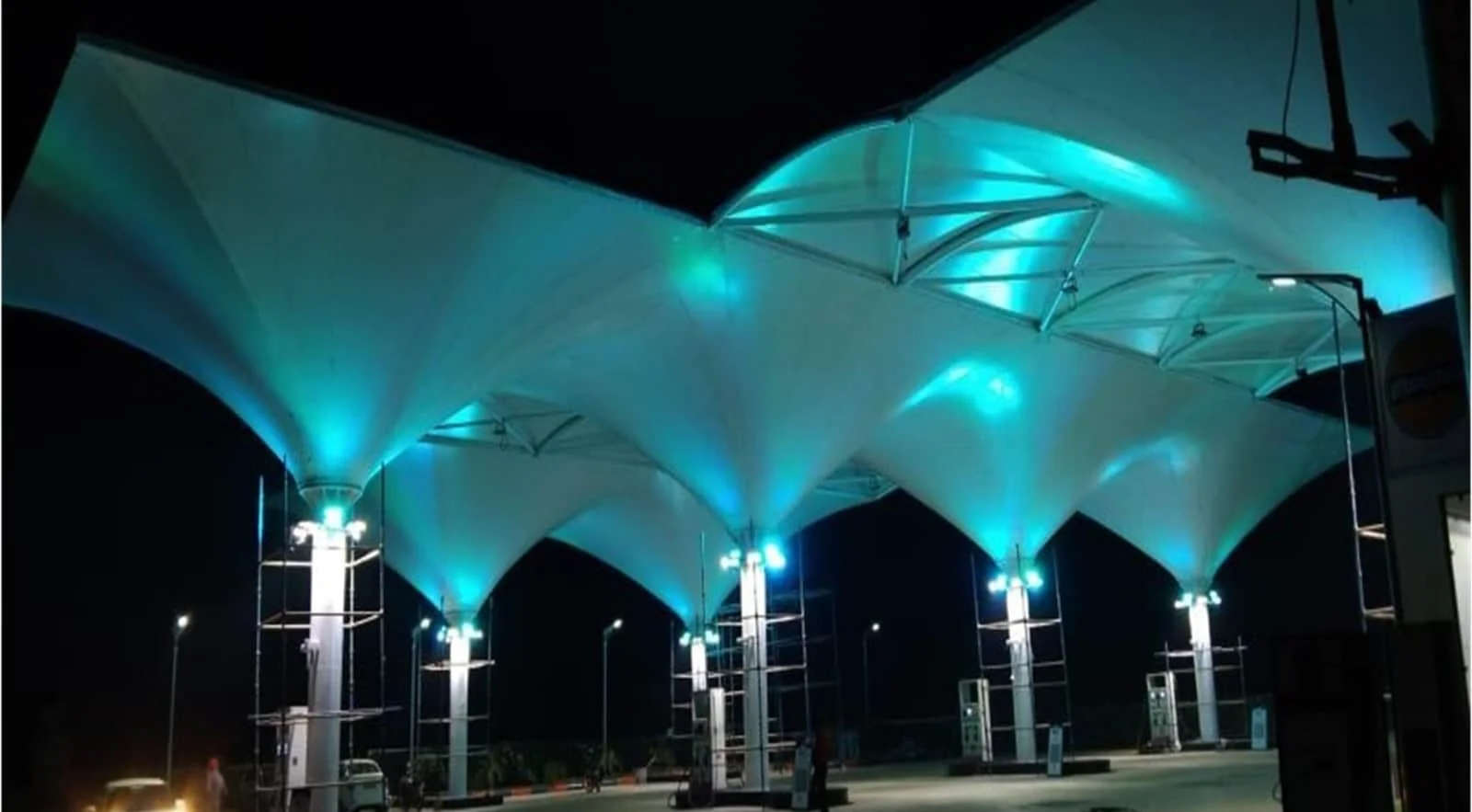
Forecourts and plant areas have their own rules. See forecourt canopies.
Open-sided car parking and walkways
Open structures away from a building line are generally the least demanding case, and B1 membranes are commonly accepted.
Interior ceilings
An interior membrane sits inside the building's fire strategy and is usually the strictest case of all. See interior ceilings.
Anything attached to a building
A canopy against a facade may fall under the building's own requirements rather than being treated as a separate structure.
How a membrane behaves in a fire
A coated fabric roof is thin and light, and under fire it tends to shrink and open rather than burn through and drip. In an open structure that behaviour vents smoke and heat upwards, which is usually helpful. It is also why a membrane roof is not treated as a fire barrier: it is not meant to hold.
PTFE-coated glass fibre is non-combustible, which is a different category rather than a better grade of the same thing. Where an authority requires non-combustible construction, no amount of flame-retardant PVC will satisfy it, and this is the point at which the material decision is made for you.
None of this replaces a fire strategy. Detection, escape routes, access for appliances and compartmentation are the building's business, and a membrane roof has to sit inside that rather than substitute for part of it.
What the test standards actually measure
Three systems turn up on Indian projects, and they are not interchangeable or directly convertible.
| Standard | Where it comes from | What it tells you |
|---|---|---|
| DIN 4102 B1 | German national standard | A reaction-to-fire class. B1 means difficult to ignite and self-extinguishing. Still the most commonly quoted figure for architectural fabric. |
| EN 13501-1 | European harmonised classification | Classes A1, A2, B, C, D, E, F for contribution to fire, plus an s rating for smoke (s1 = least) and a d rating for flaming droplets (d0 = none). |
| NFPA 701 | United States, National Fire Protection Association | A pass/fail flame-propagation test for textiles, widely used for tent and membrane fabrics. |
The practical point is that these do not map onto each other. A fabric passing NFPA 701 has not thereby been shown to meet DIN 4102 B1, and B1 is not a sub-grade of EN 13501-1 A2. If your authority names one standard, a certificate against a different one is not a substitute, however good it looks.
Read the suffixes as well as the letter. B-s1,d0 and B-s3,d0 are both “B class”, but one produces far less smoke than the other, and over an enclosed public space smoke is usually what the fire strategy actually cares about.
What to write into the specification
Four lines that prevent the common argument at handover.
Name the standard and the class
“Fire-retardant membrane” means nothing enforceable. “EN 13501-1 B-s1,d0” does.
Require the certificate for the supplied product
Ask for the test certificate naming the manufacturer and the product grade, not a generic statement about the material family.
State who approves it, and when
Make the classification a pre-order approval item. Discovering it at delivery means either a delay or a compromise.
Cover the whole assembly
Fixings, edge trims, lining layers and any printed graphics have their own behaviour. A certified membrane with an uncertified lining is not a certified roof.
Fire Rating FAQ
The questions that come up before a specification is settled.
They are specified against a reaction-to-fire classification, which is not the same as fire resistance. PVC and PVDF membranes are typically DIN 4102 B1 self-extinguishing; PTFE-coated fibreglass is non-combustible. A membrane roof is not a fire barrier and should not be specified as one.
Typically DIN 4102 B1 / EN 13501-1 B-s2,d0 or B-s3,d0, and it usually passes NFPA 701 — flame-retardant and self-extinguishing, but combustible.
PTFE-coated glass fibre, typically classified EN 13501-1 A2-s1,d0. Where an authority requires non-combustible construction this is generally the specification.
A flame-retardant architectural membrane is self-extinguishing and tends to shrink away from heat rather than carry flame across the surface. In an open structure that opening can help vent smoke and heat.
No. The classification describes the membrane. The steel, the fixings and anything attached to the structure are assessed separately, and the building's fire strategy covers escape, detection and access.
Yes, and you should ask for one. A typical classification for a material family is not proof for the roll on your site. We supply the certificate for whatever classification is specified.
It can, considerably, because it often decides the material. Moving from a B1 PVC to a non-combustible PTFE-coated glass membrane is a change of material family, not a change of grade. See the cost guide.
The occupancy and the approving authority, not the fabric supplier. Establish it before the membrane is specified; a site survey is the point to raise it.
Let’s Build Your Structure
Speak directly with our structural engineering team to discuss your project dimensions, material options, or to schedule a free on-site technical inspection across India.
- 28+Years experience
- Pan-IndiaTurnkey execution
- ISO9001:2015 certified
Request an itemised price quote
Fill in your requirements below for a free engineering assessment & itemised estimate.
* required — everything else is optional
Your details are used only to respond to this enquiry.
Chat with an Engineer on WhatsApp