

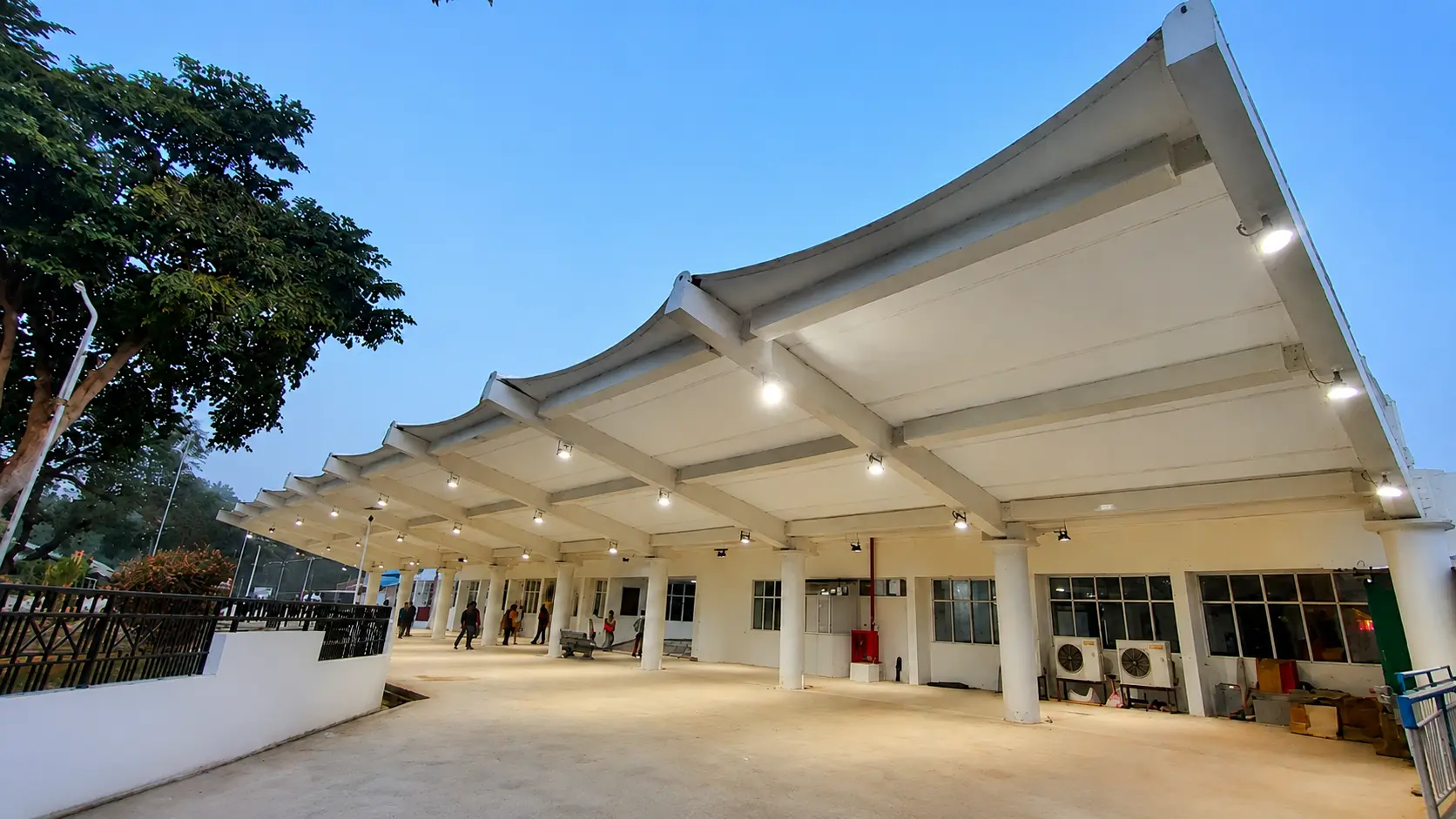
Tensile Structure vs Metal Sheet Roofing
The comparison most buyers are actually making: a tensioned fabric structure, or a steel frame with profiled metal sheeting. Where each one wins on span, weight, daylight, heat, service life and cost — including the cases where a sheeted building is the right answer and we would tell you so.
- Span, weight, daylight and heat compared
- Where a sheeted building wins, stated
- Whole-life cost, not day-one price
- A decision table you can use
Engineering Trusted by India’s Leading Names
28+ years delivering tensile structures for corporate campuses, industrial groups, and institutional developments — built with fabric technology from the world’s leading membrane manufacturers.
 TATA Motors
 L&T
L&T
 Reliance
 Adani
Adani
 Mahindra
 Godrej
 DLF
DLF
 ITC Ltd
 Maruti Suzuki
 GMR Group
 JSW Steel
 Prestige Group
 Sobha
Sobha
 Siemens
 Tata Chemicals
 Tata Tele Business Services
 Power Grid Corporation
 Emaar MGF
 National Law University Delhi
 UPES Dehradun
 Vasant Valley School
 Aditya Birla Group
 Amity University
 Vikram Solar
 Tractors India
 Mazda Colours
 Millennium Structurals
 Sehwag International School
 BSBK Pvt. Ltd.
 17 Miles Hotel
 Rich Harvest School
 The Imperial New Delhi
 Moore Constructions
 Mehra Construction
 Ramprastha
 Minda NexGenTech (UNO Minda)
 Yashmay Public School
 Gyan Mandir Foundation
 Omega Developers
 SPEC
SPEC
 Serge Ferrari
 Mehler
 Heytex
 Versaid
 PATI
PATI
Tensile membrane or a GI sheet shed?
This is the comparison most people are actually making. A plot needs covering — a parking area, a loading dock, a yard, an assembly ground — and the two realistic quotes on the table are a tensioned fabric structure and a conventional steel frame with profiled metal sheeting. They are usually within sight of each other on price, and they are genuinely different products. If the alternative on your project is a concrete slab instead, see tensile structure vs RCC roof.
We build tensile structures, so treat what follows accordingly — but a comparison that concluded “always choose ours” would be worthless to you and easy to spot. There are whole categories of building where a sheeted structure is simply the right answer, and we say no to that work rather than force a membrane into it. What follows is the honest version.
The short form: a membrane is a roof over open space; sheeting builds an enclosed building. Nearly every real difference falls out of that one distinction. If you want the lighter-weight comparison instead, see tensile vs shade sail vs polycarbonate.
Side by side
Generalisations, and every one of them is settled properly by a site survey and an engineering calculation rather than by a table.
| Tensile membrane | Metal sheet on steel | |
|---|---|---|
| Best at | Covering open space | Enclosing a building |
| Clear span per tonne of steel | Higher — the skin works in tension | Lower — purlins and rafters work in bending |
| Roof weight | A fraction of sheeting | Substantially heavier |
| Daylight | Translucent — diffuse light through the roof | Opaque, unless rooflights are added |
| Heat underneath (uninsulated) | Light-toned membrane reflects; cooler | Radiates heat downward; hot |
| Insulation | Single skin — not a thermal envelope | Insulated panels available |
| Walkable / service-carrying roof | No | Yes |
| Rooftop solar | No | Yes |
| Shape freedom | Curved, conical, free-form | Flat planes and simple pitches |
| Rain noise | Audible | Audible — often louder |
| Skin renewal | Re-skin on the same frame | Re-sheet, purlins usually reused |
| Local repair | Specialist — welded patch | Any competent fabricator |
The one difference everything else follows from
In a sheeted roof, the covering is dead weight. Sheets span between purlins, purlins span between rafters, rafters span between columns, and every one of those members works in bending. Bending is structurally expensive: to span further you need deeper sections, which weigh more, which need more support. Cost climbs steeply with span.
In a tensile structure the covering is the structure. A doubly-curved membrane held in tension carries load by pulling on its supports, and tension is the most efficient way to carry force there is — no member is wasted resisting bending. That is why a membrane roof crosses a large open span on markedly less steel, and why the gap widens as the span grows.
The practical consequences: fewer columns in the parking bays, the dock apron or the assembly ground; lighter foundations, because there is less roof to hold down (though uplift, not weight, governs the footing design on any light roof); and viability on existing structures, since a courtyard frame that could never take a sheeted roof may comfortably take a membrane. Where the span is short and columns can go anywhere, none of this advantage applies — and that is exactly the case where sheeting usually wins.
What the space feels like
For a covered area people actually use, this is often what decides it — and it is the part quotations never mention.
Where the membrane is better
- Daylight. A translucent membrane passes diffuse light across the whole floor, so a covered area does not become a dark one and the lighting load does not rise. An opaque sheet roof needs rooflights, which then become the glare and leak points.
- Heat. An uninsulated metal sheet in Indian summer absorbs and re-radiates heat downward — anyone who has stood under one at 2 pm knows it. A light-toned membrane reflects a large share of solar radiation and stays noticeably cooler beneath.
- The look. Curved, tensioned surfaces read as architecture. That is irrelevant on a back-of-house yard and decisive on a hotel forecourt, a school entrance or a mall courtyard.
- Openness. Fewer columns means the space actually works for what it was covered for.
Where sheeting is better
- Insulation. A membrane is a single skin. If the space must be air-conditioned or thermally controlled, an insulated metal panel system is the right product and a membrane is not.
- Enclosure and security. Full walls, dust-tightness and a lockable, sealed building are what sheeting does and a membrane does not.
- Anything mounted on the roof. Solar panels, plant, ducting, cable trays and walkable maintenance access all need a rigid roof deck.
- Rain noise. Neither is quiet, so this is not a reason to choose a membrane — profiled metal sheeting is famously loud in heavy rain, and a membrane is audible too. If quiet matters, that is a solid, insulated roof, not either of these.
Service life and what goes wrong
Both are steel structures with a replaceable skin. They fail in different places, and knowing which failure you are signing up for matters more than the headline life.
The membrane
Ages through UV, coating wear, soiling and flex at the clamp lines. A PVDF-finished PVC is commonly a 15–20 year system and PTFE-coated fibreglass 25–30 or more. The failure mode is gradual: chalking, gloss loss, then seams. It is renewed by unclipping the panels and re-skinning the same frame. Full lifespan detail →
The metal sheet
Ages through coating breakdown and corrosion, and fails first at the fasteners, laps and cut edges rather than in the middle of a sheet. A good coated sheet is a long-life product; a cheap one in a coastal or chemically loaded atmosphere is not, and rust streaks arrive years before real failure.
Both frames outlive both skins
Galvanised or properly painted steel is a multi-decade asset either way. In both cases you are buying a structure once and a covering more than once, so the comparison worth making is whole-life rather than day-one.
Repair is where they differ most
A damaged metal sheet can be swapped by any competent local fabricator. A torn membrane needs a welded patch by someone with the right equipment — usually a specialist, sometimes a wait. If your site is remote and self-sufficient, that is a real consideration. What repairs involve →
Which is actually cheaper
The genuine answer is that it depends on the span, and the crossover is real rather than rhetorical.
- Short spans, columns anywhere: sheeting usually wins. A small rectangular shed on a close column grid is exactly what profiled sheeting is optimised for, and a membrane brings engineering it does not need. We will tell you this rather than quote against it.
- Large clear spans: tensile often wins outright. Because steel cost climbs steeply with span in bending and much more gently in tension, there is a point past which the membrane structure is cheaper in total — not just nicer. Where that point sits depends on your geometry, wind zone and specification.
- Irregular shapes and awkward plots: tensile. Sheeting wants simple planes. Every cut, valley and junction is cost and a future leak path; a membrane is patterned to the shape at no structural penalty.
- Existing structures: often tensile. If the host frame can take a light membrane but would need strengthening for a sheeted roof, the comparison is decided before the roof is even priced.
- Programme is money. Both are pre-fabricated, but a membrane roof goes on faster once the frame is up — which matters where a car park, dock or forecourt is losing revenue while it is closed.
- Whole-life. Re-skinning a membrane is a planned event on a frame that stays. Re-sheeting is comparable work. Neither has a decisive advantage here, and anyone claiming otherwise is selling.
Most installed tensile projects fall between ₹280 and ₹2,500 per sq ft, plus GST — what decides where yours lands is set out in the cost guide and what drives tensile fabric price. If you have a sheeted quotation in hand, send us the drawing and we will tell you honestly whether a membrane is worth pricing against it.
A decision you can make in a minute
Choose a tensile membrane if
- The area must stay open on one or more sides.
- Columns have to stay out of a vehicle, forklift or play area.
- You want daylight through the roof.
- The space will be occupied by people in hot weather.
- The structure is guest-facing and has to look like architecture.
- The shape is irregular, or it has to work around existing buildings.
- It is going onto an existing frame that cannot take much weight.
- The span is large and you want it column-free.
Choose metal sheeting if
- The space must be enclosed, insulated or climate-controlled.
- You need solar panels, plant or services on the roof.
- Anyone needs to walk on the roof for maintenance.
- Security or dust-tightness requires a sealed building.
- Racking or a crane will be tied into the structure.
- The span is short and columns can go wherever you like.
- The site is remote and repairs have to be possible locally.
They are not mutually exclusive. Plenty of sites are best served by both — a sheeted production building with a membrane canopy over the dock and the parking. That is a common combination and a perfectly sensible one; see the industrial page, which sets out where each belongs on a working plant.
Tensile vs metal roofing FAQ
The questions people ask when they have a sheeted quotation in hand and are wondering whether to price a membrane against it.
It depends on the span, and the crossover is real. For a small rectangular shed on a close column grid, profiled sheeting is usually cheaper and is what that product is optimised for. For a large clear span the position reverses, because steel cost climbs steeply with span when members work in bending and much more gently when the skin works in tension. Where the crossover sits depends on your geometry, wind zone and specification.
They are comparable, and both are steel frames with a replaceable skin. A PVDF-finished PVC membrane is commonly a 15 to 20 year system and PTFE-coated fibreglass 25 to 30 or more; a good coated metal sheet is also a long-life product. They fail differently: a membrane chalks and loses gloss before the seams go, while sheeting fails at fasteners, laps and cut edges. The frame outlives the skin in both cases.
Uninsulated, yes, noticeably. A metal sheet absorbs solar radiation and re-radiates it downward, which is why standing under one at two in the afternoon in an Indian summer is unpleasant. A light-toned membrane reflects a large share of that radiation and stays cooler beneath. Against an insulated metal panel system the comparison changes completely - that is a thermal envelope and a membrane is not.
Neither is quiet, so this is not a reason to choose one over the other. Profiled metal sheeting is famously loud in heavy rain and a membrane is audible too. If quiet genuinely matters for the space, the answer is a solid insulated roof rather than either of these.
No. Solar panels, plant, ducting and cable trays all need a rigid roof deck that can carry point loads and be walked on, and a tensioned membrane is none of those things. If rooftop solar is part of the plan for that area, a sheeted structure is the right choice. Many sites do both - a sheeted building carrying the solar, with membrane canopies over the docks and parking.
Not in the way a sandwich panel is. A membrane is a single skin and is not a thermal envelope, so if the space has to be air-conditioned or thermally controlled, an insulated metal panel system is the correct product. Multi-layer and lined membrane build-ups exist for specific purposes but they are not a substitute for an insulated building.
It is worth asking if any of these are true: the area has to stay open on one or more sides, columns need to stay out of a vehicle or working route, the span is large and you want it column-free, the shape is irregular, the structure is guest-facing, or it is going onto an existing frame that cannot take much weight. If none of them are, the sheeted quote is probably the right answer and we will say so. Send us the drawing either way.
Yes, and it is a common and sensible combination - a sheeted production or storage building for the enclosed, serviced, solar-carrying floor area, with tensile canopies over the loading docks, staging yards, walkways and parking where the space has to stay open. Each does the job it is good at.
Let’s Build Your Structure
Speak directly with our structural engineering team to discuss your project dimensions, material options, or to schedule a free on-site technical inspection across India.
- 28+Years experience
- Pan-IndiaTurnkey execution
- ISO9001:2015 certified
Request an itemised price quote
Fill in your requirements below for a free engineering assessment & itemised estimate.
* required — everything else is optional
Your details are used only to respond to this enquiry.
Chat with an Engineer on WhatsApp