

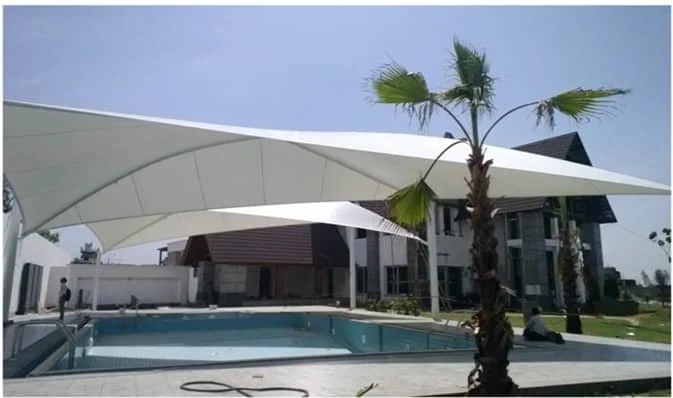
Shade Sail Structures
Two things get called a shade sail: a knitted HDPE mesh that cuts sun but lets rain through, and a coated-fabric sail that is a small waterproof tensile canopy. Ekra Decor builds both — engineered to your plot, on a galvanised steel frame, installed by one team.
- HDPE shade mesh — sun only
- Coated-fabric sail — waterproof canopy
- Engineered to your plot, not a kit
- Engineered to IS 875, IS 800 & IS 456
What a shade sail is
A shade sail is a tensioned triangular or quadrilateral fabric panel stretched between anchor points. The term covers two different products. A knitted HDPE shade sail is a woven mesh — it cuts a stated percentage of the sun and UV but is not waterproof; water passes straight through it. A coated-fabric sail (PVC or PVDF) is a small architectural-membrane canopy — fully waterproof, and really a compact tensile shade structure. A shade sail is not the same thing as an HDPE mesh: tensile structure vs shade net sets out that comparison.
Which one you want depends on the brief. Over a play area, a car port or a pool where a little spray is fine, an HDPE sail is the economical answer. Over a seating area, an entrance or anywhere that has to stay dry, a coated-fabric sail is the right choice.
Either way, a sail is a properly engineered tensioned structure — the anchor points, the cable tensions and the mast or post design all come out of the wind loading for the site.
Shade sail configurations
A sail is defined by its anchor points. Three or four is usual; more points give a bigger, more sculptural canopy.
Single triangular sail
Three anchor points, two high and one low (or the reverse) — the simplest, cheapest form over a compact area.
Overlapping sail array
Several sails at different heights that overlap in plan — covers a larger area and reads as a dynamic roofline.
Quad (hypar) sail
Four points, two lifted and two dropped, twisting the fabric into a saddle — efficient over a rectangle.
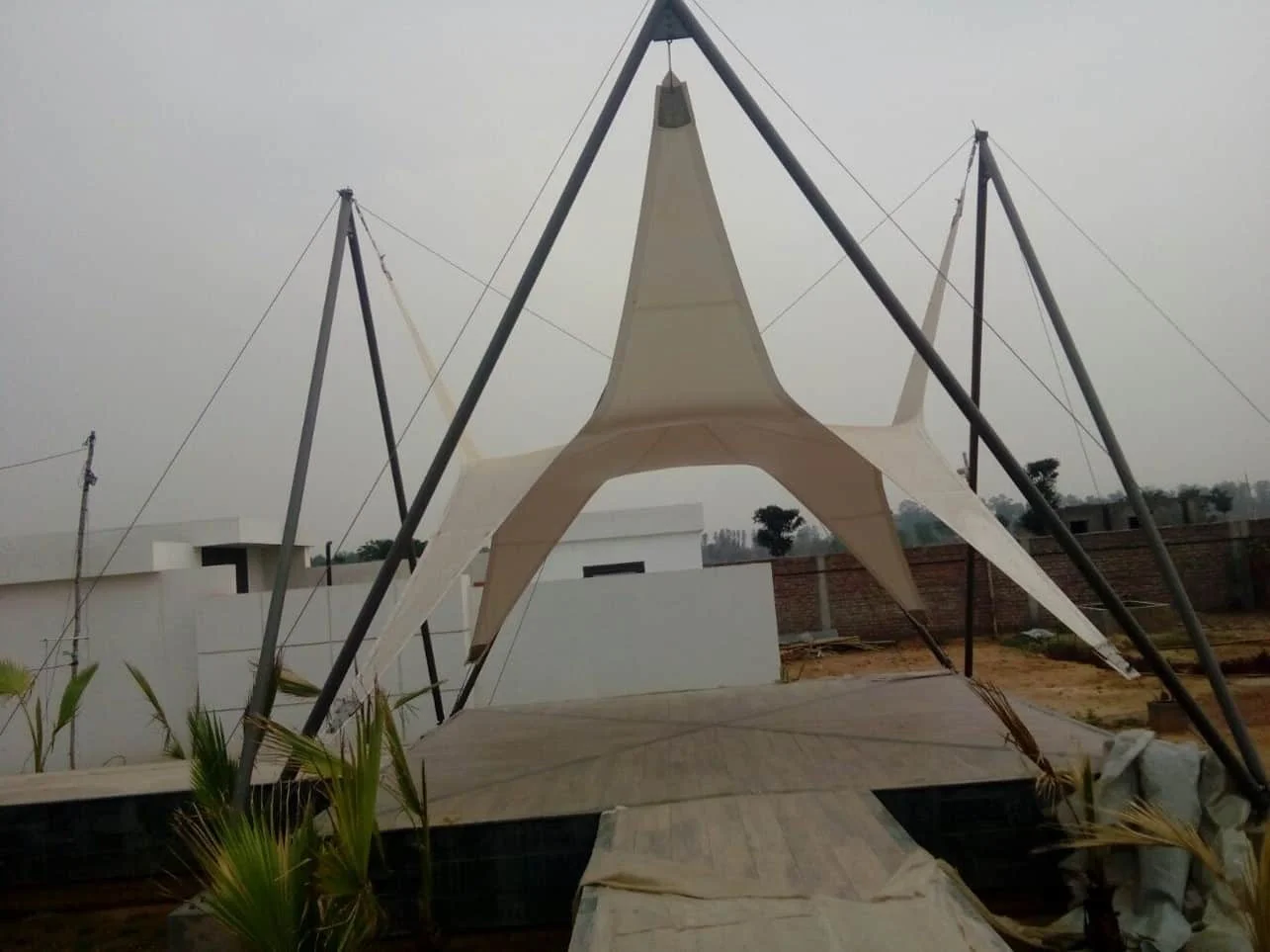
Sail on masts
Where there is no building or wall to anchor to, slender steel masts on pad footings carry the sail.
For a fully weatherproof roof over a larger area, see tensile shade structures and fabric shade structures.
What is specified
The specification starts with which fabric — mesh or coated — and then the anchor points and their supports.
| Element | Options |
|---|---|
| Fabric | Knitted HDPE shade mesh (sun only, not waterproof), or PVC / PVDF coated fabric (fully waterproof) |
| Form | Triangular, quad/hypar, or an overlapping array |
| Anchors | To building walls, columns, or slender steel masts on pad footings |
| Fittings | Stainless turnbuckles, D-shackles and cable, sized for the design tension |
| Size | A compact seating area up to a car port or a small courtyard |
| Drainage | HDPE mesh drains through itself; a coated sail drains to its low corner |
| Foundations | Pad footings to IS 456 for masts; chemical anchors into a wall or slab |
| Scope | Survey, 3D design, engineering, fabrication, installation and tensioning — one in-house team |
Membrane and film figures are manufacturer values for the material type; see the membrane materials page.
Shade mesh vs coated fabric
This is the decision that matters. Everything else follows from it.
Knitted HDPE shade mesh
WaterNot waterproof — rain passes through
SunCuts a stated percentage of sun and UV
Best forPlay areas, car ports, pools — where a little spray is acceptable and cost matters
PVC / PVDF coated fabric
WaterFully waterproof once the seams are welded
SunBlocks the direct sun and almost all UV
Best forSeating areas, entrances, anywhere that must stay dry
The coated fabrics are compared in full on the membrane materials page.
How it is engineered and built
The governing load
A sail is a light tensioned structure, so wind uplift governs. The anchor points, cable tensions and mast or post design are all worked out from the site’s design wind speed under IS 875 Part 3, with the masts to IS 800 and the pad footings to IS 456.
It is not a DIY kit
A properly engineered sail has anchor forces in the hundreds of kilograms even at garden scale — the fixings and their substrate have to be designed, not guessed.
Steel & foundations to code
The frame is designed to IS 800 and the footings to IS 456, checked for uplift and overturning. Galvanising to IS 4759 / IS 2629 for corrosion protection.
Built off-site, raised fast
Steel is cut, welded and galvanised in the workshop and the membrane is cut and welded into panels, while the footings are cast on site. On-site work is then quick and low-disruption.
One accountable team
Survey, 3D design, engineering, fabrication, installation and tensioning are all Ekra Decor’s own team, with a handover pack of drawings, load report, stability certificate and material certificates.
What drives the cost
Cost is not a fixed rate per square foot — two structures of the same size can differ widely. The main factors:
An HDPE mesh sail is the least expensive option; a coated-fabric sail on masts costs more. Send the area for a quote; see the cost guide and the shade sail comparison.
Looking after the structure
- Cleaning — a periodic wash; PVDF, PTFE and ETFE surfaces largely self-clean in rain.
- Membrane / film & edges — check for abrasion, wear and any lifting at the clamp lines and corners.
- Cable tension — a first re-tension after the initial season, then a periodic check.
- Steel & connections — inspect the galvanising and the connections at ground level.
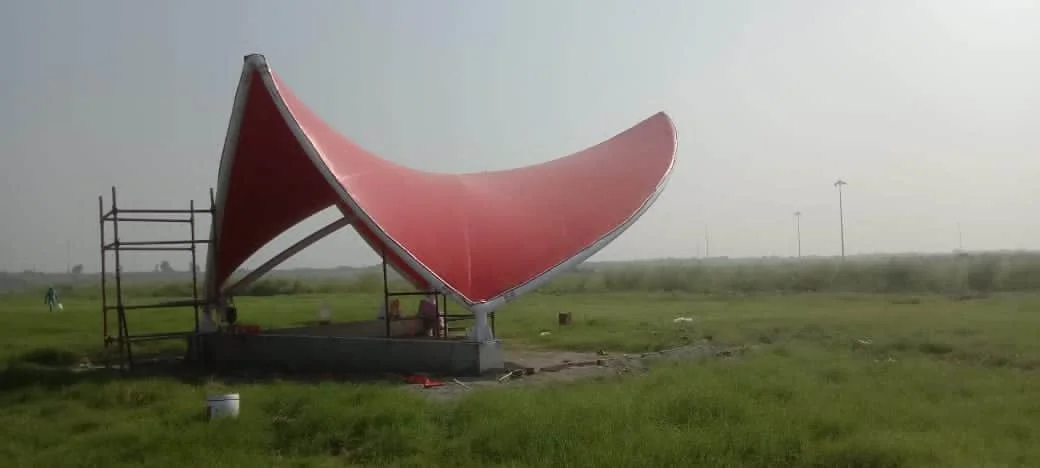
Sail-form structures we’ve built
Each project is documented with site photographs and recorded scope.
/diu-2200sqm.webp)
Shade sail structures FAQ
The questions people ask before commissioning a shade sail.
A knitted HDPE shade sail is not — rain passes straight through the mesh. A coated-fabric sail (PVC or PVDF) is fully waterproof. Which you want depends on whether the space has to stay dry.
A shade sail is a small tensioned fabric panel between a few anchor points. A tensile structure is a larger engineered roof on its own steel frame. A coated-fabric sail sits between the two — it is a compact tensile shade structure.
A stated percentage depending on the mesh — commonly in the 85–95% range for a dense knit. It also cuts most of the UV. A coated-fabric sail blocks the direct sun and almost all UV, and the rain.
Yes, unless every anchor is into an existing wall or column. Where masts are needed, they sit on pad footings designed to IS 456 and sized for wind uplift.
Yes, if engineered for it. The anchor forces, cable tensions and mast design are worked out from the site's design wind speed under IS 875 Part 3. Anchor forces reach hundreds of kilograms even at garden scale.
An HDPE mesh sail typically lasts around 10 years; a PVC coated sail is usually quoted at 15–20 years, longer with a PVDF finish. Life depends on UV exposure and maintenance.
There is no fixed rate. An HDPE mesh triangle is the cheapest; a coated-fabric sail on steel masts costs more. Send the area for an itemised quote.
Send us the area to shade
You get a fabric recommendation (mesh or coated), a form option and an itemised quote.
Let’s Build Your Structure
Speak directly with our structural engineering team to discuss your project dimensions, material options, or to schedule a free on-site technical inspection across India.
- 28+Years experience
- Pan-IndiaTurnkey execution
- ISO9001:2015 certified
Request an itemised price quote
Fill in your requirements below for a free engineering assessment & itemised estimate.
* required — everything else is optional
Your details are used only to respond to this enquiry.
Chat with an Engineer on WhatsApp