

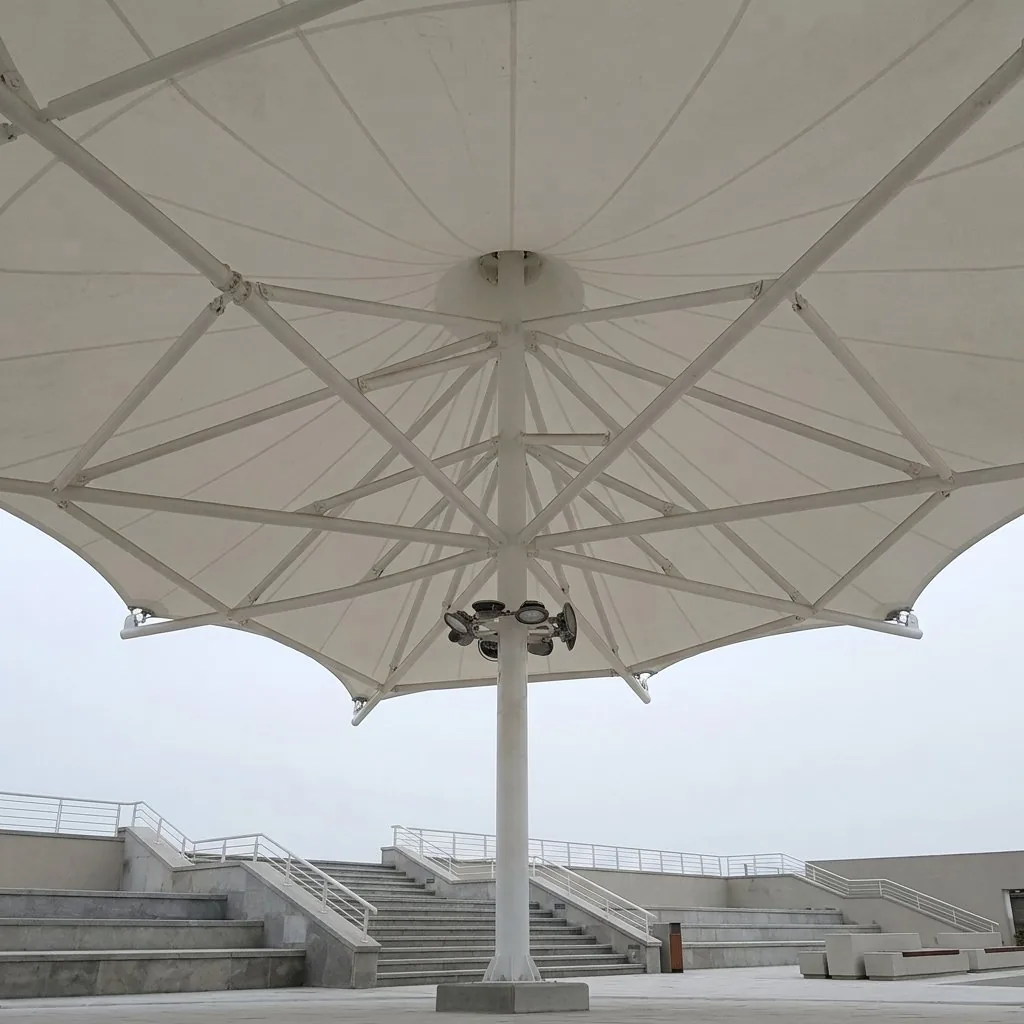
Petrol Pump Forecourt Canopies
Large-span forecourt canopies for fuel stations — open on every side, tall enough for a road tanker, with the columns only where the traffic plan allows them and the lighting and fascia designed into the frame rather than added to it. A 3,000 m² forecourt delivered at Jewar, Uttar Pradesh.
- Open on all sides, minimal columns
- Tanker headroom engineered in
- Built to the operator's approvals
- Phased so the station keeps trading
Engineering Trusted by India’s Leading Names
28+ years delivering tensile structures for corporate campuses, industrial groups, and institutional developments — built with fabric technology from the world’s leading membrane manufacturers.
 TATA Motors
 L&T
L&T
 Reliance
 Adani
Adani
 Mahindra
 Godrej
 DLF
DLF
 ITC Ltd
 Maruti Suzuki
 GMR Group
 JSW Steel
 Prestige Group
 Sobha
Sobha
 Siemens
 Tata Chemicals
 Tata Tele Business Services
 Power Grid Corporation
 Emaar MGF
 National Law University Delhi
 UPES Dehradun
 Vasant Valley School
 Aditya Birla Group
 Amity University
 Vikram Solar
 Tractors India
 Mazda Colours
 Millennium Structurals
 Sehwag International School
 BSBK Pvt. Ltd.
 17 Miles Hotel
 Rich Harvest School
 The Imperial New Delhi
 Moore Constructions
 Mehra Construction
 Ramprastha
 Minda NexGenTech (UNO Minda)
 Yashmay Public School
 Gyan Mandir Foundation
 Omega Developers
 SPEC
SPEC
 Serge Ferrari
 Mehler
 Heytex
 Versaid
 PATI
PATI
Why forecourts are a canopy problem, not a roof problem
A fuel station forecourt is one of the purest tensile briefs there is. A large area has to be covered. It has to stay completely open on every side, because vehicles arrive and leave from all of them. The columns can only stand in the few places that do not obstruct circulation around the dispensers. And the whole thing has to be tall enough for a road tanker to pass under.
That combination — big footprint, few columns, full openness, generous headroom — is exactly what a tensioned membrane does better than a conventional roof. It spans further on less steel, so there is less structure standing in the way; it weighs a fraction of a sheeted canopy, so the foundations are smaller; and it goes up fast, which matters when every day the forecourt is shut is a day of lost throughput.
The complication is that a forecourt is a regulated environment. There are zones around the dispensers and vents where what you may install is controlled, and the operator’s and oil-marketing company’s approval process governs the design. That is the part a general canopy contractor tends to discover late. For the underlying technical background, see the tensile structure guide.
A forecourt canopy is one of several forms — see types of canopies for how it compares with conical, hypar and barrel-vault roofs.
What we have built in this sector
Being straight about the portfolio: one substantial forecourt canopy and one project for an oil-marketing company. Everything else on this page is engineering practice rather than a claim of volume.
Fuel station forecourt canopy
Jewar, Gautam Buddh Nagar, Uttar PradeshA 3,000 m² forecourt canopy delivered over roughly two and a half months, near the Jewar / Noida International Airport corridor.
Indian Oil Corporation
Greater Noida, Uttar PradeshA covered working area at an oil-marketing site — a depot and office canopy rather than a retail forecourt, but the same client type and the same public-sector documentation process.
If you are comparing contractors on forecourt experience specifically, that is the honest extent of ours. What we do bring is 28 years of engineering canopies where the span, the clearance and the column positions are dictated by vehicles — see the industrial work and the car parking canopies. All commercial projects →
The constraint that makes a forecourt different
A forecourt canopy is not a car park shade with a taller frame. It sits over a fuelling operation, and that changes what may be installed and who signs it off.
Hazardous zones around the dispensers
There are classified zones around dispensers, fill points and vent stacks where vapour may be present and where what you may install — particularly anything electrical — is controlled. Canopy lighting, cabling and any fixings inside those zones have to respect that classification.
The approvals are the operator’s, not ours
Indian retail fuel outlets are licensed and inspected, and the oil-marketing company has its own engineering standards for canopies on its network. The layout, the zone classification and the approvals route are set by the operator, their consultant and the licensing authority. We build to that; we do not determine it.
Membrane fire classification
The membrane is specified against a fire classification like any architectural fabric — PVC and PVDF typically DIN 4102 B1 self-extinguishing, PTFE-coated fibreglass non-combustible. Which one is acceptable at a fuelling facility is a question for the operator’s safety requirements, and we supply the certificate for whatever is specified.
Hot work is the wrong tool here
Site welding and cutting near a live fuelling operation is exactly what a permit system exists to control. Our steel is CNC-profiled, welded to procedure and protected in the workshop, so site work is bolted assembly, erection and tensioning — which is a much easier conversation with a safety officer.
Drainage kept separate
Forecourt surface drainage is a controlled system with its own interception. Clean rainwater coming off the canopy should be taken to its own discharge rather than dumped into that system, and where it lands is a design decision, not an accident.
Earthing and lightning protection
A tall steel frame over a fuelling area is part of the site’s earthing and lightning-protection scheme. It is coordinated with the operator’s electrical consultant rather than treated as a separate structure.
How a forecourt canopy is engineered
Every structure is designed against its own site and the applicable Indian Standards. Nothing below is a catalogue figure.
- Headroom set by the tallest vehicle — a road tanker, not a car, and with the drainage falls designed above that clearance rather than eating into it. Getting this wrong is not a snag; it is a demolition.
- Column positions dictated by circulation — swept paths for cars, trucks and the tanker at its delivery position decide where a column may stand. The structural grid follows the traffic plan, not the other way round.
- Wind uplift governs — a large, flat, open-sided canopy on few columns is close to the worst case for uplift, because wind gets under it from every direction. Assessed for the specific site under IS 875 Part 3, and it is what sizes the foundations.
- Foundations designed for uplift and overturning — to IS 456, and coordinated against the tanks, lines and interceptors already under the forecourt. What is buried there frequently decides where a footing can actually go.
- Steel — to IS 800, hot-dip galvanised to IS 4759 / IS 2629 or a specified paint system, detailed for a wash-down environment.
- Form-finding — the geometry is generated so the membrane stays in balanced tension under load, then unrolled into 2D cutting patterns with pre-stress compensation.
- Handover pack — as-built drawings, calculations and load report, structural stability certificate, membrane and steel mill certificates with the fire classification, and an O&M manual.
The canopy is the sign
A forecourt canopy is the most visible object on the site. It is what a driver sees from the highway, and on a branded network it carries the brand.
Fascia
Branded networks specify their own fascia treatment, colours and signage. Where a fascia band is required, it is designed as part of the structure from the start — the frame has to carry it, and the membrane edge has to meet it cleanly.
Lighting designed in
A forecourt needs high, even illumination without glare into the driver’s eyes. Fixture positions, mounting and cable routes are designed into the frame, and inside any classified zone the fittings must suit that classification. Retrofitting lighting onto a finished canopy is expensive and usually looks it.
A membrane can be lit through
A translucent membrane lit from below glows as a single surface at night, which on a highway site is worth more than any amount of signage. It has to be planned in, for the same reasons it does on a hospitality structure.
Colour that lasts
A branded white or coloured canopy on a dusty highway needs a finish that holds colour and sheds dirt. This is the clearest case for a PVDF-lacquered membrane — a faded, streaked canopy is a brand problem as much as a maintenance one.
Clean underside
Drivers stand and look up at this ceiling for several minutes. Cable routes, fixings and drainage are detailed to be tidy from underneath, not just from above.
EV and CNG bays
Forecourts are adding charging and CNG bays, which have their own clearance, ventilation and equipment requirements. Those are the operator’s to specify; the canopy has to be designed around whatever they are.
Building without shutting the station
On a retail forecourt, programme is money in a very direct way — every day a pump island is fenced off is throughput lost.
- Almost everything is made off site. Steel is CNC-profiled, welded to procedure and protected in the workshop; membrane panels are plotter-cut and high-frequency welded there. Site work is foundations, bolted erection and tensioning.
- Foundations are the disruptive part. Excavation near live tanks, lines and interceptors is the slow, careful phase, and it is sequenced so only part of the forecourt is out of use at a time.
- Work in halves. A forecourt can usually be built in two phases so half the islands keep trading throughout, which is almost always worth the small extra programme.
- Lifts planned around trading peaks. Crane positions and delivery slots are agreed against the site’s busy periods rather than dropped on it.
- Permits and inductions before mobilising. Method statements, risk assessments, hot-work avoidance and operator inductions are settled before the crew arrives, not on the first morning.
- A realistic figure up front. Our Jewar forecourt ran to roughly two and a half months at 3,000 m². Your programme depends on your area, your ground and how much of the site has to keep trading — but that is a real number from a real job rather than a sales estimate.
What drives the cost of a forecourt canopy
Most installed projects fall between ₹280 and ₹2,500 per sq ft, plus GST. These are the variables that decide where a project lands in that range.
- Clear span and column count — how few columns the traffic plan allows is the single biggest driver, far more than the covered area.
- Headroom — tanker clearance raises the frame, the wind moment and the footing loads together.
- What is already buried — tanks, product lines and interceptors under the forecourt often decide the foundation design, and the survey settles that before the price does.
- Fascia and lighting — a branded fascia band and integrated lighting are structure, not decoration, and they belong in the design from the start.
- Membrane grade and finish — the choice that decides whether the canopy still looks like the brand in year eight.
- Trading through the build — phasing to keep islands open costs programme, and is usually still the cheaper option overall.
We issue a free itemised quote after a site survey. The variables are set out in full in the cost guide and what drives tensile fabric price.
Forecourt canopy FAQ
What fuel station owners and dealers ask before commissioning a forecourt canopy.
Because the brief suits it almost perfectly: a large area that must stay open on every side, with columns only where they do not obstruct circulation around the dispensers, and enough headroom for a road tanker. A tensioned membrane spans further on less steel than a sheeted canopy, weighs a fraction as much so the foundations are smaller, and goes up fast - which matters when closed pump islands mean lost throughput.
The membrane is specified against a fire classification like any architectural fabric - PVC and PVDF typically DIN 4102 B1 self-extinguishing, PTFE-coated fibreglass non-combustible. Which is acceptable at a fuelling facility is set by the operator's safety requirements and the licensing authority rather than by us, and we supply the certificate for whatever is specified. Separately, because our steel is pre-fabricated and protected in the workshop, site work is bolted assembly rather than welding and cutting near a live operation.
The operator, their consultant and the licensing authority. Indian retail fuel outlets are licensed and inspected, and an oil-marketing company has its own engineering standards for canopies on its network, including the classified zones around dispensers, fill points and vents where what may be installed is controlled. We build to that approval route; we do not determine it.
It is set by the tallest vehicle that has to pass under, which is the road tanker at its delivery position rather than a car. The drainage falls are then designed above that clearance instead of eating into it. This is the dimension least worth getting wrong, because the remedy is not a snag list.
Usually the forecourt is built in two phases so half the islands keep trading throughout, which is almost always worth the small extra programme. Fabrication happens off site, so site work is foundations, erection and tensioning. Excavation near live tanks, product lines and interceptors is the slow, careful phase and is sequenced so only part of the forecourt is out of use at a time.
Our Jewar forecourt was roughly 3,000 square metres and ran to about two and a half months. Your programme depends on the area, the ground, what is already buried under the forecourt and how much of the site has to keep trading - but that is a real figure from a completed job rather than an estimate.
Yes, and both should be designed into the structure from the start. A branded fascia band has to be carried by the frame with the membrane edge meeting it cleanly, and forecourt lighting needs high, even illumination without glare, with fixtures and cable routes built into the frame and suitable for any classified zone they sit in. A translucent membrane can also be lit from below so the whole canopy glows at night, which on a highway site is worth more than signage.
One substantial retail forecourt, at Jewar in Uttar Pradesh, plus a covered working area for Indian Oil Corporation at Greater Noida, which is a depot and office canopy rather than a retail forecourt. We would rather say that plainly than imply a volume we do not have. What we do bring is 28 years of engineering canopies where span, clearance and column positions are dictated by vehicle movement.
Let’s Build Your Structure
Speak directly with our structural engineering team to discuss your project dimensions, material options, or to schedule a free on-site technical inspection across India.
- 28+Years experience
- Pan-IndiaTurnkey execution
- ISO9001:2015 certified
Request an itemised price quote
Fill in your requirements below for a free engineering assessment & itemised estimate.
* required — everything else is optional
Your details are used only to respond to this enquiry.
Chat with an Engineer on WhatsApp