

Types of Canopies
The forms a canopy can take, the materials it can be made from, and which combination suits an entrance, a walkway, a forecourt or a car park.
What counts as a canopy
Before the types: the word covers a wider range than most people expect, which is why two quotations for “a canopy” can describe quite different things.
A canopy is a roof that covers an outdoor space without enclosing it. It has no walls, it is usually supported from one side or from a small number of columns, and its job is to keep sun and rain off the area beneath while leaving the sides open.
That single word covers a light fabric sail over a house porch and a twenty-metre steel-and-membrane structure over an airport forecourt. What separates them is not the name but three decisions: the form the roof takes, the material it is covered with, and whether it is engineered as part of the building or simply propped over the space.
A structural canopy is the engineered kind — its own frame, its own foundations, and a design case for wind uplift. Everything on this page is that kind. A tarpaulin on poles is also technically a canopy; it is not what a building needs.
The canopy forms, and what each is good at
Form is the first decision, because it settles the column positions and therefore what the space underneath can be used for.
Cantilever (flat or single-curve)
Columns on one side only; the roof reaches out over the space with nothing in front. The default wherever people or vehicles must move freely underneath — car parking bays, walkways, platform edges. The trade-off is a heavier column and footing, because the whole roof hangs off one line.
Conical
A mast in the middle pulls the fabric up into a cone. Sheds water outward to the perimeter, reads as a landmark, and covers a roughly circular area — courtyards, seating clusters, entrance plazas, hotel forecourts.
Hypar (saddle)
Two high corners and two low corners, so the surface curves in opposite directions at once. That double curvature is what keeps a membrane taut and stops it lifting or flapping. The most structurally efficient fabric form, and the one that looks most obviously like a tensile structure.
Barrel vault
A half-cylinder running along a length. Ideal for anything linear — a covered walkway between two blocks, a queueing lane, a loading bay — because it repeats as far as the route goes.
Arched / ridge-and-valley
A series of arches with valleys between them, used to cover large continuous areas such as an assembly yard or a parking deck. Drainage is planned into the valleys rather than left to run off the edges.
Retractable
A canopy that opens. Panels run on tracks so the space can be covered in the rain and open the rest of the year. Used over restaurant terraces, courtyards and pools. Mechanically the most complex of the six, and priced accordingly.
These are not mutually exclusive. A large project usually combines them — a conical feature at the entrance, barrel vaults along the walkways, cantilevers over the parking. Tensile canopy structures covers the fabric versions in more depth.
What the canopy is covered with
The form decides the shape; the material decides how long it lasts, how it looks from underneath and what it costs to keep clean.
| Material | Light | Typical life | Best suited to |
|---|---|---|---|
| PVC-coated polyester the usual choice | Translucent, wide colour range | Manufacturers typically quote 15–20 years | Most commercial canopies — parking, walkways, courtyards |
| PVDF-lacquered PVC cleaner for longer | As PVC, holds its colour | Longer than plain PVC | Dusty or polluted sites, corporate and public frontages |
| PTFE-coated glass the permanent option | Translucent, near self-cleaning | The longest of the fabrics | Landmark and high-fire-class structures |
| ETFE film a film, not a fabric | Highly transparent | Very long | Where daylight through the roof is the point — atria, cushion roofs |
| Polycarbonate sheet | Clear or tinted, rigid | Varies with grade and UV protection | Small spans, porches, where a hard roof is wanted |
| Metal sheet | Opaque | Long, with coating maintenance | Industrial sheds and utilitarian covers |
The first four are membranes: they carry load in tension and need double curvature to stay taut. The last two are rigid sheets laid on a frame — simpler, cheaper over short spans, and not able to span far without more steel underneath.
This is the distinction behind the phrase canopy sheet. If a quotation says “canopy sheet” it almost certainly means polycarbonate or metal on a frame, not a tensioned membrane. Both are legitimate; they are not the same product and should not be compared on rate alone. The material guide sets out each one in detail.
Where each type ends up being used
The same six forms recur across very different buildings. These are the placements we are asked for most often.
Entrance canopies
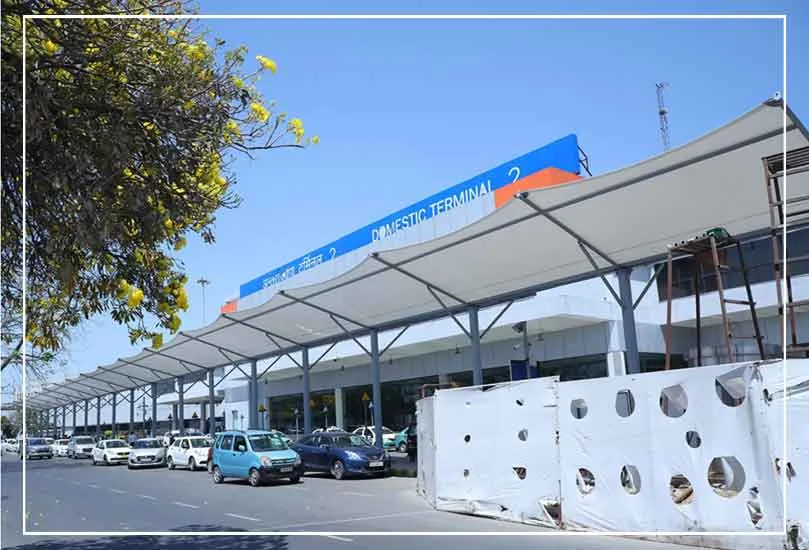
The arrival point, so form matters as much as cover. Usually a cantilever or a conical feature. Ekra Decor built the entrance canopy at IGI Airport Terminal 2.
Walkway canopies
Linear and repetitive — barrel vaults or repeating cantilevers between blocks. The student walkway at Allen Career Institute, Kota is one of ours.
Car park canopies
Almost always cantilever, so no column lands in a bay or a drive aisle. See car parking tensile shades.
Forecourt canopies
Fuel stations and drop-offs need clear height for vehicles and a roof that reads from the road. See forecourt canopies.
Courtyard and terrace canopies
Conical or hypar where the space is roughly square, retractable where the client wants the option of open sky. See retractable roofs.
Gazebos and garden canopies
Small conical or hypar canopies over seating. See pergola and gazebo canopies.
How to choose between them
In the order the decisions actually have to be made.
1. Where can the columns go?
This settles the form before anything else. If nothing may obstruct the space, it is a cantilever. If a centre point is free, a cone becomes possible. Mark the no-go zones on the plan first — bays, aisles, fire tender access, existing services.
2. How far must it span?
Short spans can be a rigid sheet on a simple frame. Once the span grows, a tensioned membrane carries it with far less steel, which is usually where fabric starts to win.
3. Does light need to come through?
A translucent membrane lights the space underneath in the day. An opaque metal sheet does not. ETFE goes furthest if the roof should read as glass.
4. How dirty is the air?
On a dusty arterial road or an industrial site, a PVDF lacquer or PTFE will still look presentable in five years where a plain PVC will not.
5. Does it ever need to open?
If yes, it is a retractable roof and the conversation changes — tracks, drive system, power, and a maintenance regime.
6. What is the fire requirement?
Assembly buildings, airports and some industrial uses carry a fire classification that rules out some materials. Settle this before the form, not after.
What should be specified on any canopy
Whatever type is chosen, a serious quotation states these. If one is missing, ask.
Design wind load
The governing case. A canopy weighs almost nothing, so it is uplift that sizes the frame and the footings — to IS 875 Part 3 for the site's wind zone.
Steel section and grade
Pipe or section sizes, wall thickness and grade, designed to IS 800, with the corrosion protection stated (hot-dip galvanising to IS 4759 / IS 2629).
Membrane or sheet specification
Base cloth, coating, top finish and weight in GSM for a membrane; grade, thickness and UV protection for a sheet. “Imported fabric” is not a specification.
Foundation design
Isolated footings to IS 456, sized for uplift and overturning, with the soil assumption written down.
Drainage
Where the water goes, and what happens to it — free edge, valley gutter, or downpipe through a column. Left unstated, it becomes the client's problem later.
Clear height
At the lowest point, not the highest. This is the number people are most often surprised by once the canopy is up.
One of each, from the archive
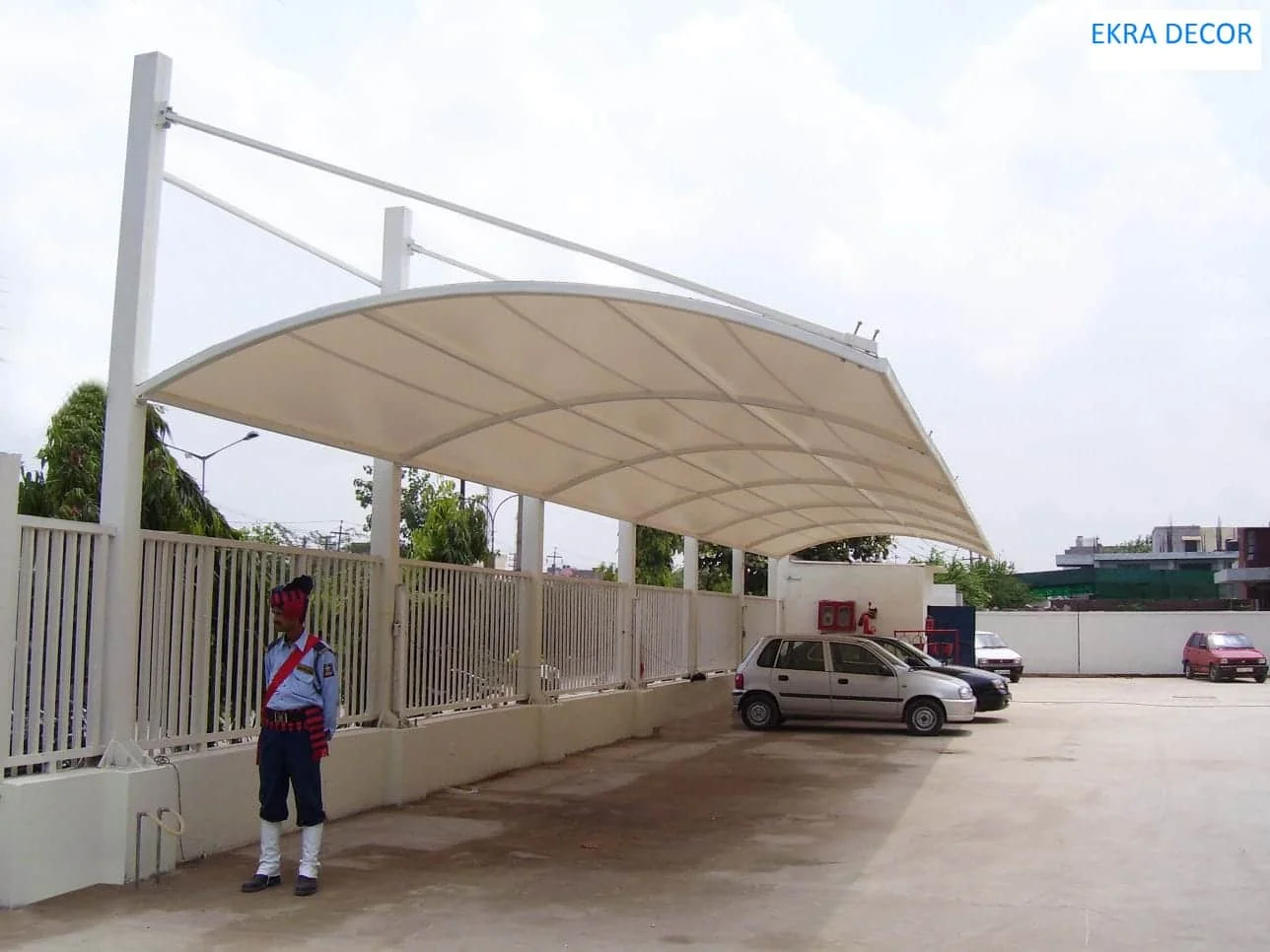
- FormCantilever, repeating bays
- UseCar parking
- LocationManesar, Haryana
- MembraneTensioned coated fabric on a galvanised steel frame
A single line of columns sits behind the bays and the membrane reaches forward over the cars and the drive aisle, so nothing obstructs a car door or a reversing vehicle. The curve across each bay is what keeps the fabric taut and sheds the water to a planned edge.
This is a commercial car park, not a house. The engineering at a domestic scale is the same — the same uplift case, the same need for real footings — the span is simply shorter. More projects →
Canopy types FAQ
The questions that come up before a canopy is specified.
By shape: cantilever, conical, hypar or saddle, barrel vault, arched or ridge-and-valley, and retractable. By material: PVC-coated polyester, PVDF-lacquered PVC, PTFE-coated glass, ETFE film, polycarbonate sheet and metal sheet. Most real projects combine a form from the first list with a material from the second.
One engineered as a building element rather than propped over a space — its own frame, its own foundations, and a design case for wind uplift, which is what governs a roof this light. Every canopy on this page is that kind.
The same thing, described by intent: a canopy shaped to belong to the building rather than to be a rectangle that happens to cover the area. Fabric suits it because the double curvature that makes a membrane structurally sound is also what gives it its shape.
Among the fabrics, PTFE-coated glass. PVDF-lacquered PVC sits in the middle and stays presentable far longer than plain PVC on a dusty site. Plain PVC is the most economical and is what most commercial canopies use. Actual life depends on the site, not just the material.
A sheet is rigid — polycarbonate or metal laid on a frame. A fabric is a coated membrane stretched into double curvature and carrying load in tension. A membrane spans much further without columns; a sheet is cheaper over a short, simple span. They are different products and comparing them on rate alone is misleading.
Usually yes. The steel and the membrane are fabricated off-site, so site work is limited to casting the footings and erecting the frame. Areas are fenced in sections and handed back as they are finished.
There is no rate per square foot that means anything across these types. Cost follows the form, the span, the clear height, the material grade, the wind zone, the soil and site access. Send a plan or a photograph of the space and you will get an itemised quotation against it.
Yes — porches, gazebos, terrace covers and single-car canopies — though most of our delivered work is commercial and institutional. The engineering does not change with size; the span does.
Let’s Build Your Structure
Speak directly with our structural engineering team to discuss your project dimensions, material options, or to schedule a free on-site technical inspection across India.
Direct Phone & WhatsApp Hotlines
+91 98102 37952 (Delhi HQ) / +91 93159 45187 (Bangalore) / +91 82879 92289 (Engineering)
Official Email Address
Delhi Factory & Administrative HQ
No. 367 Badam Singh Market, Rangpuri, Near Shiv Murti, NH-8, New Delhi 110037
Bangalore Regional Office
93/5, Kada Agrahara Village, Dodda Gubbi Post, Bangalore, Karnataka - 560077, India
Chattarpur Office
House No. 488, 3rd Floor, Khasra No. 60, 100 Futa Road, Opposite Delhi Jal Board, Near Diwan Bajaj Showroom, Chattarpur Pahari, New Delhi - 110074, India
Request Itemized Price Quote
Fill in your requirements below for an instant engineering assessment & 3D estimate.