

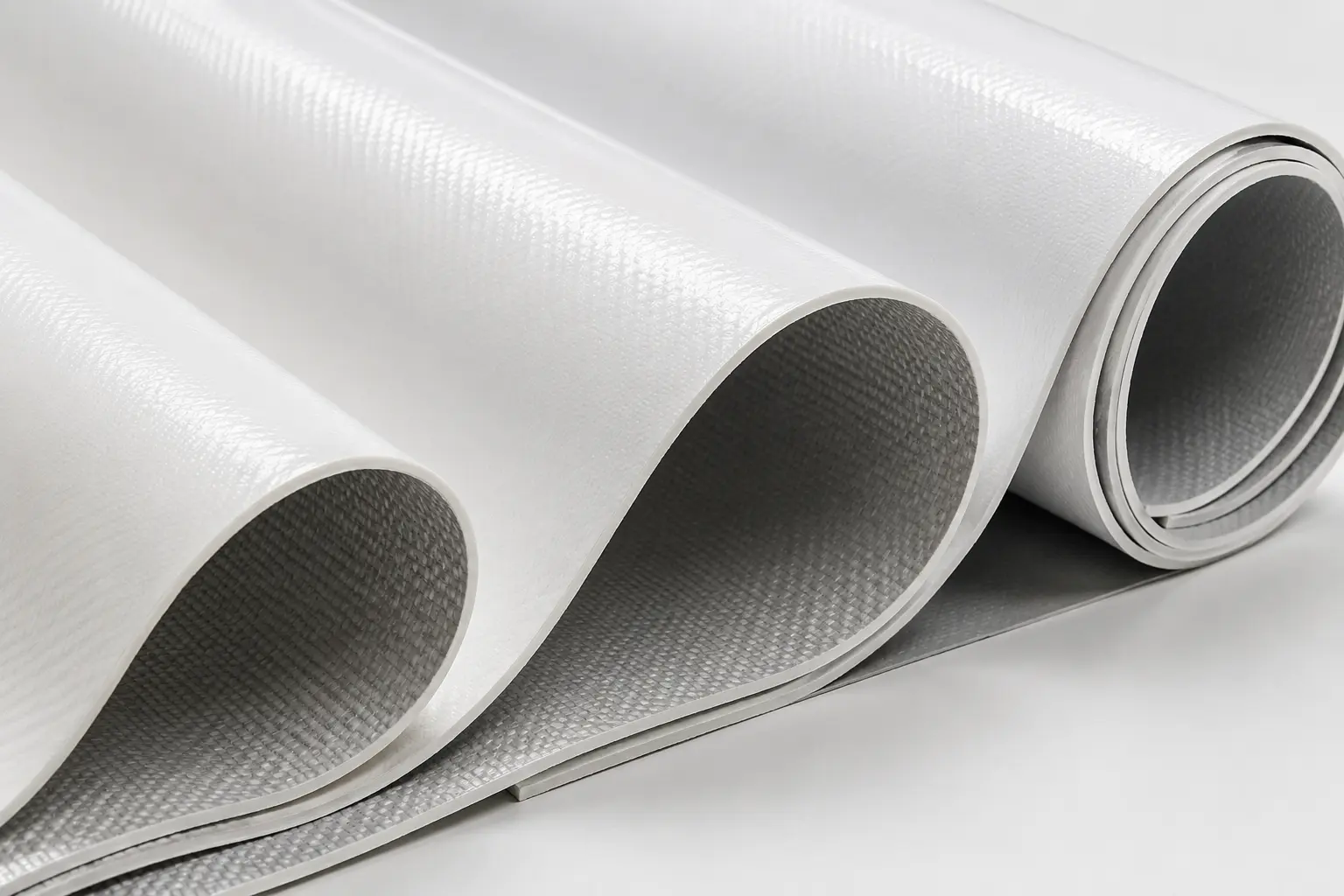
PVC-Coated Polyester Membrane
The workhorse architectural fabric — a woven polyester scrim coated both sides in PVC and finished with a surface lacquer. The polyester weave carries the load; the PVC waterproofs and protects it; the lacquer resists weather and dirt. Strong, flexible, high-frequency weldable, ships folded, and available in almost any colour. Typically quoted at 15–20 years, longer with a PVDF finish.
Reviewed by Mohd. Talib, Senior Design Manager · Last updated: 7 September 2026
- Woven polyester scrim, PVC-coated both sides
- Widest colour range, weldable, ships folded
- ~15–20 yr with acrylic lacquer; ~25 yr with a PVDF finish
- Flame-retardant, self-extinguishing — B-class, not non-combustible
What PVC-coated polyester is
A woven polyester scrim, coated on both faces with flexible PVC and finished with a thin surface lacquer. It is the most widely used architectural membrane in the world — strong, flexible, high-frequency weldable, available in almost any colour, and the lowest-cost of the coated fabrics. Most tensile canopies, car parks and walkways are built in it.
How it is built up
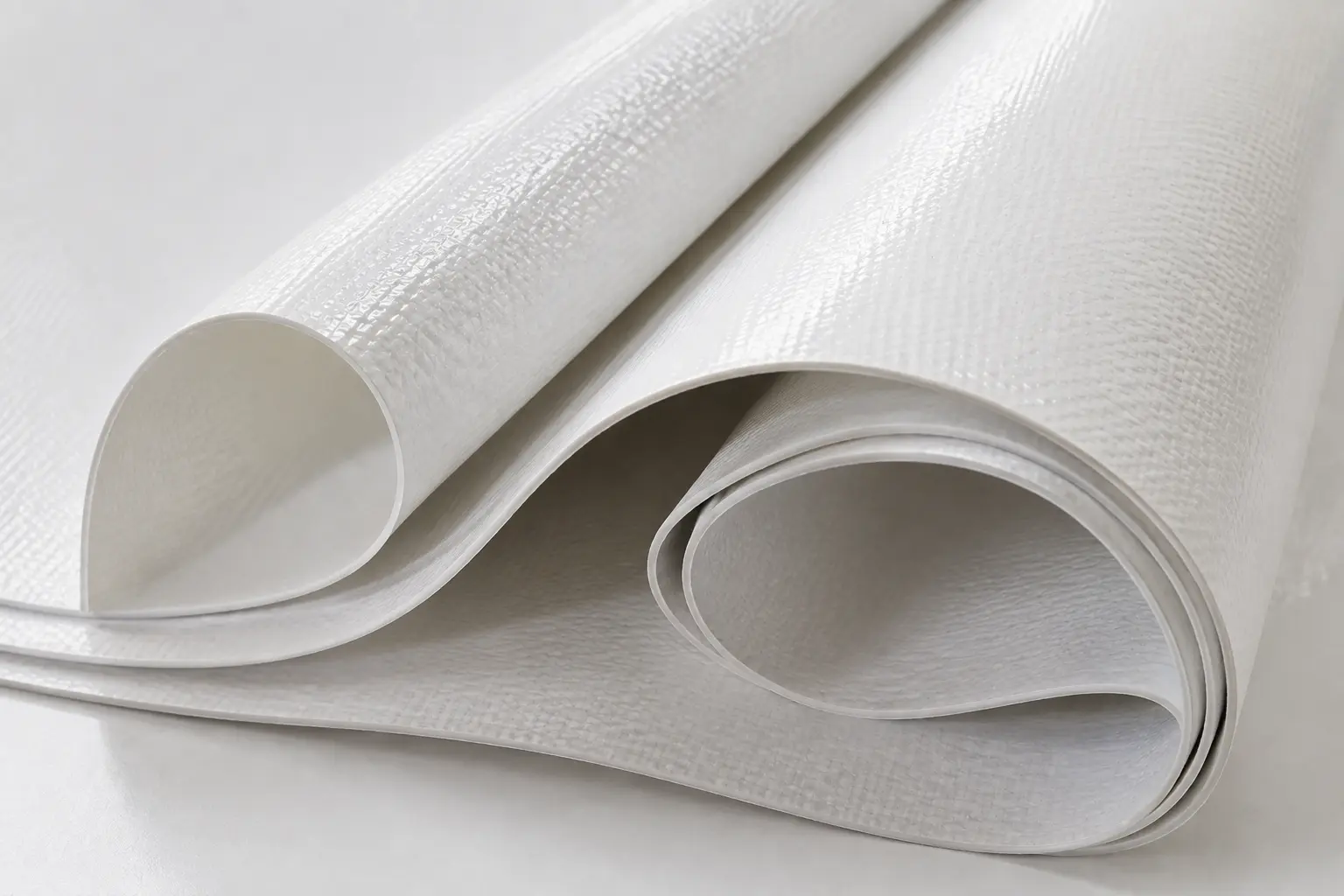
A high-tenacity polyester yarn is woven into the base cloth. PVC plastisol is knife- or dip-coated onto both faces and fused, sealing the weave and making it waterproof. A thin lacquer — acrylic, PVDF or PVF — is applied on top to resist UV, weathering and soiling. An adhesion primer is often used between the yarn and the PVC.
What each layer does
The polyester weave carries all the tension — it is strong, tough and impact-resistant, but it is a plastic yarn, so it has some creep and is UV-sensitive if unprotected. The PVC coating waterproofs the fabric, protects the yarn and gives the colour. The lacquer does no structural work — it is a sacrificial weathering layer that determines how long the surface stays clean and bright.
Why it is the default
It costs the least, fabricates the fastest, comes in every colour, folds for transport, welds into seams as strong as the parent fabric, and repairs with a patch. Its limits are a shorter life than PTFE, a B-class (not non-combustible) fire reaction, and slow plasticiser migration over decades — which is exactly what the lacquer topcoat is there to slow.
Physical characteristics (typical)
- Coated weight
- ~700–1,400 g/m² across Type I–V
- Base yarn
- High-tenacity woven polyester
- Tensile strength (strip)
- ~3,000–9,000 N/5cm warp & weft by type — manufacturer specified
- Light transmission
- ~5–15% by colour and weight, fully diffused
- Reaction to fire
- Commonly DIN 4102 B1 / EN 13501-1 B-s2,d0 or B-s3,d0 — flame-retardant, self-extinguishing, not non-combustible (verify the product)
- Design service life
- ~15–20 years with an acrylic lacquer; ~25 years and beyond with a PVDF finish
Ranges are typical industry figures for the material class. Actual values come from the datasheet for the specific product, grade and finish.
For the cross-material picture — PVC, PVDF, PTFE, ETFE and HDPE side by side — see the tensile fabric & membrane materials guide. The related materials have their own pages: PVDF-lacquered PVC, PTFE-coated fibreglass, ETFE film.
The Type I–V grade system
PVC-coated polyester is sold in weight-and-strength bands, conventionally numbered Type I to Type V. The band is chosen for the span and the loads — a small entrance canopy and a wide clear-span roof use the same material in different grades.
~700–900 g/m²
Light grade. Small canopies, shade sails, walkway bays, short spans and tight-radius shapes.
Lowest strength — not for wide spans or high wind zones.
~900–1,050 g/m²
The common general-purpose grade for car-park bays, gazebos and mid-size canopies.
Balanced — the default unless the span says otherwise.
~1,050–1,200 g/m²
Heavier grade for larger cantilevers, longer clear spans and higher design loads.
Stiffer to handle; slightly lower translucency.
~1,200–1,400+ g/m²
High-strength grades for the largest PVC spans, permanent commercial roofs and demanding wind or snow loads.
Heaviest, stiffest, highest cost within PVC.
Acoustic build-up
An outer membrane with an inner liner and an absorption layer in the cavity, for rain noise and reverberation.
A multi-layer system, not one fabric.
Opaque / blockout grade
An interlayer that stops light transmission entirely for projection surfaces and full-shade roofs.
No translucency, no interior glow.
The exact weight bands and the Type numbering vary between suppliers — some markets use a I–V scale, others a numbered product range. What matters at design stage is the strength, the finish and the fire class the project needs; the grade follows from the structural analysis.
The lacquer question: acrylic vs PVDF vs PVF
The lacquer is a thin surface layer, not the membrane — but it is what sets how long the roof stays clean and bright, and it is the single biggest lever on the life of a PVC structure.
Unlacquered PVC
Rarely used architecturally. The PVC surface picks up dirt and the plasticiser migrates faster — surface problems can show within a few years.
Lowest cost, shortest life.
Acrylic lacquer
The volume default. A clear acrylic coat that improves soiling and UV resistance and gives a ~15–20 year system life. Fully weldable.
Weathers faster than PVDF; gloss and colour fade sooner.
PVDF lacquer
A fluoropolymer topcoat — the self-cleaning and colour-retention standard for permanent work, pushing system life toward ~25 years, and renewable mid-life.
Costs more; welding needs a weldable PVDF grade or the topcoat removed at the seam.
PVF (fluorine) film
A laminated fluoropolymer film rather than a lacquer — the most durable surface on a PVC base, closest to PTFE in cleanliness.
Highest cost of the PVC finishes; specialist welding.
The PVDF-lacquered PVC page covers the fluoropolymer finish in detail — what it changes, the weldability constraint, and when the uplift over acrylic is worth it.
How the fabric carries load — and why it can’t be flat
Membrane fabric has no bending stiffness. It carries load only in tension, in the plane of the cloth, so a PVC roof works by being pulled taut into a doubly-curved shape that resists load from both directions.
The weave is the structure
Warp and weft polyester yarns carry the tension. They are strong and tough but not perfectly elastic — the fabric creeps slightly under sustained load, which the prestress and the patterning allow for.
Form-finding
The 3D shape is not drawn — it is found. Software relaxes a prestressed surface between the fixed boundaries until tension is uniform and the shape is in equilibrium.
Patterning & compensation
The curved surface is developed into flat panels. Each is cut slightly undersize (“compensation”) so it reaches the right size and shape only once stressed to its design prestress.
What is not published here
Prestress, panel stresses, cable and anchor forces are project-specific and come from a structural analysis to the applicable code — not from a generic figure.
From cloth to installed roof
PVC-polyester is the easiest architectural membrane to fabricate: it welds fast, folds for transport and patches simply. The care goes into the patterning and the weld quality.
Form-finding & load analysis
Design loads, prestress, boundary geometry, the primary steel — and the grade and finish of PVC that suit them.
Cutting patterns & compensation
The found surface is developed into flat panels, each compensated for the prestress and the fabric’s stretch.
Plotting & cutting
Panels are plotted and cut on a flat table, numbered and laid out in weld order.
Seam welding
Panels are joined by HF or hot-wedge welding. On a PVDF or PVF finish the topcoat is removed or a weldable grade is used at the seam. Every weld is peel-tested.
Edge & corner details
Keder cords, boltrope edges, webbing belts and reinforced corner plates are welded on for the clamp lines and corner fittings.
Folding & transport
The finished membrane is folded along planned lines and crated — compact and low-cost to ship, unlike PTFE.
Spreading & connecting
On site the membrane is unfolded, lifted and connected to the structure at the edges and corners.
Tensioning & handover
The membrane is stressed to its design prestress in a defined sequence, geometry and tension checked, and handed over with a maintenance plan.
Welding, not stitching
A stitched seam would leak and would fail before the fabric. PVC welds are thermally fused and develop the full strength of the parent material — the seam is not the weak point.
It folds
The big handling advantage over PTFE: PVC-polyester folds without damage, so it ships compact and installs without wide-core rolls or the same level of on-site care.
Repair
A tear or puncture is repaired with a welded patch, on site, in most weather. Acting early — before a defect runs under tension — is the key.
Colour & print
PVC takes pigment in the coating for any colour, and accepts printed graphics and digital print — used for branded canopies and feature roofs.
How PVC-polyester performs
Its case is cost, colour, speed and toughness. Its limits are life, fire class and long-term surface ageing — all of which the grade and the lacquer address to a point.
Light & colour
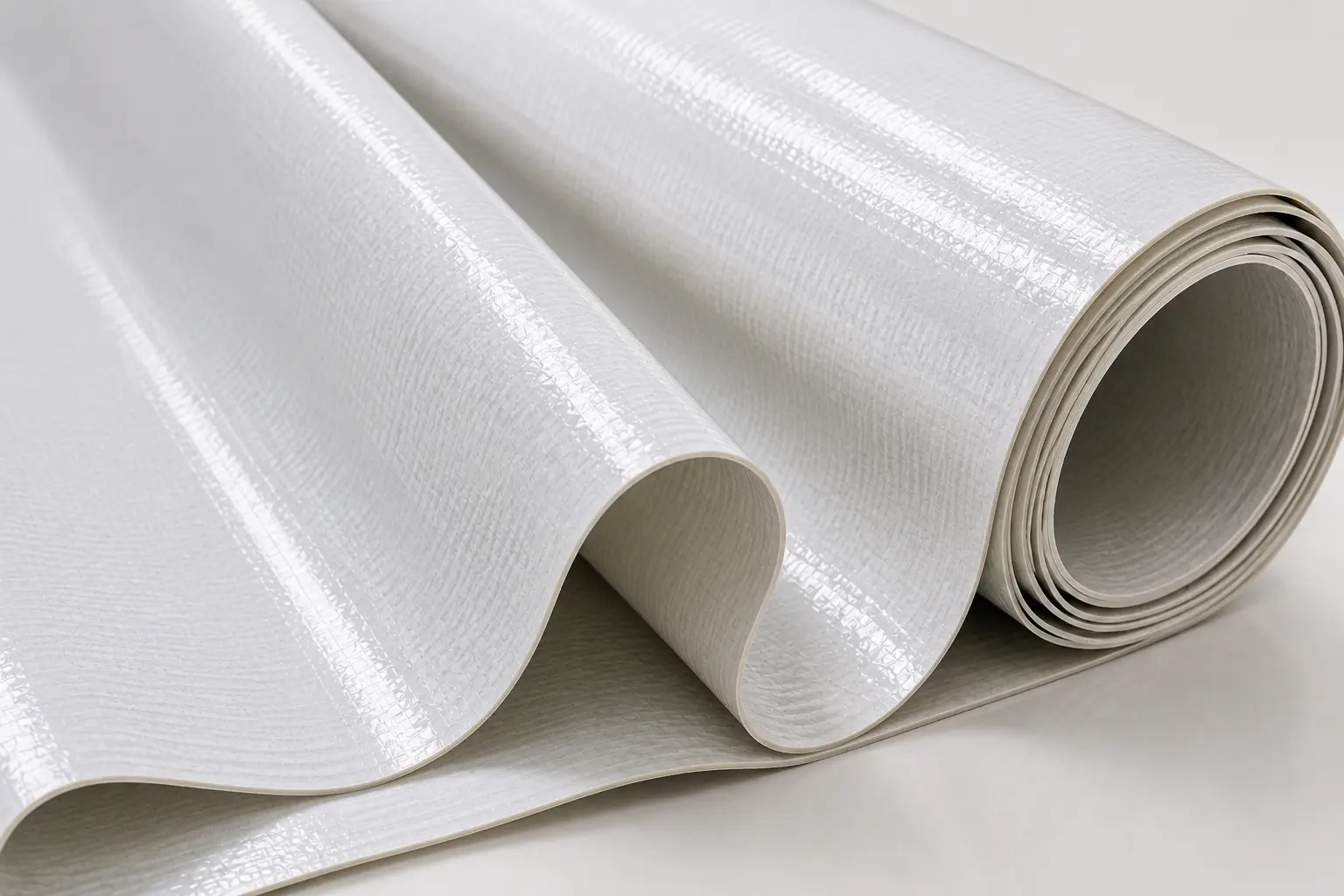
PVC-polyester transmits roughly 5–15% of daylight depending on colour and weight, fully diffused — a soft, even, shadow-free interior with no view of the sky. It has the widest colour range of any architectural membrane; a light tone reflects the most solar heat and gives the brightest interior, a dark tone the least. Blockout grades transmit nothing.
Solar & thermal
A light-coloured PVC roof reflects a large share of solar energy and keeps the space below cooler than a dark one. It is a single membrane, so for a controlled indoor temperature in a conditioned building a lined or insulated build-up is used. Colour choice is a real thermal decision, not just an aesthetic one.
Weather, UV & ageing
The lacquer resists UV and soiling; underneath, PVC slowly loses plasticiser over decades, which is what eventually stiffens and embrittles an old membrane. A PVDF or PVF finish slows both the soiling and the plasticiser loss, which is why it extends life. Pollution, coastal salt and standing dirt all shorten surface life — design and maintenance matter.
Fire
PVC-polyester is flame-retardant and self-extinguishing but combustible — typically DIN 4102 B1 / EN 13501-1 B-s2,d0 or B-s3,d0, and it usually passes NFPA 701. It will not sustain a flame once the source is removed, but it is not non-combustible. Where a building or fire code requires a non-combustible (A-class) reaction, PTFE-coated glass is the membrane to use. Verify the exact product classification against the project’s fire strategy.
Acoustics
Low mass, so little sound insulation; rain is audible on a taut roof and large volumes can be reverberant. Where acoustics matter, an acoustic build-up (liner plus absorption) or room design is the answer, not the membrane alone.
Durability & service life
Commonly ~15–20 years with an acrylic lacquer and ~25 years or more with PVDF, in temperate exposure. In hot, high-UV, polluted or coastal conditions expect the lower end unless the finish is upgraded. The structure, connections and maintenance often set the life of the roof as much as the membrane does.
Trade-offs — stated plainly
Shorter life than PTFE or ETFE. B-class, not non-combustible. Surface ages — plasticiser migration and lacquer weathering are real. Best value is on projects where a 15–25 year life, colour and low cost are the priority — which is most tensile work.
PVC-polyester vs PVDF, PTFE and ETFE — by application
PVC-polyester is the practical default for most tensile work — cost, colour, speed. Step up to PVDF for a longer-lasting finish on a permanent project, to PTFE for a decades-long non-combustible roof, or to ETFE for genuine transparency. This table is PVC-forward; the decision matrix turns it into a recommendation.
| Factor | PVC-polyester | PVDF-lacquered PVC | PTFE-coated glass | ETFE film |
|---|---|---|---|---|
| Construction | Woven polyester + PVC + lacquer | Same + PVDF fluoropolymer topcoat | Woven glass fibre + PTFE coating | Extruded fluoropolymer film |
| Relative cost (material + fab) | Lowest | Small uplift over PVC | Highest of the coated fabrics | High (system cost higher again) |
| Design service life | ~15–20 yr | ~20–25 yr | 25–30+ yr (roofs 40–50+ yr exist) | 25–30+ yr (system-dependent) |
| Reaction to fire | B-class, self-extinguishing | B-class, self-extinguishing | A2 — non-combustible | B-s1,d0 — combustible, self-extinguishing |
| Colour | Widest range of any membrane | Full range; better colour retention | White / off-white only | Clear or printed frit |
| Light transmission | ~5–15%, diffuse | ~5–12%, diffuse | ~7–20%, diffuse | ~88–95%, clear |
| Self-cleaning | Limited — needs washing | Good | Excellent | Good — sheds dirt in rain |
| Surface ageing | Lacquer weathers; plasticiser migrates | Both slowed by the fluoropolymer | Inert — effectively none | Inert — effectively none |
| Handling | Flexible — folds, ships compact | Flexible — folds | Brittle — no folds, ships rolled | Delicate film — ships rolled |
| Welding / fabrication | Fast HF / hot-wedge welding | Weldable grade or strip the topcoat | Specialist heat welding, exacting | Film heat-welding + aluminium framing |
| Impact / toughness | Good — tough polyester base | Good | Brittle to sharp folds | Low — keep out of reach |
| Lead time | Shortest | Short–medium | Longest | Long |
| Best at | Everyday canopies & shade, colour, budget, speed | Longer-life permanent commercial & civic work | Permanent, large-span, non-combustible white roofs | Transparent, ultra-light envelopes |
| Weakest at | Longevity, self-cleaning, fire class | Upfront cost vs plain PVC | Cost, colour, handling | Cost, acoustics, impact, opacity |
Ranges are typical industry figures for the material class. See the dedicated pages: PVDF-lacquered PVC, PTFE-coated fibreglass, ETFE film.
Which membrane suits which application
| Application | PVC | PVDF | PTFE | ETFE |
|---|---|---|---|---|
| Car-park / forecourt canopy | Excellent | Good | Over-spec | No |
| Covered walkway | Excellent | Good | Good | Conditional |
| Gazebo / pavilion (coloured) | Excellent | Good | No (white only) | No |
| Sports / assembly cover | Good | Good | Excellent | Good |
| Permanent commercial canopy | Good | Excellent | Good | Conditional |
| Civic / landmark roof | Conditional | Good | Excellent | Good |
| Stadium / large-span roof | Conditional | Conditional | Excellent | Good |
| Non-combustible roof required | No | No | Excellent | No |
| Transparent / view-through roof | No | No | No | Excellent |
| Branded / printed roof | Excellent | Good | No | Conditional (frit) |
| Temporary / demountable structure | Excellent | Good | No | No |
| Tight budget / fast programme | Excellent | Good | No | No |
Choose PVC-polyester when
The project is an everyday canopy, car park, walkway or shade structure; a 15–25 year life is acceptable; colour or branding matters; the budget or the programme is tight; the structure may be relocated or demounted; or the fabric needs to be tough against impact and easy to repair.
Looking after a PVC membrane
A PVC roof needs a little more attention than PTFE — the surface is not fully self-cleaning — but the maintenance is simple and the repairs are easy.
- Visual inspection for tears, abrasion, ponding, slack areas and any lifted seam — typically annually and after severe weather.
- Seam check — welded seams and edge welds for any peeling or damage.
- Corners & clamps — corner plates, boltropes, clamp bars and bolts for movement or loss of tension.
- Cables & prestress — edge and ridge cables, turnbuckles and the overall tautness of the surface.
- Cleaning — a periodic wash with water and a mild detergent, more often in polluted or coastal areas; no abrasives or solvents.
- Drainage — valleys and low points kept clear so water runs off and does not pond.
- Topcoat condition — on older membranes, checking whether a re-lacquer is worthwhile before the PVC itself ages.
- Records — inspection findings kept so slow changes are caught early.
Minor damage
A cut or puncture is repaired with a welded patch on site, in most weather. Early action stops a small defect running under tension.
Larger damage
A failed seam or widespread abrasion is handled by replacing the affected welded panel — straightforward on a PVC membrane.
Re-lacquering
A weathered but sound membrane can sometimes be re-lacquered in place to reset the surface life — cheaper than replacement where the PVC is still good.
End of life
PVC-polyester can be mechanically recycled into lower-grade products through take-back schemes; separating the PVC from the polyester is the limiting step.
What drives the cost of a PVC membrane
PVC-polyester is the lowest-cost architectural membrane, and the fabric is usually a minority of a tensile-structure quote — the steel and the installation dominate. What moves the fabric line:
Upfront
The cheapest membrane and the fastest to fabricate. A PVDF finish is a modest uplift; a premium brand such as Serge Ferrari sits above commodity PVC; a heavier Type IV–V grade costs more per m²; an acoustic or lined build-up is a step change because it is really several layers. See what determines the fabric price.
Life-cycle
Lower capex, but a shorter life and periodic cleaning. Over 25–30 years a plain PVC roof may need re-lacquering or replacing where a PVDF or PTFE roof would not — which is the whole-life case for spending more upfront on a permanent building.
See the tensile structure cost guide for how membrane, steel and installation split in a typical quote.
Where PVC-polyester is used
PVC-coated polyester is the default for most tensile work — wherever colour, cost and speed matter and a 15–25 year life is acceptable.
Car-park & forecourt canopies
Column-free cantilevers over parking bays — see car-parking tensile shades.
Covered walkways
Continuous weatherproof routes between buildings — see walkway tensile structures.
Gazebos & pavilions
Conical and hypar structures in a chosen colour — see gazebo tensile structures.
Sports & assembly covers
Clear-span roofs over courts and grounds — see auditorium roofs.
Commercial & event canopies
Entrance, courtyard and event canopies where colour and cost matter.
Waterproof shade structures
Full shade that also sheds rain — see tensile shade structures.
Where PVC-polyester fits in Ekra Decor’s work
PVC-coated polyester is the membrane behind most of the canopies, car parks, walkways and gazebos Ekra Decor designs, fabricates and installs. We specify the grade from the structural analysis and the finish from the project’s life expectancy — acrylic for standard work, PVDF where the surface has to stay clean for longer.
Membrane selection is made per project, so the portfolio spans PVC, PVDF and PTFE. The structures on this site are documented by type and scope; we do not label a roof’s membrane grade unless it is recorded for that project.
Typical PVC-polyester technical data
Industry-typical ranges for the material class. Confirm every value against the datasheet for the specific product, grade and finish — and do not combine figures from different products.
| Property | Typical value | Unit | Basis |
|---|---|---|---|
| Coated weight (Type I–V) | ~700–1,400 | g/m² | Grade-specific |
| Total thickness | ~0.7–1.4 | mm | Grade-specific |
| Strip tensile strength | ~3,000–9,000 | N/5cm, warp & weft | Manufacturer specified, by type |
| Light transmission | ~5–15 | % | Colour- & weight-dependent, diffuse |
| Reaction to fire | DIN 4102 B1 / EN 13501-1 B-s2,d0–B-s3,d0; NFPA 701 pass | class | Verify per product |
| Design service life — acrylic lacquer | ~15–20 | years | Temperate exposure |
| Design service life — PVDF finish | ~25+ | years | Temperate exposure |
| Temperature range | Manufacturer specified | — | Product datasheet |
| Tear strength, adhesion, elongation | Manufacturer specified | — | Datasheet per product & grade |
Sources for the ranges above include published architectural-membrane data from PVC-fabric manufacturers and topcoat suppliers. They are orientation for early design, not specification values.
PVC-coated polyester — FAQ
The questions specifiers and clients ask about PVC architectural membrane.
An architectural membrane made of a woven polyester scrim coated both sides in flexible PVC and finished with a surface lacquer. The polyester carries the load; the PVC waterproofs and colours it; the lacquer resists weather and dirt.
A coated fabric — a woven polyester textile is the structural base and PVC is the coating. That makes it different from ETFE, which is a film with no weave.
A high-tenacity polyester yarn is woven into a base cloth. PVC plastisol is knife- or dip-coated onto both faces and fused to seal the weave, then a thin lacquer — acrylic, PVDF or PVF — is applied on the outer face for UV and soil resistance.
Weight-and-strength bands, roughly 700 to 1,400 g/m squared, from light grades for small canopies and shade sails to heavy grades for large spans and high loads. The exact bands and the numbering vary by supplier; the grade is chosen from the structural analysis.
Commonly about 15 to 20 years with an acrylic lacquer, and about 25 years or more with a PVDF finish, in temperate exposure. Hot, high-UV, polluted or coastal conditions shorten that unless the finish is upgraded. The structure and maintenance often set the roof's life as much as the membrane.
It is a sacrificial surface layer, not part of the structure. It slows soiling, UV attack and — with a fluoropolymer lacquer — the plasticiser migration that eventually ages the PVC. The lacquer choice is the biggest single lever on how long a PVC roof stays clean and bright.
Acrylic is the volume default — it gives a roughly 15 to 20 year system life and is fully weldable. PVDF is a fluoropolymer topcoat that keeps the surface cleaner for longer, retains colour and gloss better, and pushes system life toward 25 years, at a higher cost and with a welding constraint. See the PVDF page for detail.
Yes, once the seams are high-frequency welded into a continuous membrane. It sheds rain completely and blocks almost all UV from reaching the space below.
Typically DIN 4102 B1 / EN 13501-1 B-s2,d0 or B-s3,d0, and it usually passes NFPA 701 — flame-retardant and self-extinguishing, but combustible. Where a non-combustible A-class reaction is required, PTFE-coated glass is used instead.
It has the widest colour range of any architectural membrane, plus printed graphics and digital print. A light colour reflects the most solar heat and gives the brightest diffuse interior; a blockout grade transmits no light at all.
Roughly 5 to 15 percent depending on colour and weight, fully diffused — a soft, even, shadow-free interior with no view of the sky. Darker colours and blockout grades transmit less or nothing.
By high-frequency or hot-wedge welding: the PVC coatings of the overlapped panels melt and fuse into a continuous, waterproof seam that is as strong as the parent fabric. Not stitched, not glued.
Yes — it is flexible and folds along planned lines without damage, so it ships compact and installs more simply than PTFE-glass, which must be rolled on wide cores.
Yes. Small tears and punctures are patch-welded on site in most weather. Larger damage or a failed seam is handled by replacing the affected welded panel. A weathered but sound membrane can sometimes be re-lacquered in place.
It can be mechanically recycled into lower-grade products through manufacturer take-back schemes. Separating the PVC from the polyester base is the limiting step, so recycling rates depend on the local scheme.
Yes — it is the most common membrane for canopies, car parks and walkways across the country. In hot, high-UV or coastal locations a PVDF finish is worth the uplift for surface life, and the design must handle monsoon drainage and wind loads.
PVDF where the finish must stay clean and bright for longer on a permanent commercial or civic project. PTFE where a 25 to 30+ year life or a non-combustible A-class fire class is required. For genuine transparency, ETFE.
For most tensile work — everyday canopies, car parks, walkways, coloured or temporary structures, tight budgets and fast programmes — yes. For permanent landmark roofs, non-combustible requirements or transparency, a step up to PVDF, PTFE or ETFE is the better answer.
Planning a canopy, car park or walkway?
Send the span, the site and the intended life. An engineer reviews it and advises the PVC grade and finish — or whether PVDF, PTFE or ETFE fits the brief better.
Let’s Build Your Structure
Speak directly with our structural engineering team to discuss your project dimensions, material options, or to schedule a free on-site technical inspection across India.
- 28+Years experience
- Pan-IndiaTurnkey execution
- ISO9001:2015 certified
Request an itemised price quote
Fill in your requirements below for a free engineering assessment & itemised estimate.
* required — everything else is optional
Your details are used only to respond to this enquiry.
Chat with an Engineer on WhatsApp