

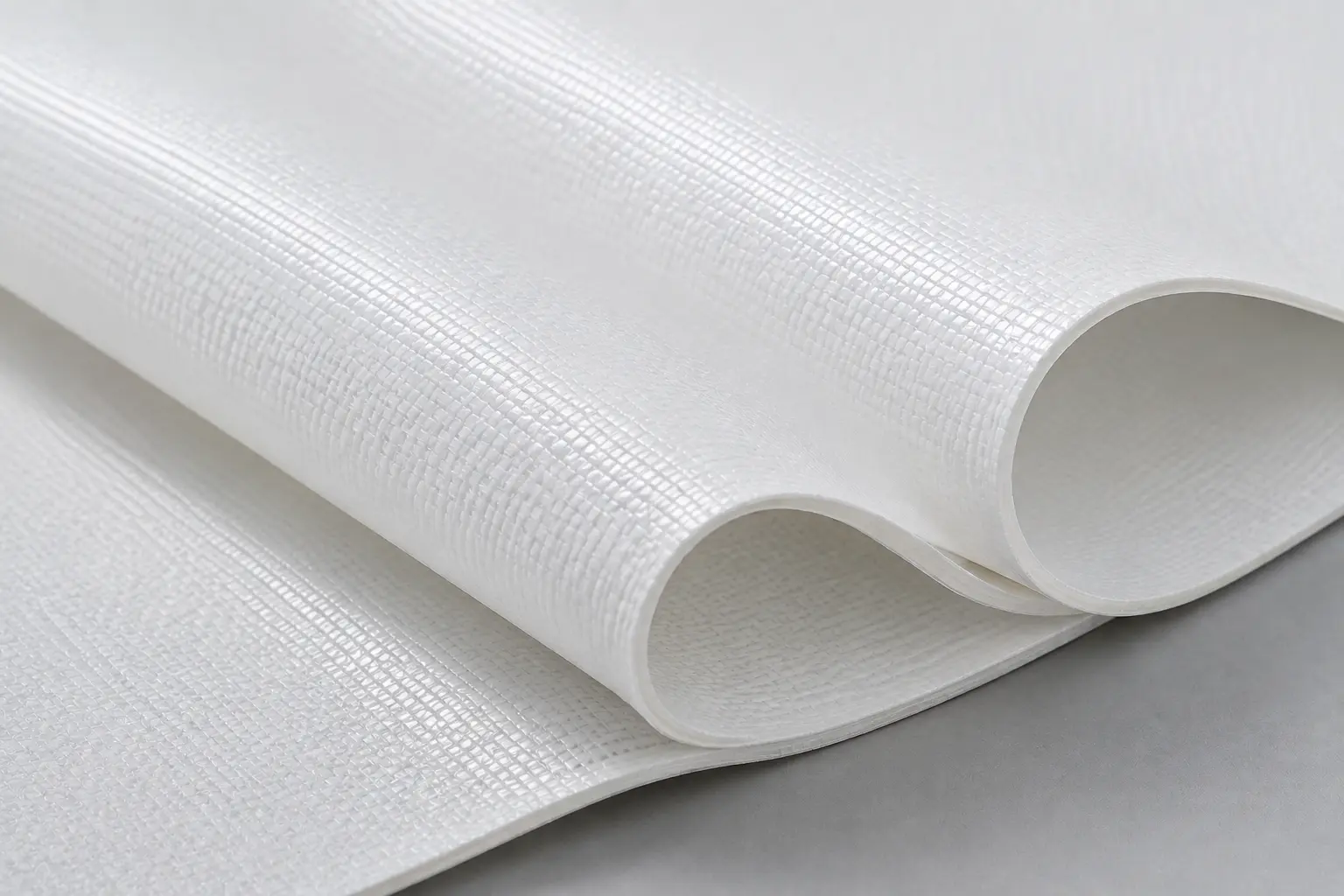
PTFE-Coated Fibreglass Membrane
A woven glass-fibre cloth fully encapsulated in PTFE — the same fluoropolymer as non-stick coatings. The glass weave carries the load; the PTFE makes it inert, weather-stable and self-cleaning. Non-combustible to EN 13501-1 A2, with a design service life generally quoted at 25–30 years and beyond. The membrane of choice for permanent, large-span and non-combustible roofs.
Reviewed by Mohd. Talib, Senior Design Manager · Last updated: 7 September 2026
- Glass-fibre base, fully PTFE-encapsulated
- Non-combustible — EN 13501-1 A2-s1,d0
- Design life 25–30+ yr; earliest roofs now 40–50+ yr old
- White / off-white only
What PTFE-coated fibreglass is
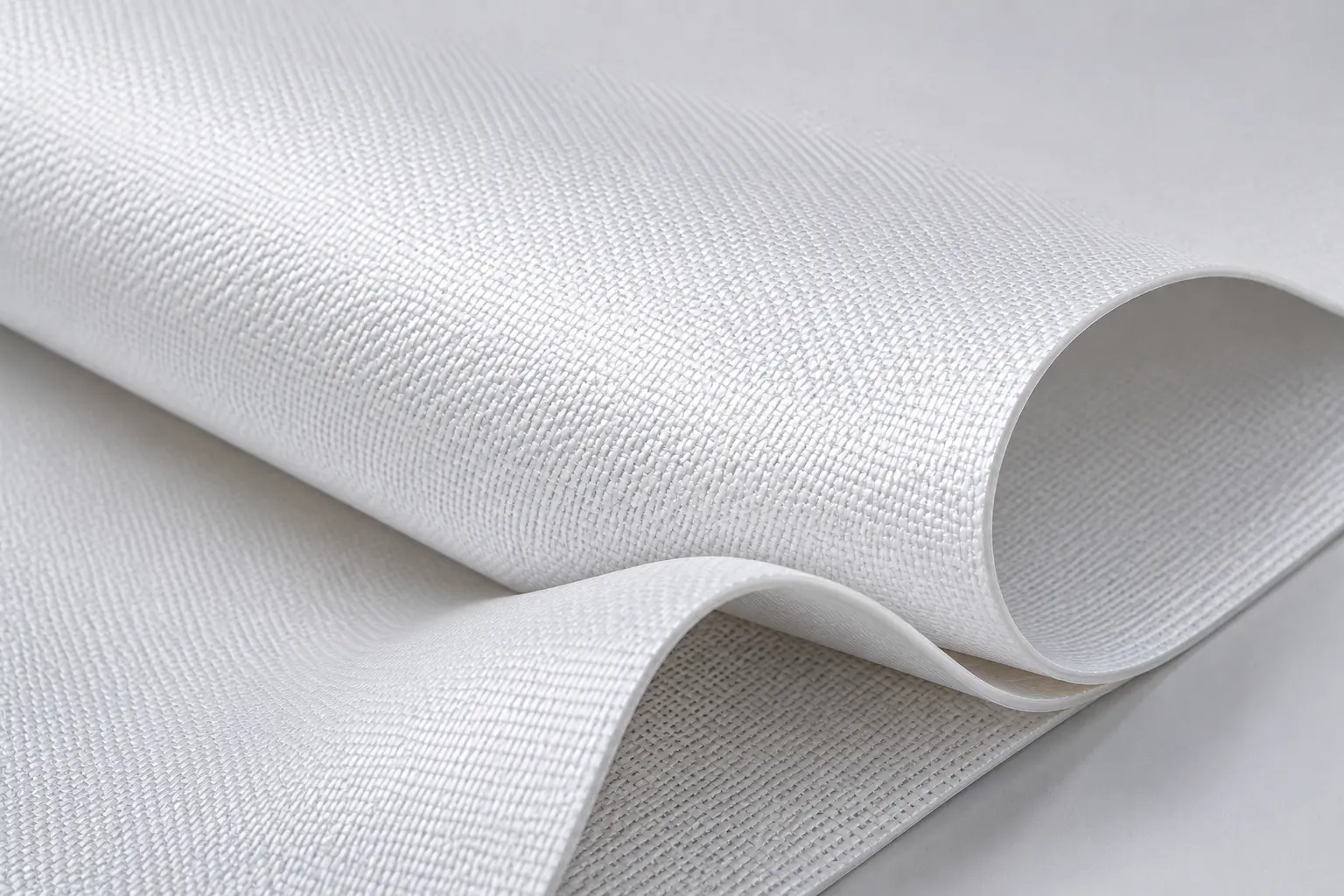
A woven glass-fibre cloth sealed inside polytetrafluoroethylene — the same fluoropolymer as non-stick cookware coatings. The glass weave is the structure; the PTFE is a continuous, chemically inert film fused onto and into it. It is the longest-lived and only genuinely non-combustible material in common architectural-membrane use.
How it is built up
Fine continuous glass filaments are twisted into yarns and woven into a base cloth. The cloth is then drawn repeatedly through a PTFE dispersion and sintered at high temperature after each pass, so the coating fuses into a continuous film that encapsulates every fibre. The number of coats and the base-cloth weight set the grade.
What each part does
The glass weave carries all the tension — it is strong, dimensionally stable and does not creep or degrade under UV. The PTFE film does no structural work: it seals the glass against water and abrasion, gives the surface its very low friction (hence the self-cleaning) and its chemical inertness, and provides the fire performance.
Why it is not just "a better PVC fabric"
PVC-coated polyester uses a flexible polyester weave and a soft PVC coat — it folds, takes colour and welds easily. PTFE-glass uses a stiff, brittle mineral weave and a hard fluoropolymer film — it cannot be sharply folded, comes in white only, and needs specialist welding, but it lasts far longer and will not burn.
Physical characteristics (typical, standard grade)
- Total coated weight
- ~800–1,600 g/m² by grade; ~1,100 g/m² is a common standard
- Thickness
- ~0.6–1.0 mm (grade-dependent)
- Tensile strength (strip)
- Standard grade around 3,500–7,000 N/5cm warp & weft; higher grades more — manufacturer specified
- Light transmission
- ~7–20% by grade; commonly ~12–17%, fully diffused
- Solar reflectance
- ~70–75% for a clean white surface
- Reaction to fire
- EN 13501-1 A2-s1,d0 (non-combustible); passes NFPA 701; no melting, no flaming droplets — verify the exact product
- Design service life
- Commonly quoted 25–30+ years; the earliest PTFE roofs are now 40–50+ years old and in service
Ranges are typical industry figures for the material class. Actual values come from the datasheet for the specific product and grade, confirmed against the project’s structural and fire requirements.
For the cross-material picture — PVC, PVDF, PTFE, ETFE and HDPE side by side — see the tensile fabric & membrane materials guide. The alternatives have their own pages: PVC-coated polyester, PVDF-lacquered PVC, ETFE film.
PTFE-glass is a family of grades, not one fabric
The base-cloth weight and the coating build are chosen for the span, the loads and the light target. A canopy and a stadium roof use different grades of the same material.
Lightweight grade
Lower base-cloth weight, thinner build. Higher light transmission, easier to handle, for smaller spans and feature roofs.
Lower strength — not for the largest spans.
Standard architectural grade
The common choice — around 1,100 g/m², balanced strength, life and translucency. Most permanent roofs use this.
White only, like all PTFE-glass.
Heavy / high-strength grade
Heavier base cloth and more coats for the largest clear spans, stadiums and high-load roofs.
Stiffer, heavier to install, higher cost.
Low-emissivity / solar-control grade
A metallised or modified surface layer that lowers solar gain and radiant heat transfer for hot climates and conditioned spaces.
Changes the appearance; product-specific.
Acoustic build-up
PTFE-glass outer with an inner liner membrane and an insulation/absorption layer in the cavity, for rain noise and reverberation control.
A multi-layer system, not a single fabric — more cost and detailing.
Insulated build-up
Outer PTFE-glass, an air/insulation cavity and a liner, to give a usable U-value for enclosed, heated or cooled buildings.
Reduces translucency; adds weight and layers.
Grade names vary by manufacturer. What matters at design stage is the combination of strength, translucency, solar performance and fire class the project needs — the grade follows from that.
How the fabric carries load — and why it can’t be flat
Membrane fabric has no bending stiffness. It only carries load in tension, in the plane of the cloth, so a PTFE roof works by being pulled taut into a doubly-curved shape that resists loads from both directions.
The weave is the structure
Warp and weft glass yarns carry the tension. They are strong and stable, but the weave has different stiffness in the two directions, which the patterning and the prestress have to account for.
Form-finding
The 3D shape is not drawn — it is found. Software relaxes a prestressed surface between the fixed boundaries until tension is uniform and the shape is in equilibrium. That shape then drives everything downstream.
Patterning & compensation
The curved surface is developed into flat panels. Each panel is cut slightly undersize (“compensation”) so that when it is stressed to its design prestress it reaches the right size and shape.
What is not published here
Prestress levels, panel stresses, cable forces and anchor loads are all project-specific and come from a structural analysis to the applicable code — never from a generic figure.
From cloth to installed roof
PTFE-glass is welded, not sewn, and it is unforgiving of a sharp crease. The workshop and site sequence is built around protecting the coating and the glass.
Form-finding & load analysis
Design loads, prestress, boundary geometry and the primary steel or cable structure — and the grade of PTFE-glass that suits them.
Cutting patterns & compensation
The found surface is developed into flat panels, each compensated so it reaches size and shape only once stressed.
Plotting & cutting
Panels are plotted and cut on a flat table, kept clean and free of any hard crease from the moment the roll is opened.
Seam welding
Panels are joined by heat-and-pressure welding — the PTFE films are fused across the seam. Seam strength and width are set by the grade and the design forces; every seam is checked.
Edge & corner details
Keder cords, webbing belts and reinforced corner plates are welded on for the clamp lines and the high-load corner fittings.
Rolling & transport
The finished membrane is rolled onto a wide-diameter core — never folded — and crated. A sharp fold fractures glass fibres and is a permanent defect.
Lifting & spreading
On site the membrane is unrolled, lifted and spread across the structure in clean, dry, low-wind conditions, protected from tools and footwear throughout.
Tensioning & clamping
The membrane is stressed to its design prestress in a defined sequence, clamped along the edges, and the corners fixed. Geometry and tension are checked before handover with a maintenance plan.
Welding, not stitching
PTFE-glass seams are thermally fused, not sewn — a stitched seam would leak and would not develop the strength. It is a specialist process with tighter tolerances than PVC welding.
The no-sharp-fold rule
The glass base is brittle. Any hard crease breaks fibres along the fold line and creates a permanent weak point. This is why PTFE ships rolled, costs more to transport, and is handled slowly on site.
Attachment to the structure
Aluminium clamp plates on keder edges, plate-and-pin corner castings, and catenary or fixed edges to the primary steel or cables. The membrane connects mechanically — nothing is bonded to the frame.
Appearance over time
PTFE-glass leaves the factory a pale cream and bleaches to bright white in the first months of UV exposure, then stays white because the surface self-cleans. It looks newer with age, not older.
How PTFE-glass performs
Its case rests on four things: it will not burn, it lasts for decades, it stays clean, and it turns a bright roof into soft daylight. Its limits are acoustic mass, colour and cost.
Fire — A2, non-combustible
Both the glass base and the PTFE film are non-combustible. Products are typically classified EN 13501-1 A2-s1,d0 and pass NFPA 701: the membrane does not ignite, does not melt, adds no fuel to a fire and produces no flaming droplets. This is the reason PTFE-glass is specified for assembly occupancies, escape routes and buildings whose codes demand a non-combustible reaction — where PVC, PVDF and ETFE (all B-class, self-extinguishing) are not accepted. Always verify the exact product classification against the project’s fire strategy.
Light & night appearance
PTFE-glass transmits roughly 7–20% of daylight depending on grade — commonly around 12–17% — and diffuses all of it, so the interior is evenly lit and shadow-free with no view of the sky. At night, uplighting the membrane makes the whole roof glow, which is often part of the architecture.
Solar & thermal
A clean white PTFE surface reflects about 70–75% of incident solar energy and absorbs very little, so an uninsulated PTFE roof runs cool and re-radiates little heat downward — useful in hot climates. It is still a single membrane: for a controlled U-value in a heated or cooled building, an insulated or lined build-up is used, which trades away some translucency. Low-emissivity grades reduce radiant gain further.
Weather, UV & self-cleaning
PTFE is chemically inert and essentially unaffected by UV, ozone, pollution and salt air — the surface chemistry that limits PVC does not apply. The low-friction surface is hydrophobic, so rain lifts and carries away most airborne dirt and the roof stays white with little intervention. Decades of installed roofs in a wide range of climates support the long-life claims.
Acoustics
Like all single membranes, PTFE-glass has low mass and gives little sound insulation; rain on a taut roof is audible and large volumes can be reverberant. Where acoustics matter, an acoustic build-up (liner plus absorption) or room design — not the membrane alone — is the answer.
Durability & real service life
Manufacturers quote 25–30 years and more; the earliest PTFE-glass roofs, from the 1970s, are 40–50+ years old and still in service. In practice the membrane rarely sets the life of the roof — handling damage, seam condition, connections and the supporting structure usually do. Any lifespan figure should be tied to a named product, a specification and an exposure.
Trade-offs — stated plainly
White only, no pigmented colour. Brittle glass base — no sharp folds, careful handling, higher logistics cost. Highest material and fabrication cost of the common membranes. Longer lead times. Not an acoustic or an insulation solution on its own.
PTFE-glass vs PVC, PVDF and ETFE — by application
PTFE-glass is the permanent, non-combustible, long-span membrane. It is not the right choice for everyday shade, tight budgets, coloured roofs or short-life structures — the coated polyesters and ETFE each own a different part of the picture. This table is PTFE-forward; the decision matrix below turns it into a recommendation.
| Factor | PTFE-coated glass | PVC-polyester | PVDF-lacquered PVC | ETFE film |
|---|---|---|---|---|
| Construction | Woven glass fibre + PTFE coating | Woven polyester + PVC coating | Woven polyester + PVC + PVDF lacquer | Extruded fluoropolymer film |
| Base does the structure | Yes — glass weave | Yes — polyester weave | Yes — polyester weave | No — needs net or air |
| Reaction to fire | A2-s1,d0 — non-combustible | B / Class 2, self-extinguishing | B / Class 2, self-extinguishing | B-s1,d0 — combustible, self-extinguishing |
| Design service life | 25–30+ yr (roofs 40–50+ yr exist) | ~15–20 yr | ~20–25 yr | 25–30+ yr (system-dependent) |
| Light transmission | ~7–20%, diffuse | ~5–15%, diffuse | ~5–12%, diffuse | ~88–95%, clear |
| Colour | White / off-white only | Full range | Full range | Clear or printed frit |
| Solar reflectance (white) | ~70–75% | ~60–75% by colour | ~70–80% white | Low — transparent |
| Self-cleaning | Excellent | Limited — needs washing | Good | Good — sheds dirt in rain |
| UV / chemical resistance | Outstanding — inert | Good; plasticiser loss over time | Very good | Outstanding |
| Handling | Brittle — no sharp folds, ships rolled | Flexible — folds, ships compact | Flexible — folds | Delicate film — ships rolled |
| Welding / fabrication | Specialist heat welding, exacting | Fast RF / hot-wedge welding | Fast RF / hot-wedge welding | Film heat-welding + aluminium framing |
| Acoustic mass | Low–moderate | Low | Low | Very low |
| Relative cost (material + fab) | Highest of the coated fabrics | Lowest | Medium | High (system cost higher again) |
| Lead time | Longest | Shortest | Short–medium | Long |
| Best at | Permanent, large-span, non-combustible white roofs | Everyday canopies & shade at low cost | Long-life commercial & civic work | Transparent, ultra-light envelopes |
| Weakest at | Cost, colour, acoustics, handling | Longevity, self-cleaning | Upfront cost vs PVC | Cost, acoustics, impact, opacity |
Ranges are typical industry figures for the material class. See the dedicated pages: PVC-coated polyester, PVDF-lacquered PVC, ETFE film.
Which membrane suits which application
| Application | PTFE-glass | PVC / PVDF | ETFE |
|---|---|---|---|
| Stadium / arena roof | Excellent | Conditional | Good |
| Airport terminal roof | Excellent | Conditional | Good |
| Civic / cultural landmark | Excellent | Good | Good |
| Non-combustible roof required | Excellent | No | No |
| Large permanent industrial roof | Excellent | Good | Conditional |
| Long-span atrium (diffuse light) | Excellent | Good | Good |
| Transparent / view-through roof | No | No | Excellent |
| Shopping-mall skylight | Good | Good | Excellent |
| Entrance canopy / porte-cochere | Good | Excellent | Conditional |
| Everyday car-parking shade | Conditional (over-spec) | Excellent | Not first choice |
| Coloured / branded roof | No | Excellent | Conditional (frit) |
| Temporary / short-term structure | No | Excellent | Not first choice |
| Tight budget | No | Excellent | No |
Choose PTFE-glass when
The structure is permanent (measured in decades); the fire code requires a non-combustible reaction; the span is large and the design life is specified from the outset; a bright, self-cleaning white roof that stays white is wanted; the building is a landmark where lowest whole-life cost and appearance over time outweigh upfront price.
Choose another membrane when
The roof needs colour or branding (PVC/PVDF); the budget or the programme is tight (PVC); the structure is temporary or demountable (PVC); genuine transparency is the point (ETFE); or the project is an everyday shade canopy or car park where PTFE’s life and fire class are more than the brief needs.
Looking after a PTFE-glass roof
The membrane needs very little. Most of the maintenance is checking the things around it — connections, cables, drainage — and an occasional wash of the areas rain misses.
- Visual inspection of the membrane for abrasion, impact marks, ponding and any slack area — typically annually and after severe weather.
- Seam check — welded seams and edge welds for any lifting, delamination or damage.
- Corners & clamps — corner castings, clamp plates and bolts for movement, corrosion or loss of torque.
- Cables & prestress — edge and ridge cables, turnbuckles and the overall tension of the surface.
- Primary structure — steel connections and protective coatings.
- Drainage — valleys, low points and outlets kept clear so water runs off as designed.
- Cleaning — rain does most of it; an occasional gentle wash of sheltered areas with water and a soft method, no abrasives or solvents.
- Records — inspection findings kept so slow changes are caught early.
Minor damage
A small cut or puncture is repaired by welding a matching PTFE-glass patch over the sound fabric — done in place on accessible areas.
Larger damage or a failed seam
Handled by replacing the affected panel. Because panels are welded, a full-panel replacement is a specialist job but a well-understood one.
Fittings & cables
Clamps, gaskets, turnbuckles and cables are replaceable components with their own service intervals, independent of the membrane.
End of life
PTFE-glass is not readily recycled like a thermoplastic; removed membrane is generally disposed of, while the steel and aluminium are recycled. Its long life is the main environmental argument.
What drives the cost of a PTFE-glass roof
PTFE-glass is the most expensive architectural membrane, in both material and fabrication — a step change over PVDF. There is no universal rate; each roof is priced as an engineered system.
Upfront
Higher than PVC or PVDF for the membrane itself, higher again for the slower specialist fabrication, and the brittle-handling logistics add cost. On a large-span roof the primary steel is still usually the largest single line.
Life-cycle
Against the higher capex: a 25–30+ year (often far longer) life with no recoating, near-zero cleaning cost, a stable appearance, and no mid-life membrane replacement. Over a landmark building’s life PTFE-glass is frequently the lower-cost choice — but that depends on the project and the discount rate.
See the tensile structure cost guide for how membrane, steel and installation split in a typical quote.
Where PTFE-glass is used
PTFE-glass is chosen where the structure is permanent, large-span, or has to meet a non-combustible fire class.
Airports & transit
Terminal roofs, forecourt canopies and interchange structures — permanent, A-class, decades of life.
Stadiums & arenas
Wide-span roofs over bowls and stands — see auditorium & stadium roofs.
Civic & cultural landmarks
Structures meant to define a place for a generation, where appearance over time matters.
Large industrial & logistics roofs
Very large clear-span covered areas — see tensile roofing.
Assembly & escape-route occupancies
Wherever the building or fire code requires a non-combustible reaction to fire.
Long-span diffuse-daylight halls
Exhibition, sports and worship spaces lit softly and evenly through the roof.
Where PTFE-glass fits in Ekra Decor’s work
Ekra Decor engineers, fabricates and installs tensile membrane structures on one in-house basis, and specifies PTFE-coated fibreglass where a project’s design life, span or fire class calls for it — taking it from form-finding and patterning through specialist welding, handling, installation and stressing.
Membrane selection is made per project against its brief, so our built portfolio spans PVC, PVDF and PTFE. The structures shown on this site are documented by structure type and scope; we do not label a roof’s membrane grade unless it is recorded for that project. If your project needs a non-combustible, permanent or large-span membrane, that is the conversation to have at feasibility stage.
Typical PTFE-glass technical data
Industry-typical ranges for the material class. Confirm every value against the datasheet for the specific product and grade — and do not combine figures from different products.
| Property | Typical value | Unit | Basis |
|---|---|---|---|
| Total coated weight | ~800–1,600 (std ~1,100) | g/m² | Grade-specific |
| Thickness | ~0.6–1.0 | mm | Grade-specific |
| Strip tensile strength | ~3,500–7,000+ (std grade) | N/5cm, warp & weft | Manufacturer specified |
| Light transmission | ~7–20 (commonly 12–17) | % | Grade-specific, diffuse |
| Solar reflectance (clean white) | ~70–75 | % | Product-specific |
| Reaction to fire | EN 13501-1 A2-s1,d0; NFPA 701 pass | class | Verify per product |
| Design service life | 25–30+ (roofs 40–50+ yr exist) | years | Well-specified, well-installed roof |
| Colour | White / off-white | — | Material property |
| Tear strength, adhesion, U-value | Manufacturer / project specified | — | Datasheet & build-up dependent |
Sources for the ranges above include published architectural-membrane data from PTFE-glass manufacturers and specialist contractors. They are orientation for early design, not specification values.
PTFE-coated fibreglass — FAQ
The questions specifiers and clients ask about PTFE architectural membrane.
An architectural membrane made of a woven glass-fibre cloth fully encapsulated in PTFE, the fluoropolymer used in non-stick coatings. The glass weave carries the load; the PTFE film makes the fabric inert, weatherproof, self-cleaning and non-combustible.
It is a coated fabric: a woven glass-fibre textile is the structural base, and PTFE is the coating. That makes it different from ETFE, which is a film with no weave.
Glass filaments are woven into a base cloth, which is then drawn through a PTFE dispersion and sintered at high temperature in several passes, so the coating fuses into a continuous film around every fibre. More coats and a heavier cloth give a stronger, longer-life, less translucent grade.
Yes. Products are typically classified EN 13501-1 A2-s1,d0 and pass NFPA 701. Both the glass base and the PTFE coating are non-combustible: the membrane does not ignite, melt, add fuel or produce flaming droplets. Verify the exact product against the project's fire strategy.
Because it is genuinely non-combustible (A2). PVC, PVDF and ETFE are all B-class — flame-retardant and self-extinguishing, but combustible — so they are not accepted where a building or fire code requires a non-combustible reaction to fire.
Manufacturers generally quote 25 to 30 years and more. PTFE is chemically inert and essentially unaffected by UV, and the earliest PTFE-glass roofs, from the 1970s, are 40 to 50+ years old and still in service. The practical life is usually set by handling, connections and the structure rather than the membrane.
Roughly 7 to 20 percent of daylight depending on grade — commonly around 12 to 17 percent — and it diffuses all of it, so the interior is evenly lit and shadow-free with no view of the sky.
A clean white PTFE surface reflects about 70 to 75 percent of solar energy and absorbs very little, so an uninsulated PTFE roof runs cooler than a dark or absorptive one. For a controlled indoor temperature in a heated or cooled building, an insulated or lined build-up is used, which reduces translucency.
Essentially white or off-white only. It cannot be pigmented like PVC. It leaves the factory pale cream and bleaches to bright white in the first months of sun exposure, then stays white because the surface self-cleans.
Largely, yes. The low-friction, hydrophobic PTFE surface lets rain lift and carry away most airborne dirt, so the roof stays white with only occasional washing of the areas rain misses. It is low-maintenance, not maintenance-free.
No. The glass base is brittle and a sharp crease fractures fibres along the fold line, creating a permanent weak point. PTFE-glass is rolled onto a wide-diameter core and handled carefully — one reason its logistics cost more than PVC, which ships folded.
By heat-and-pressure welding that fuses the PTFE films across the seam — not by stitching, which would leak and would not develop the strength. It is a specialist process with tighter tolerances than PVC welding.
The glass base and PTFE coating both cost more, fabrication is slower and more exacting, handling is more restrictive, and it comes in white only. In return it lasts far longer, needs no recoating, and meets an A-class fire class.
On its own, no — like all single membranes it has low mass, so rain is audible and large volumes can be reverberant. Where acoustics matter, an acoustic build-up with a liner and absorption layer, or room design, is used.
Yes. A small cut or puncture is repaired by welding a matching PTFE-glass patch over the sound fabric. Larger damage or a failed seam is handled by replacing the affected welded panel.
Yes. It is UV- and pollution-stable, the white surface reflects solar heat well in hot climates, and it is non-combustible for assembly buildings. The design still has to handle monsoon drainage, and the higher cost and lead time suit permanent and landmark projects rather than everyday shade.
PTFE-glass is an opaque-to-translucent woven membrane, non-combustible, that carries its own span in tension. ETFE is a transparent film that needs a support net or an air-inflated cushion. Choose PTFE for a diffuse-light or white long-life roof and a non-combustible reaction; choose ETFE where near-glass transparency and minimum weight are the priority.
Only where its strengths are needed — permanence, large span, a non-combustible fire class, a self-cleaning white roof. For coloured roofs, tight budgets, temporary structures or everyday canopies, PVC or PVDF is more economical and easier to work with, and for transparency ETFE is the answer.
Planning a permanent, non-combustible roof?
Send the span, the design life and any fire-class requirement. An engineer reviews it and advises whether PTFE-glass is the right membrane — or whether PVDF or ETFE fits the brief better.
Let’s Build Your Structure
Speak directly with our structural engineering team to discuss your project dimensions, material options, or to schedule a free on-site technical inspection across India.
Direct Phone & WhatsApp Hotlines
+91 98102 37952 (Delhi HQ) / +91 93159 45187 (Bangalore) / +91 82879 92289 (Engineering)
Official Email Address
Delhi Factory & Administrative HQ
No. 367 Badam Singh Market, Rangpuri, Near Shiv Murti, NH-8, New Delhi 110037
Bangalore Regional Office
93/5, Kada Agrahara Village, Dodda Gubbi Post, Bangalore, Karnataka - 560077, India
Chattarpur Office
House No. 488, 3rd Floor, Khasra No. 60, 100 Futa Road, Opposite Delhi Jal Board, Near Diwan Bajaj Showroom, Chattarpur Pahari, New Delhi - 110074, India
Request Itemized Price Quote
Fill in your requirements below for an instant engineering assessment & 3D estimate.