

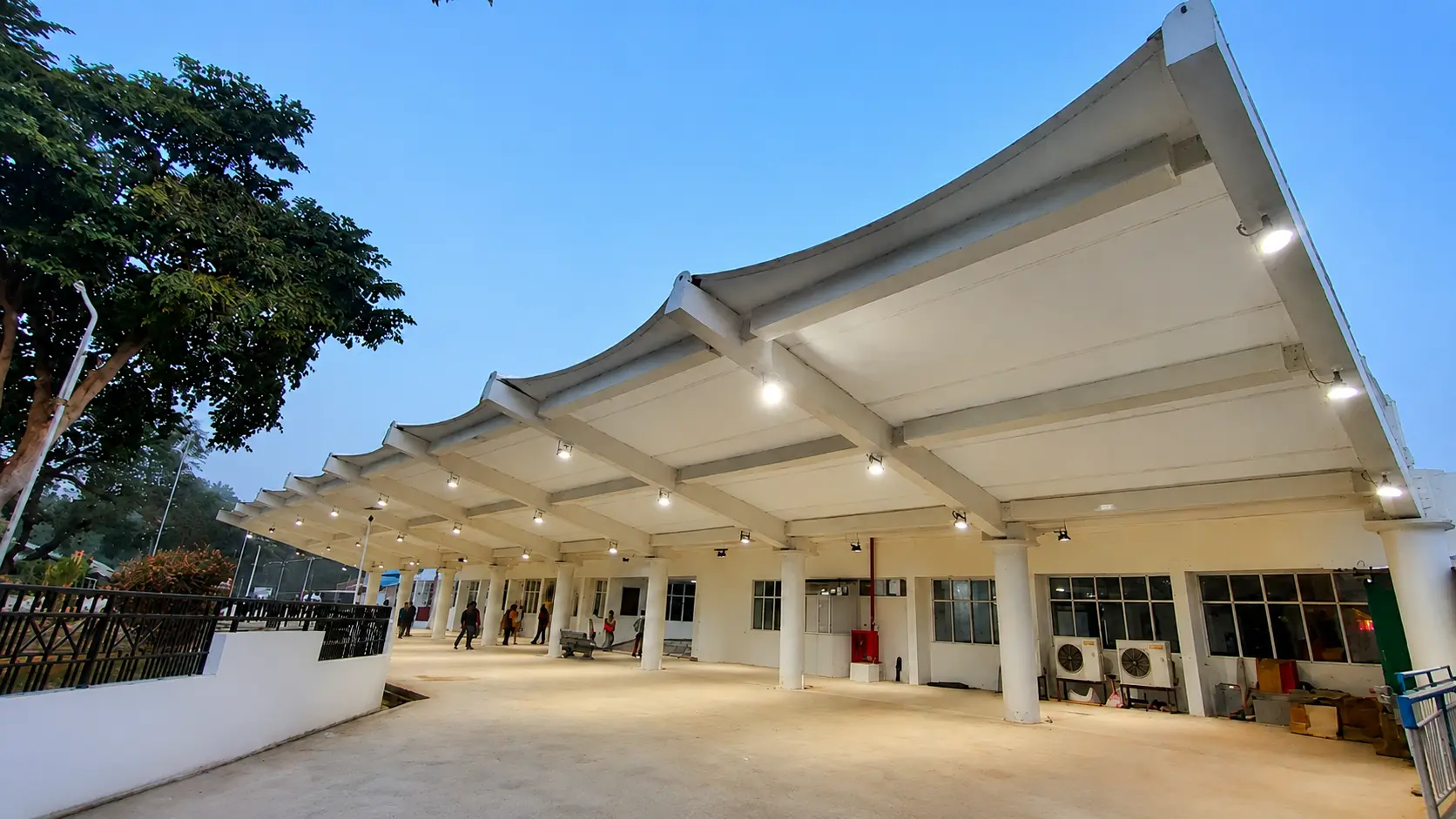
Tensile Structure vs Shade Net
A tensioned membrane and an HDPE shade net get compared on price and almost nothing else, which is how the wrong one gets bought. One is an engineered roof; the other is a shading device that rain goes straight through. Here is where each is right.
Shading a space, or roofing it?
Almost every enquiry that starts “how much cheaper is a shade net?” is really two different questions wearing one coat. A monofilament HDPE net is a shading device: an open mesh, stretched on poles, that cuts direct sun and lets air and water through. A tensile structure is a roof: a coated fabric membrane, tensioned into a doubly-curved surface on an engineered frame, that sheds water and carries wind and its own load into foundations.
They are not two grades of the same thing, and the price gap between them is not a quality gap — it is a difference in what you get at the end. The useful question is not which is cheaper per square foot. It is whether the space under it has to stay dry, how long it has to last, and how many times you are willing to buy it.
If you are comparing against a hard roof instead, the other two comparisons are tensile vs metal sheet roofing and tensile vs shade sail vs polycarbonate.
Side by side
Generalisations. Every one of them is settled properly by a site survey and an engineering calculation rather than by a table.
| Tensile membrane | HDPE shade net | |
|---|---|---|
| What it is | An engineered, tensioned roof | A woven or knitted shading mesh |
| Keeps rain off | Yes — that is the point | No — the weave is open by design |
| Light underneath | Even, diffuse, bright | Dappled — light comes through the mesh in patches |
| Typical service life | Long; PTFE longer again | Short by comparison — a replaceable consumable |
| Structure required | Engineered frame and foundations | Poles and edge fixings |
| Wind behaviour | Load is designed for and carried down | Much passes through; edges and fixings take the punishment |
| Usual failure mode | Rarely, and from neglected tension or fixings | Edge tears, fixing pull-out, UV embrittlement |
| Appearance after five years | Cleanable; PVDF or PTFE stays presentable | Faded, often sagging |
| Approvals | Structural drawings and calculations | Usually none |
| Best at | Roofing a space you will use and show | Filtering sun over a large, low-value or temporary area |
The difference that decides most enquiries
If the space has to be dry, the comparison is already over.
A shade net has an open area — commonly described as a shade percentage — and that openness is not a defect. It is how the net breathes, how it lets heat out, and how it survives wind. It also means rain goes through it. A denser net drips more slowly and more annoyingly; it does not keep anyone dry.
A tensioned membrane is a continuous welded surface. It is shaped with curvature in two directions so water runs off predictably instead of ponding, and the gutters and downtakes are sized for an intense burst rather than an annual average. Water leaves where the design says it leaves.
This single difference decides most cases without anything else being weighed. Parking where cars must stay dry, a seating or dining area, a loading bay, an entrance, a school assembly space in July — a net does not do any of them. Shading a nursery bed or a stockyard — a membrane is more roof than the job needs.
What each one does to the space underneath
Diffuse light vs dappled light
A translucent membrane spreads daylight evenly, so the space reads as bright and finished. A net breaks sun into moving patches of light and shade — fine over plants, tiring over a seating area or a shopfront.
Radiant heat
Both cut direct solar radiation on whatever is under them. A light-toned membrane reflects rather than re-radiating downward, which is the property that makes a fabric roof usable in a north Indian May.
Ventilation
This is the net’s real advantage: hot air passes straight through. A membrane roof has to be designed with the ventilation gaps or the eaves height to do the same job, and on a low canopy that matters.
Glare and contrast
Under a net, the contrast between lit and shaded patches can be worse than open sun for reading or for merchandise display. Under a membrane it is flat and even.
Colour of what is underneath
Dappled light distorts how products and finishes look. Retail and hospitality clients notice this quickly; it is a common reason a net gets replaced by a canopy.
Night lighting
A membrane can be lit from below and glows evenly, which is a genuine architectural effect. A net is simply dark.
How many times you buy it
A UV-stabilised HDPE net degrades from the day it goes up. Sunlight embrittles the monofilament, the weave opens at the fixing points, and the edges — where movement concentrates — go first. Replacement is expected; it is a consumable, priced and specified as one.
A coated architectural membrane is a different proposition. PVC-coated polyester with a PVDF lacquer stays serviceable and cleanable for a long time, and PTFE-coated fibreglass longer again — long enough that re-skinning, rather than replacement of the whole structure, is the planned end-of-life event. The frame and foundations outlast several membranes.
So the comparison a facilities manager should be making is not one net against one canopy. It is a run of nets, plus the labour and the disruption of each change, against one structure and a maintenance contract. Which way that lands depends entirely on how long the space has to work. See how long tensile structures last and maintenance and re-skinning.
Where each one actually fails
Neither product fails in the middle of the fabric. Both fail at the edges.
Why a net survives wind
Its open weave lets a large part of the wind through, so the net itself sees less pressure than a solid surface of the same area would.
Why nets still fail
Because the load that does not pass through concentrates at the fixings and the perimeter rope. A net that is slack flogs; flogging saws through the weave at every tie point. Almost all net failures start there.
Why a membrane handles it differently
It is not trying to let wind through. Curvature in two opposing directions means one curve is always resisting uplift while the other resists downward load, so the surface stays taut instead of flapping.
What that demands
Real foundations. Uplift on a light roof is usually the governing load case, and it is resisted by the anchors and the foundation mass, not by the fabric.
Pre-monsoon squalls and dust
Short, violent and abrasive. A tensioned surface rides them. A slack one, of either material, does not.
What maintenance actually is
For a net: inspect the edges and replace. For a membrane: check and restore tension, check fixings, clean. Tension is the thing that keeps it alive.
Comparing them honestly over time
No rate per square foot is published on this site — a single figure would be wrong for almost every enquiry that read it. What can be set out is the shape of the cost.
Day-one cost
The net wins, clearly and by a lot. Nobody disputes this and this page will not pretend otherwise.
Cost of the structure under it
A net needs poles and fixings. A membrane needs an engineered frame and foundations sized from the site’s own soil report. That gap is most of the price difference.
Replacement cycles
The number that changes the answer. Each net replacement carries material, labour and the disruption of closing the area.
What the space earns
A dry, bright, finished space can be let, traded in, parked in or eaten under. A shaded but wet one usually cannot. For retail and hospitality this dominates everything else.
Maintenance
A membrane is inspected, cleaned and re-tensioned under an AMC. A net is inspected and eventually replaced.
End of life
A membrane structure is re-skinned and the frame stays. A net is taken down and thrown away.
How a membrane quotation is actually built up is set out in the cost guide.
A decision you can make in a minute
Two questions settle it.
Does the space have to stay dry?
If yes, it is a tensile structure and the rest of this page is detail. A net does not keep rain out at any specification.
How long does it have to last?
Under a few years, or seasonal, or temporary — the net is the rational buy.
Choose a shade net for
Nurseries and horticulture where filtered light is the requirement; seasonal or temporary shade; very large low-value areas; sites where a permanent structure has no approval route.
Choose a tensile structure for
Parking, entrances, walkways, seating and dining, assembly areas, loading bays, and anywhere the space is part of how the place presents itself.
Consider both
A membrane over the part that must stay dry, net over the larger area that only needs shade. There is no rule that a site buys one product.
Still not sure?
A site survey answers it faster than a comparison page can. Request one →
Tensile structure vs shade net FAQ
The questions that come up when a net and a membrane are being priced against each other.
Up front, substantially — it is a different class of product, not a cheaper version of the same one. A monofilament HDPE net on poles is a shading device; a tensile structure is an engineered roof. The honest comparison is not price per square foot but how many times you expect to replace it, and whether you need the space under it to stay dry.
No. HDPE shade net is a woven or knitted mesh with an open area by design — that is how it breathes and how it sheds wind load. Rain passes through it. If the requirement is a dry space, a net is the wrong product however densely it is woven.
A UV-stabilised HDPE net is typically replaced in single-digit years, sooner in high-UV locations and sooner again if it flaps. A PVDF-lacquered PVC membrane is a long-life roof and PTFE-coated fibreglass longer again. Over the life of a building the net is usually bought several times.
Its open weave lets a lot of wind through, which is genuinely useful — but the poles and the edge fixings still take load, and a net that is not tensioned properly will flog itself to pieces at the edges. Most net failures are edge and fixing failures, not fabric failures.
Nurseries and horticulture, where filtered light is the actual requirement. Temporary or seasonal shade. Very large low-value areas where a roof cannot be justified. Sites where a planning route for a permanent structure is not available. On any of those a tensile structure would be over-engineering.
Yes, and it is common: a tensioned membrane over the part that must stay dry — an entrance, a seating area, a loading bay — and net over the larger surrounding area that only needs shade. There is no reason to buy one product for the whole site.
It reduces direct solar radiation on whatever is under it, which is what it is for. What it does not do is give you a bright, dry, finished space; light passes through the mesh in patches rather than as the even diffuse light a translucent membrane gives.
Ekra Decor builds engineered tensile membrane structures. Where a net is genuinely the right answer for part of a site, we will say so — this page exists because being sold the wrong one of these two is a common and expensive mistake in both directions.
Let’s Build Your Structure
Speak directly with our structural engineering team to discuss your project dimensions, material options, or to schedule a free on-site technical inspection across India.
Direct Phone & WhatsApp Hotlines
+91 98102 37952 (Delhi HQ) / +91 93159 45187 (Bangalore) / +91 82879 92289 (Engineering)
Official Email Address
Delhi Factory & Administrative HQ
No. 367 Badam Singh Market, Rangpuri, Near Shiv Murti, NH-8, New Delhi 110037
Bangalore Regional Office
93/5, Kada Agrahara Village, Dodda Gubbi Post, Bangalore, Karnataka - 560077, India
Chattarpur Office
House No. 488, 3rd Floor, Khasra No. 60, 100 Futa Road, Opposite Delhi Jal Board, Near Diwan Bajaj Showroom, Chattarpur Pahari, New Delhi - 110074, India
Request Itemized Price Quote
Fill in your requirements below for an instant engineering assessment & 3D estimate.