

Top 15 Uses of Tensile Structures
Fifteen applications, from car parking to atrium ceilings, with the form each one usually needs and where fabric is the wrong answer.
What a tensile roof is actually good at
Fifteen uses follow. They have a common thread worth stating first.
A tensile membrane covers area for very little material. It carries load by tension rather than by bending, so there is no deep beam and no heavy frame, and a column grid that would be needed for a flat roof largely disappears. That is why it keeps turning up over car parks, walkways and courtyards: places where the covering matters and the columns are a nuisance.
It is also why it is the wrong answer in some places. A membrane is not an insulated building envelope, it is not secure, and it is not a floor. Where you need a sealed, conditioned interior, a fabric roof is the wrong tool — see tensile versus metal sheet and tensile versus RCC for the honest comparisons.
Fifteen uses of tensile structures in India
Each links to the page covering that application in depth.
-
Car and vehicle parking
Cantilevered bays keep columns out of the parking area and the membrane drops roof temperature under it substantially compared with bare metal sheet. Car parking tensile shades.
-
Covered walkways and link corridors
A walkway is mostly edge, so wind uplift governs rather than weight, and water has to be shed across the width rather than along the length. Walkway structures.
-
School courtyards and assembly areas
A tensioned membrane shades a courtyard while letting air move through the open sides, which a sheet roof over a closed box does not. Tensile structures for schools.
-
Hotel, banquet and resort spaces
Hospitality work is judged at close range, so the finish, the seam lines and the lighting through the membrane all matter. Hotels and banquets.
-
Swimming pools
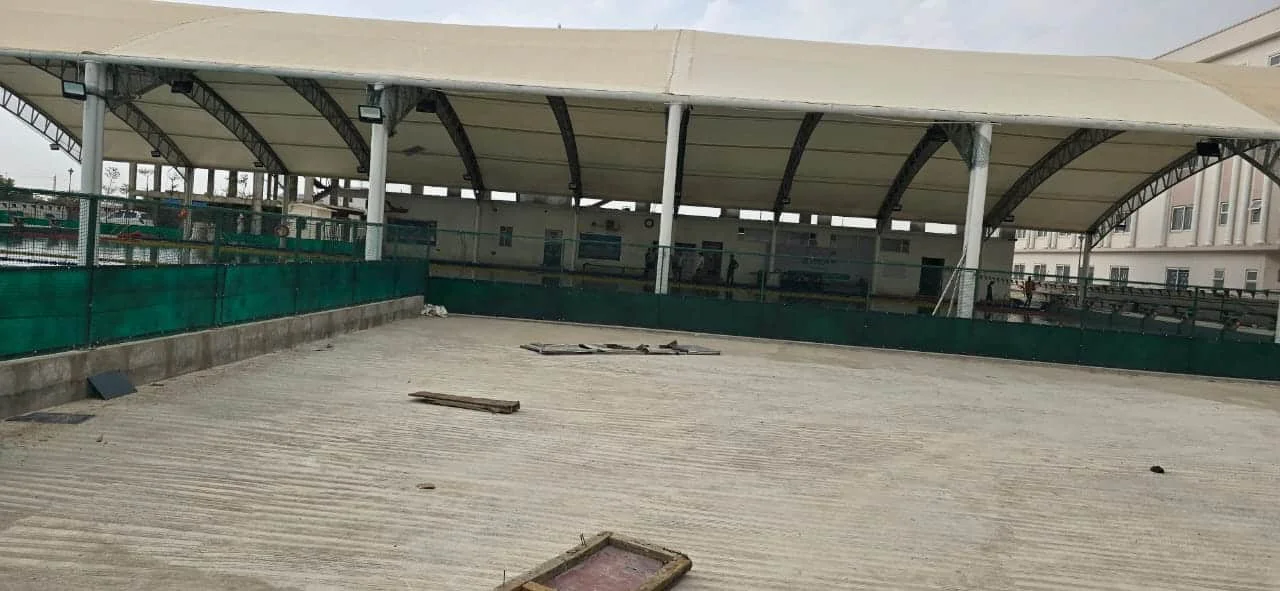
A pool enclosure has to cope with a corrosive, humid atmosphere underneath and strong glare above. Swimming pool structures.
-
Auditoria and stadium seating
Spectator cover needs sightlines without columns, which usually means cantilever or arch-supported forms. Auditorium and stadium.
-
Industrial yards and material storage
Membrane over a working yard keeps rain off plant and stock without the cost of a building. Industrial tensile structures.
-
Petrol pump forecourts
Forecourt canopies carry branding, lighting and strict clearances, and are seen by more people per day than almost any other structure a company owns. Forecourt canopies.
-
Atrium roofs and interior ceilings
Tensioned membrane inside a building for daylight diffusion, acoustics or to conceal services. Atrium and interior ceilings.
-
Entrance canopies and gateways
A conic or propeller form over an entrance does a disproportionate amount of architectural work for its area. Tensile canopies.
-
Gazebos and garden structures
Umbrella and small hypar forms for gardens, farmhouses and landscape settings. Gazebo structures.
-
Food courts and open-air restaurants
Covered seating that stays open-sided, so air moves and the space does not need mechanical cooling to be usable.
-
Retractable roofs over terraces
A membrane that folds away, for restaurant terraces and event spaces. Retractable roof systems.
-
Two-wheeler parking
Narrow bays with low headroom and high density, which makes column position and drainage unusually tight. Two-wheeler parking.
-
Temporary and demountable structures
Bays detailed to be dismantled and re-erected rather than scrapped. Portable and demountable structures.
Which industries buy which
The same form turns up across very different buyers.
| Sector | Typically covering | Usual form |
|---|---|---|
| Aviation and transit | Walkways, forecourts, kerbside | Barrel vault, cantilever |
| Education | Courtyards, assembly, walkways | Hypar, multi-cone |
| Hospitality | Banquet lawns, pool decks, entrances | Conic, umbrella |
| Industrial | Yards, storage, canteen areas | Cantilever, arch |
| Retail and malls | Atria, entrances, parking | Interior ceiling, cantilever |
| Healthcare | Ambulance bays, waiting areas | Cantilever, barrel vault |
| Religious and civic | Precincts, assembly, shade | Conic, multi-cone |
| Residential | Car porches, gardens, terraces | Umbrella, small hypar |
Sector pages and project evidence
Our industries index groups the sector pages, and the projects index carries 61 documented builds that can be filtered by type and location. If you want the engineering rather than the applications, the tensile structure guide is the long-form version.
15 Uses FAQ
What people ask before committing to a supplier or a form.
Car parking, by a wide margin. Cantilevered membrane bays keep columns out of the parking area, go up quickly on an operating site, and run much cooler underneath than bare metal sheet.
As a roof, yes — these are permanent structures with design lives measured in decades. As a complete building envelope, usually not: a membrane is not insulated, sealed or secure in the way a walled building is.
Yes, and they are common over yards, storage and canteen areas. The specification changes: coating choice matters more where there is chemical or particulate fallout. See industrial tensile structures.
They cut direct solar gain substantially compared with an uninsulated metal sheet, and because the sides stay open, air keeps moving. They do not cool air the way a conditioned building does.
Not in the way a rigid roof can. A membrane is designed for the tension in its own surface, and point loads from panel fixings are not part of that. Panels normally go on separate structural steel.
Long, narrow covers such as walkways are deceptively hard: mostly edge, so wind uplift governs, and water has to be shed across the width or it runs the length and drips down the middle.
Yes, with the right protection system. Salt attacks fixings and steel before it troubles the membrane, so galvanising and coating specification change. Our Port Blair and Goa projects are both coastal.
Start from the constraint rather than the catalogue: what has to be covered, where columns can land, where water can go and what the wind does there. A site survey settles all four and costs nothing.
Let’s Build Your Structure
Speak directly with our structural engineering team to discuss your project dimensions, material options, or to schedule a free on-site technical inspection across India.
- 28+Years experience
- Pan-IndiaTurnkey execution
- ISO9001:2015 certified
Request an itemised price quote
Fill in your requirements below for a free engineering assessment & itemised estimate.
* required — everything else is optional
Your details are used only to respond to this enquiry.
Chat with an Engineer on WhatsApp