

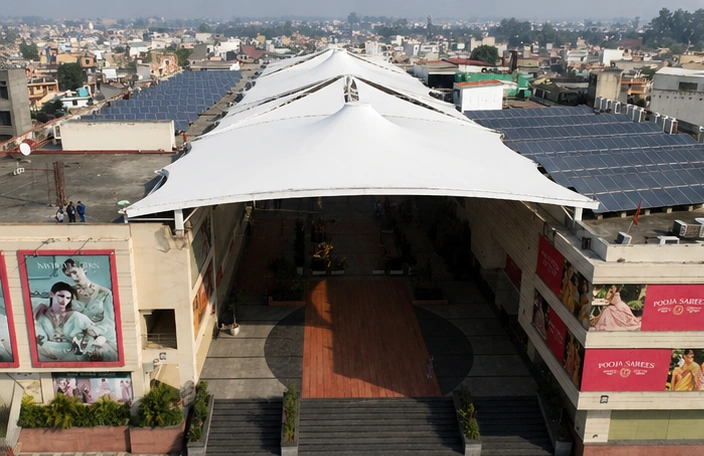
Tensile Structure in Ambala
Tensioned fabric canopies and roofs for Ambala City, Ambala Cantt and the instruments and cloth-market belt — engineered for a 44 °C May, an intense monsoon burst and the winter fog of the Delhi–Chandigarh corridor. Ekra Decor’s documented local project is the entrance walkway canopy at Pooja Sarees.
Why a tensile structure in Ambala
Ambala sits on NH-44 where the Delhi plain runs up to the Punjab and Haryana border, and it has an industrial character that is unusual for a city of its size: it is the country’s largest cluster for scientific and laboratory instruments, it has a long-established wholesale cloth market, and Ambala Cantt is one of the biggest cantonments in India. The tensile demand that comes out of that mix is commercial and institutional rather than heavy-industrial — retail frontages, covered walkways, school and college courtyards, and parking cover.
Ekra Decor’s documented Ambala project is exactly that kind of work: a tensioned fabric canopy on a light steel frame over the entrance walkway of the Pooja Sarees retail complex, sheltering the covered approach between the shopfronts.
Ambala is roughly 200 km from the Delhi NCR workshop, a comfortable single run up NH-44. Steel and membrane are cut and fabricated at the workshop and shipped; the same in-house crew installs. More on how we work as a tensile structure manufacturer, from design through installation.
How the local climate shapes the design
Ambala has hot, dry Haryana summers, a concentrated monsoon and the dense winter fog the Delhi–Chandigarh corridor is known for — and it is inland, so there is no coastal corrosion to design around. This is general climate information for the area; the wind, rain and snow values used in a structural design come from the site survey and the applicable codes, not from a page like this.
Hot, dry summers and the loo
May and June run into the mid-40s °C with a hot dry wind off the plains. A light-toned membrane reflects most of the solar gain instead of re-radiating it downward the way a metal sheet does, which is the main reason a fabric canopy is usable over a shop frontage in June.
A concentrated monsoon
July to September delivers most of the year’s rain, often in short intense bursts. The surface is pitched and the curvature set so water runs off fast and nothing ponds; gutters and downtakes are sized for the burst, not the annual average.
Dense winter fog
December and January fog on this corridor is a soiling problem rather than a load case — damp, polluted air leaves grime on the fabric. A PVDF lacquer or a PTFE coating keeps the roof cleanable and is the difference between a canopy that still looks white in year five and one that does not.
Dust and pre-monsoon squalls
Dust storms ahead of the monsoon load the roof briefly and abrasively. Fittings are specified so grit cannot work into a moving joint, and the membrane is tensioned so it does not flutter and chafe at the edges.
Seismic Zone IV
Ambala sits in a high seismic zone. A tensile roof helps here rather than hurting: seismic force is proportional to mass, and a fabric roof weighs a fraction of a concrete or sheeted one, so the demand on the frame and foundations is lower.
Hail, occasionally
Hail is infrequent but real in this belt. Membrane weight and the fixing detail are chosen with that in mind; a tensioned surface absorbs an impact far better than a brittle sheet, which cracks.
Inland north Indian sites share dry summers, a concentrated monsoon and dense winter fog, with no coastal corrosion to design around: Panchkula, tensile structures in Chandigarh and our Ludhiana coverage.
Tensile structures that make sense in Ambala
Weighted towards retail, education and institutional work, which is what the city is.
Retail frontages and entrance walkways
The documented local job. A covered approach shelters shoppers and window displays and makes the entrance obvious from the street. Walkway canopies →
School and college courtyards
Assembly areas and circulation routes that have to work through a 44 °C May and a July downpour. Schools & campuses →
Car and two-wheeler parking cover
Staff and customer parking for the instruments cluster, the cloth market and the institutional campuses. Parking shades →
Banquet and event cover
Covered forecourts and event lawns for the banqueting trade along the highway. Hotels & banquets →
Light industrial and yard cover
Covered loading, staging and working areas for the instruments and light-engineering units. Industrial structures →
Institutional and cantonment work
Parade-ground shade, waiting areas and covered links, where the approval route runs through the Cantonment Board rather than the municipal corporation. Custom structures →
Membrane choice for the local climate
Inland, high-UV, foggy in winter, dusty before the monsoon. That points at the finish more than at the fabric.
| PVC + PVDF lacquer | PTFE-coated fibreglass | |
|---|---|---|
| Typical service life | Long, and the usual choice here | Longer again — the premium option |
| Behaviour in winter fog and grime | Stays cleanable; the lacquer is what does it | Very good — effectively self-cleaning in rain |
| UV load of a Haryana summer | Handles it | Handles it |
| Cost | The economical answer for most Ambala work | Higher — specified when the client wants the longer life |
| Where it is usually specified | Retail canopies, parking, school courtyards | Institutional and landmark work meant to outlast a repaint cycle |
An untreated PVC membrane is cheaper again, and on this corridor it is the one to avoid for anything with a shopfront under it: it greys in the fog months and there is no lacquer to clean back to. The full comparison is on the membrane materials page, and the finish itself on the PVDF page.
Engineering for local conditions
Wind before everything
For a canopy this size wind governs, not snow. Uplift on a light roof is the load case that decides the frame, the anchors and the foundation size.
Foundations sized from the site’s own soil
Indo-Gangetic alluvium varies plot to plot. Foundations are sized from the site’s own soil investigation to IS 456, not from a rule of thumb.
Columns kept out of the walking line
On a retail walkway the structural problem is where the supports are allowed to land. Support is set to the edges so the walking width and the display frontage stay open — which is exactly how the Pooja Sarees canopy is built.
Drainage sized for a burst
Gutters, outlets and downtakes are sized for an intense monsoon burst. On a retail frontage, where the water leaves the roof matters as much as how fast.
Seismic mass kept low
In Zone IV the lightness of the roof is a structural advantage, and it is carried through to the frame and foundation design rather than treated as a bonus.
Fabricated in NCR, installed by the same team
Cutting patterns and steel are produced at the workshop and shipped up NH-44. No sub-contracted install crew, which is where tension and detailing usually go wrong.
Pooja Sarees, Ambala — entrance walkway canopy
- ProjectTensile canopy over a retail entrance walkway
- ClientPooja Sarees retail complex — confirmed by the shopfront signage in the archive photograph
- LocationAmbala, Haryana
- StructureTensioned fabric roof on a light steel frame
- Records6 archive photographs; no area, address or date recorded
The canopy covers the pedestrian approach running between the storefronts. For a retail frontage that does real commercial work: it shelters shoppers and the window displays from sun and rain, it makes the entrance obvious from the street, and a translucent membrane keeps the shopfront bright rather than shadowed — which a heavier roof would not.
The archive entry carries no covered area, exact address or completion date, so none is quoted. The full project page has all six photographs.
How Ekra Decor covers Ambala
Ambala is served from the Delhi NCR base, about 200 km down NH-44 — near enough for a survey visit and a return trip for inspection or re-tensioning without the logistics of a far-flung site. Design, cutting patterns, steel fabrication and membrane welding all happen at the workshop; the structure ships in sections and the same in-house team erects it.
The same run covers Ambala City, Ambala Cantt and the belt out towards Shahabad, Kurukshetra and Jagadhri. After handover the structure can be kept under an annual maintenance contract — inspection, cleaning, re-tensioning and repair — which matters more on this corridor than most, because of what the fog months deposit on a membrane. See maintenance and AMC.
What drives the cost of a tensile structure in Ambala
No rate per square foot is published on this site, for Ambala or anywhere else, because a single rate would be wrong for almost every enquiry that reads it.
Span and shape
Clear span drives the steel, and the steel usually drives the price more than the fabric does.
Membrane and finish
PVC with a PVDF lacquer against PTFE-coated fibreglass is a real cost fork, and it is a service-life decision rather than a cosmetic one.
Foundations
Sized from the site’s own soil report. Two visually identical canopies on different plots can need different foundations.
Site access and sequencing
A canopy built over a trading shopfront is sequenced around opening hours, and that is a programme cost.
Height and lifting
What plant is needed to get the steel up, and whether it can reach the position at all.
What the structure has to carry
Lighting, fans, signage or services in the roof change the frame before they change the fabric.
How the numbers are actually built up is set out in the cost guide.
One in-house team, concept to maintenance
Since 1998
Design, fabrication and installation under one roof, with an ISO 9001:2015 certified process.
A real local project
Ambala is not a coverage claim on this site — there is a completed canopy and six photographs of it.
No sub-contracted install
The crew that fabricates is the crew that erects and tensions. It is also the crew that comes back.
Engineering that is written down
Structural drawings and calculations in the form the approving authority wants, including for cantonment work.
Honest about the records
Where the archive has no area or date, this site says so rather than filling the gap with a plausible number.
After handover
Inspection, cleaning, re-tensioning, repair and re-skin under an annual maintenance contract.
Tensile structures in Ambala FAQ
Questions specific to tensile structure projects in Ambala and the surrounding Haryana belt.
Yes. Ekra Decor built the tensile canopy over the entrance walkway at the Pooja Sarees retail complex in Ambala, and covers the city from the Delhi NCR workshop, about 200 km down NH-44. Steel and membrane are fabricated at the workshop and the same in-house team installs on site.
One documented project: a tensioned fabric canopy on a light steel frame over the covered approach between the shopfronts at Pooja Sarees. Six photographs of it survive in the project archive. The archive entry records no covered area, address or completion date, so none is quoted here.
The site survey and the structural drawings come first, then fabrication at the NCR workshop, then installation. Programme depends on the span, the foundation work and the approvals; it is set out in writing at quotation stage rather than estimated on a web page.
Not structurally. Dense fog on the Delhi–Chandigarh corridor is a visibility and soiling issue rather than a load case: damp, polluted air deposits grime on the membrane. A PVDF-lacquered or PTFE-coated fabric sheds that far better than an untreated PVC, which is why the finish matters more here than the fabric weight does.
Construction inside cantonment land is administered by the Cantonment Board rather than the municipal corporation, so the approval route differs. Ekra Decor prepares the structural drawings and calculations the authority asks for; obtaining the permission itself sits with the client or their architect, as it does anywhere.
For most work, PVC-coated polyester with a PVDF lacquer — it handles the UV load of a Haryana summer and stays cleanable through the foggy months. PTFE-coated fibreglass is the longer-life option where the client wants a 25-year-plus roof and will pay for it. The choice is set out on the materials page.
Yes — Ambala City, Ambala Cantt and the belt out towards Shahabad, Kurukshetra and Jagadhri are all within the same run from NCR. Panchkula and Chandigarh are covered from the same route.
Usually, yes, and the Pooja Sarees canopy is that kind of job — a covered approach between working shopfronts. It needs the foundation and column positions agreed so the walking width and the display frontage stay clear, and the noisy work sequenced around trading hours. That is a programme question settled at survey, not a design limitation.
Let’s Build Your Structure
Speak directly with our structural engineering team to discuss your project dimensions, material options, or to schedule a free on-site technical inspection across India.
Direct Phone & WhatsApp Hotlines
+91 98102 37952 (Delhi HQ) / +91 93159 45187 (Bangalore) / +91 82879 92289 (Engineering)
Official Email Address
Delhi Factory & Administrative HQ
No. 367 Badam Singh Market, Rangpuri, Near Shiv Murti, NH-8, New Delhi 110037
Bangalore Regional Office
93/5, Kada Agrahara Village, Dodda Gubbi Post, Bangalore, Karnataka - 560077, India
Chattarpur Office
House No. 488, 3rd Floor, Khasra No. 60, 100 Futa Road, Opposite Delhi Jal Board, Near Diwan Bajaj Showroom, Chattarpur Pahari, New Delhi - 110074, India
Request Itemized Price Quote
Fill in your requirements below for an instant engineering assessment & 3D estimate.