

Tensile Structures in Snow and Cold
Snow is a geometry problem before it is a strength one. What changes in the form, the steel and the foundations when snow governs.
Not a marginal problem in India
Srinagar, Jammu, Himachal, Uttarakhand and the high north-east all carry snow loads that govern the design.
It is easy to design for India as though the whole country were hot. A large part of the north is not, and on a membrane roof snow behaves very differently from wind: it is a downward load that accumulates, it does not come and go within minutes, and it collects in exactly the places a tensile roof creates — the low points.
IS 875 Part 4 covers snow load. On a conventional pitched roof snow is mostly an intensity question. On a doubly curved membrane it is a geometry question first, because the shape decides whether snow slides off or builds up in a valley until the fabric deforms and makes the valley deeper.
What changes when snow governs
Steeper pitch, everywhere
The surface has to be steep enough for snow to shed under its own weight. A shallow saddle that works perfectly in Delhi will hold snow in Srinagar.
No shallow valleys
Valleys and low points are where drifted snow collects. Geometry that is merely acceptable for rain can be dangerous under snow.
Heavier steel and bigger foundations
Snow adds a sustained downward load that wind does not. The structure is sized for the worse of the two cases, and in the hills that is usually snow.
Unbalanced loading checked
Snow rarely sits evenly. One side loaded and the other clear is often worse for the structure than a uniform cover, and it must be checked as its own case.
Fabric chosen for cold flexibility
Coated fabrics stiffen as temperature drops. The specification should suit the lowest temperature the structure will see, not the average.
Access for clearing
If the design assumes snow will be removed at some threshold, that has to be written into the O&M manual, with a safe way to do it.
Where we have built in snow
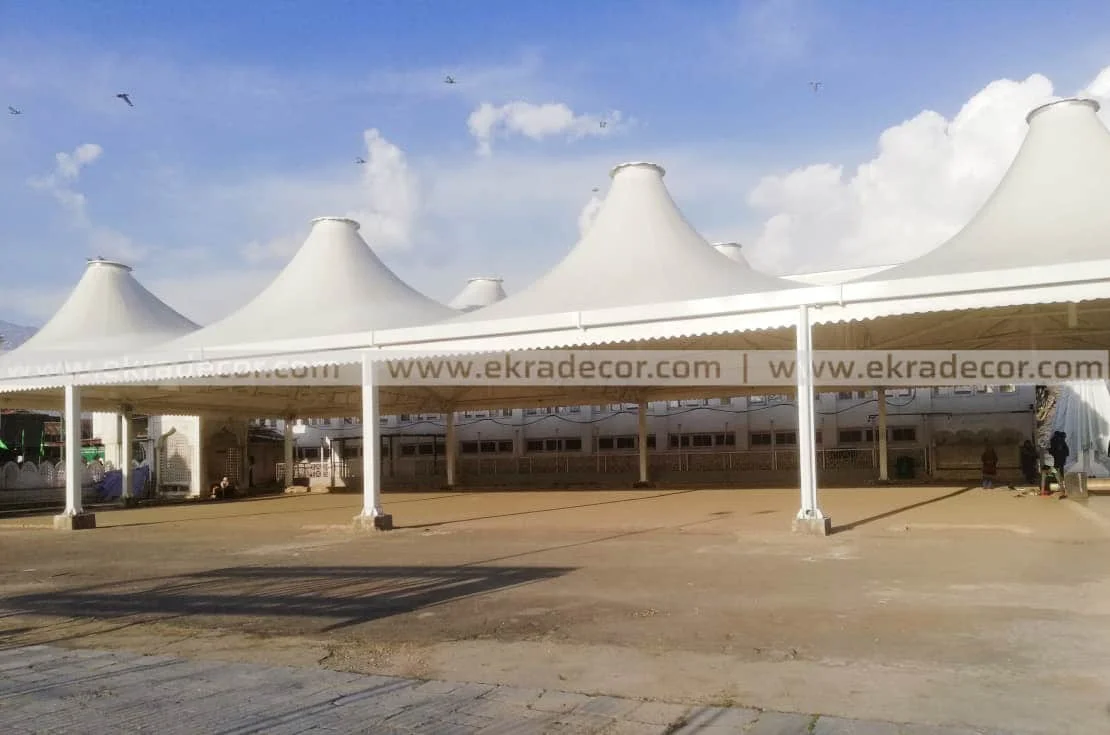
The canopies at Hazratbal Dargah in Srinagar are the clearest example on our record: a Kashmir site where snow rather than wind sets the governing case, and the geometry has to shed it rather than collect it. We have also built at Jammu and Dehradun, and our Srinagar and Jammu pages cover the local conditions in more detail.
If your site is in a snow zone, say so at enquiry stage. It changes the form, the steel and the foundations, so it is not something that can be added to a quotation afterwards without re-pricing most of it.
How snow actually comes off a membrane
Shedding is not automatic. It depends on pitch, surface and what is below the edge.
Snow leaves a membrane roof in one of three ways: it slides, it melts, or someone removes it. Good design aims for the first and plans for the third. Sliding needs enough pitch for the snow to overcome friction against the surface, and coated fabrics are slippery, which helps — a PTFE-coated glass surface sheds notably better than a textured one. Melting is unreliable because it depends on sun and on any heat leaking from the space below, and partial melting is actively dangerous: it refreezes at the colder edge and builds an ice dam that holds the next fall in place.
Which means the edge detail does as much work as the pitch. Where snow slides off, something is underneath it — a walkway, a parking bay, an entrance. A roof that sheds perfectly onto the door people use has solved the structural problem and created a safety one, so the discharge zone has to be decided at design stage and kept clear or guarded.
The same logic applies to anything projecting through or near the surface. Masts, stays, lighting columns and adjacent walls all create places where drifted snow piles against an obstruction and stays there after the rest of the roof is clear. Those local accumulations, not the average depth, are what the structure has to carry.
What to tell us, and what to expect back
The exact location, not the region
Snow load varies sharply with altitude. A site at 1,600 m and one at 700 m in the same district are different design cases.
What sits below the edges
Doors, walkways, parked vehicles and services under the discharge zone all change the geometry we propose.
Whether clearing is possible
If nobody will ever get to the roof, it must be designed to shed unaided. That is a more expensive structure, and it is the right one.
Both load cases in the calculation
Expect to see snow under IS 875 Part 4 and wind under Part 3, checked separately and in combination, with the unbalanced snow case shown.
Snow & Cold Climates FAQ
The questions that come up before a specification is settled.
Yes, when they are designed for it. Snow load is covered by IS 875 Part 4, and the design response is mostly geometric: a steeper surface that sheds snow rather than collecting it, with no shallow valleys for drift to build up in.
The fabric deflects under the weight, which deepens the hollow, which collects more snow. It is the same compounding failure as ponding in rain but with far more weight involved, and it is why pitch matters more than fabric strength.
Yes. The canopies at Hazratbal Dargah, Srinagar are on our project record, and we have built at Jammu and Dehradun.
Coated fabrics stiffen as the temperature falls, which matters most during installation — tensioning a cold membrane behaves differently. For the finished structure, the specification should be chosen for the lowest temperature the site actually sees.
Only if the design says so, and only in the way the O&M manual describes. Walking on a tensioned membrane or using metal tools on it causes more damage than the snow would.
It depends on the site, and both must be checked. In much of the Himalayan belt snow governs the downward case while wind still governs uplift, so the structure ends up sized by two different cases in two different directions.
Usually yes. A steeper geometry, heavier steel and larger foundations all follow from the load. This is why the site location has to be stated at enquiry rather than at order.
Tell us the location at the outset. A site survey establishes the snow and wind cases together, and the quotation is built on both.
Let’s Build Your Structure
Speak directly with our structural engineering team to discuss your project dimensions, material options, or to schedule a free on-site technical inspection across India.
- 28+Years experience
- Pan-IndiaTurnkey execution
- ISO9001:2015 certified
Request an itemised price quote
Fill in your requirements below for a free engineering assessment & itemised estimate.
* required — everything else is optional
Your details are used only to respond to this enquiry.
Chat with an Engineer on WhatsApp