

Every client in India asks about the monsoon, and they are right to. It is the season that finds out whether a structure was designed or merely assembled.
But the question usually gets asked the wrong way round. People worry about whether the fabric can hold the rain. The fabric is almost never the issue. What the monsoon actually tests is where the water was told to go, and whether the wind that comes with it was taken seriously.
Rain is a geometry problem
A coated architectural membrane is impermeable. Water does not pass through it, and the seams are welded - the coatings fused into a continuous joint - rather than stitched, so there are no needle holes either.
What matters is not whether water gets through the fabric but whether it leaves. A surface with proper double curvature and fall sheds rain continuously, as fast as it lands. A surface with a flat area does not, and that is where the trouble starts.
Standing water is heavy. A pool pushes the membrane down slightly, which deepens the pool, which makes it heavier. Through a long spell of heavy rain that loop is how a structure ends up carrying a load nobody designed for. It is covered properly in what goes wrong with tensile structures, and it is prevented entirely at design stage rather than managed later.
Rain that is moving is harmless. Rain that has stopped moving is the whole problem.
Wind is the structural problem
The monsoon does not arrive as steady rain. It arrives with squalls, and wind is the load case a tensile structure is actually designed against.
A membrane roof weighs almost nothing, so there is no mass holding it down. Wind moving over it lowers the pressure above, and on an open-sided canopy it also pushes up from underneath. Those two act in the same direction and add. The frame and, above all, the foundations are what resist it.
This is why the pre-monsoon question worth asking of an existing structure is not about the fabric. It is: what wind speed was this designed for, and is that document anywhere? Why a tensile roof is held down, not held up explains the mechanism.
Where the water goes after it leaves the roof
This is where most real complaints originate, and it is rarely the structure's fault in any interesting sense.
A membrane sheds to a planned point - a free edge, a valley gutter, an outlet into a downpipe. If that point is blocked, the water backs up onto a surface that was designed on the assumption that it would not. Leaves, dust, nesting birds and construction debris all end up in outlets, and none of them announce themselves.
- Where does the water leave the membrane, and is that point clear?
- Where does it go after that - and does the downpipe actually discharge somewhere, or just onto the paving?
- Does the gutter have fall, or is it sitting level and holding water?
- Is there anywhere the discharge lands that people walk?
Humidity, dirt and the things that are only cosmetic
In a humid climate, mould and algae will grow on the dirt that settles on a roof - not on the membrane itself, on what is lying on it. In shade, under trees, on a north-facing slope, it happens faster.
This is a cleaning matter, not a structural one, and it is worth saying plainly because it is often presented as a defect. What changes is how much dirt settles in the first place: a PVDF lacquer or a PTFE coating holds far less than plain PVC, which is exactly why they are specified on humid and polluted sites. The material guide →
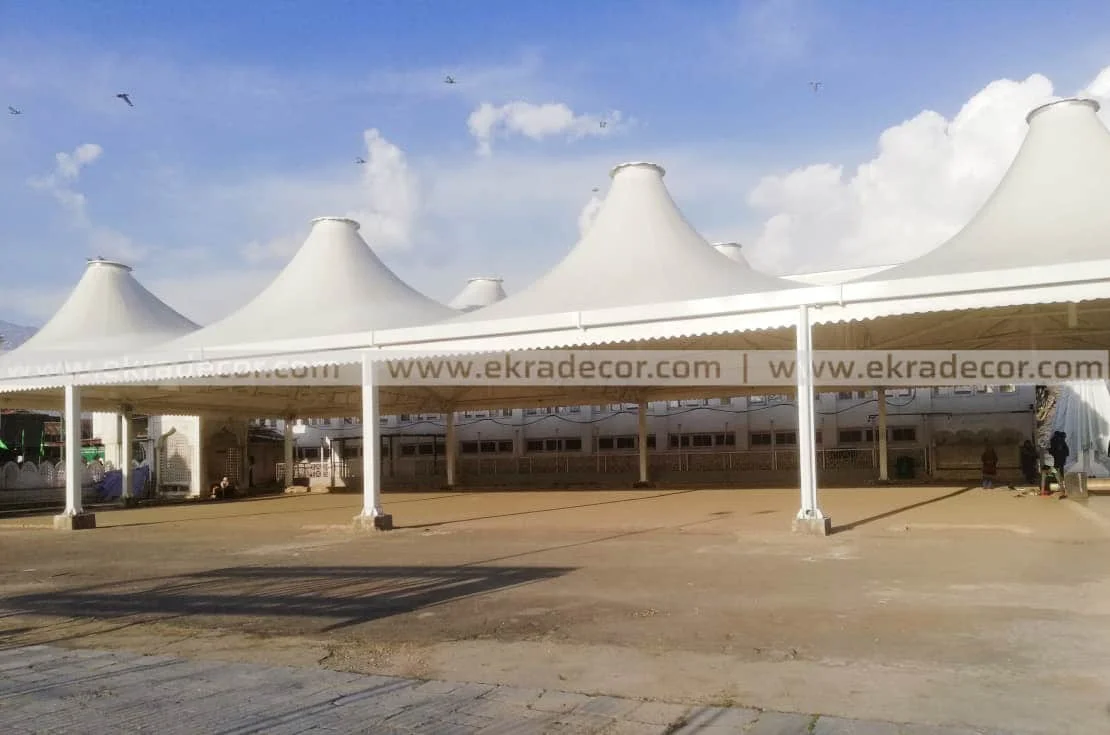
The pre-monsoon check
An hour, once a year, before the rain rather than during it. In rough order of value:
- Clear every outlet, gutter and downpipe. This one item prevents most of what gets reported in August.
- Look at the membrane for slack. A surface that has gone soft since last year wants re-tensioning, and that is a calm-weather job.
- Check the fixings and the base plates. Anywhere water collects or the galvanising has been damaged is where corrosion starts.
- Look underneath for daylight at the junctions. Where a canopy meets a building is the most common leak path.
- Clear whatever has been stacked against a column or over a drain since last year. Something always has been.
If the structure is retractable, add one item: check that it still closes fully and easily, and confirm who is responsible for closing it when a squall arrives.
What the monsoon is actually testing
Not the fabric. The fabric is the part least likely to disappoint you.
It tests whether the surface was given somewhere to send water, whether the outlets are clear, whether the foundations were sized for the wind that comes with the rain, and whether anyone has looked at the structure since it was handed over.
All four of those are decided long before the season starts - three at design stage and one in an hour each spring.