

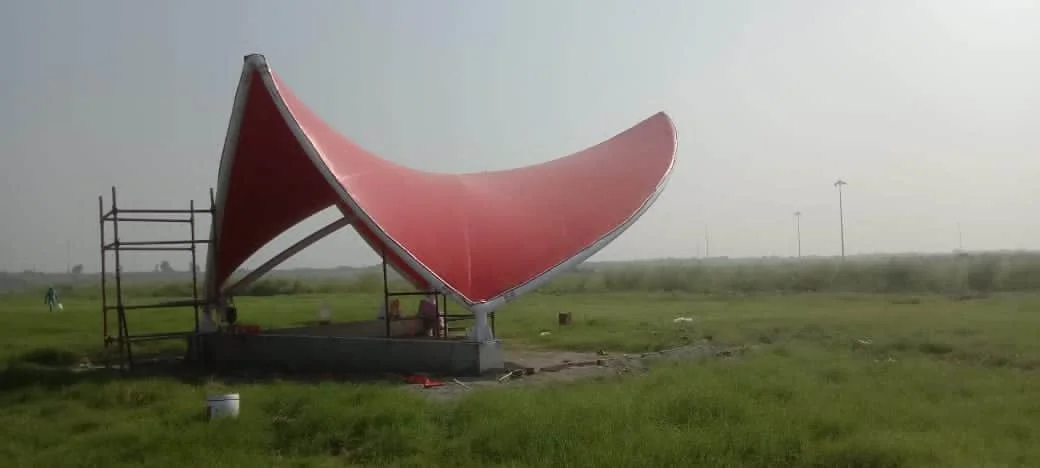
Portable & Demountable Fabric Structures
Relocatable tensile canopies and pavilions — a membrane on a bolted steel frame with pad or ballast bases, engineered to be taken down, moved and re-erected for events, temporary yards, exhibitions and phased sites. Designed and built by Ekra Decor since 1998.
- Bolted frame — demount and re-erect
- Pad or ballast bases where digging isn't possible
- Sail, cone and hypar forms
- Engineered to IS 875, IS 800 & IS 456
Engineering Trusted by India’s Leading Names
28+ years delivering tensile structures for corporate campuses, industrial groups, and institutional developments — built with fabric technology from the world’s leading membrane manufacturers.
 TATA Motors
 L&T
L&T
 Reliance
 Adani
Adani
 Mahindra
 Godrej
 DLF
DLF
 ITC Ltd
 Maruti Suzuki
 GMR Group
 JSW Steel
 Prestige Group
 Sobha
Sobha
 Siemens
 Tata Chemicals
 Tata Tele Business Services
 Power Grid Corporation
 Emaar MGF
 National Law University Delhi
 UPES Dehradun
 Vasant Valley School
 Aditya Birla Group
 Amity University
 Vikram Solar
 Tractors India
 Mazda Colours
 Millennium Structurals
 Sehwag International School
 BSBK Pvt. Ltd.
 17 Miles Hotel
 Rich Harvest School
 The Imperial New Delhi
 Moore Constructions
 Mehra Construction
 Ramprastha
 Minda NexGenTech (UNO Minda)
 Yashmay Public School
 Gyan Mandir Foundation
 Omega Developers
 SPEC
SPEC
 Serge Ferrari
 Mehler
 Heytex
 Versaid
 PATI
PATI
Portable fabric structures for events and temporary sites
A portable fabric structure is engineered to go up fast, stand for days or weeks, and come down clean with nothing left in the ground. It sits between a party tent and a permanent canopy: properly engineered for wind, but with no cast foundations.
How it stays down without foundations
Instead of concrete footings the structure is held by ballast — weighted base plates, filled water barrels or concrete blocks — or by stakes and ground anchors where the surface allows. The ballast is sized for the same wind loads a permanent structure would see, which is what separates an engineered portable structure from a marquee.
Assembly and transport
Frames are aluminium or light steel in bolt-together sections that pack flat. A crew can raise a mid-size structure in a day, and the whole thing fits in a truck for the next site.
Weather limits
Every portable structure has a stated take-down wind speed. Below it the structure performs like a permanent one; above it the plan is to strike the membrane, not to ride out the storm. Ekra Decor supplies that figure and a striking procedure with every structure.
Typical uses
Exhibitions and trade shows, product launches and roadshows, sports and cultural events, seasonal retail, site welfare and offices, and rapid cover for relief operations.
Hire or buy
Buy if you will re-use it several times a year across your own sites; hire for a one-off. Either way it is the same engineered structure, not a consumer tent.
Related: modular tensile structures and fabric buildings for longer-term needs. Tell us the event and dates for a quote.
Portable fabric structure configurations
A portable fabric structure trades some permanence for the ability to be moved. The frame is fully bolted and the bases sit on the surface rather than being cast in.
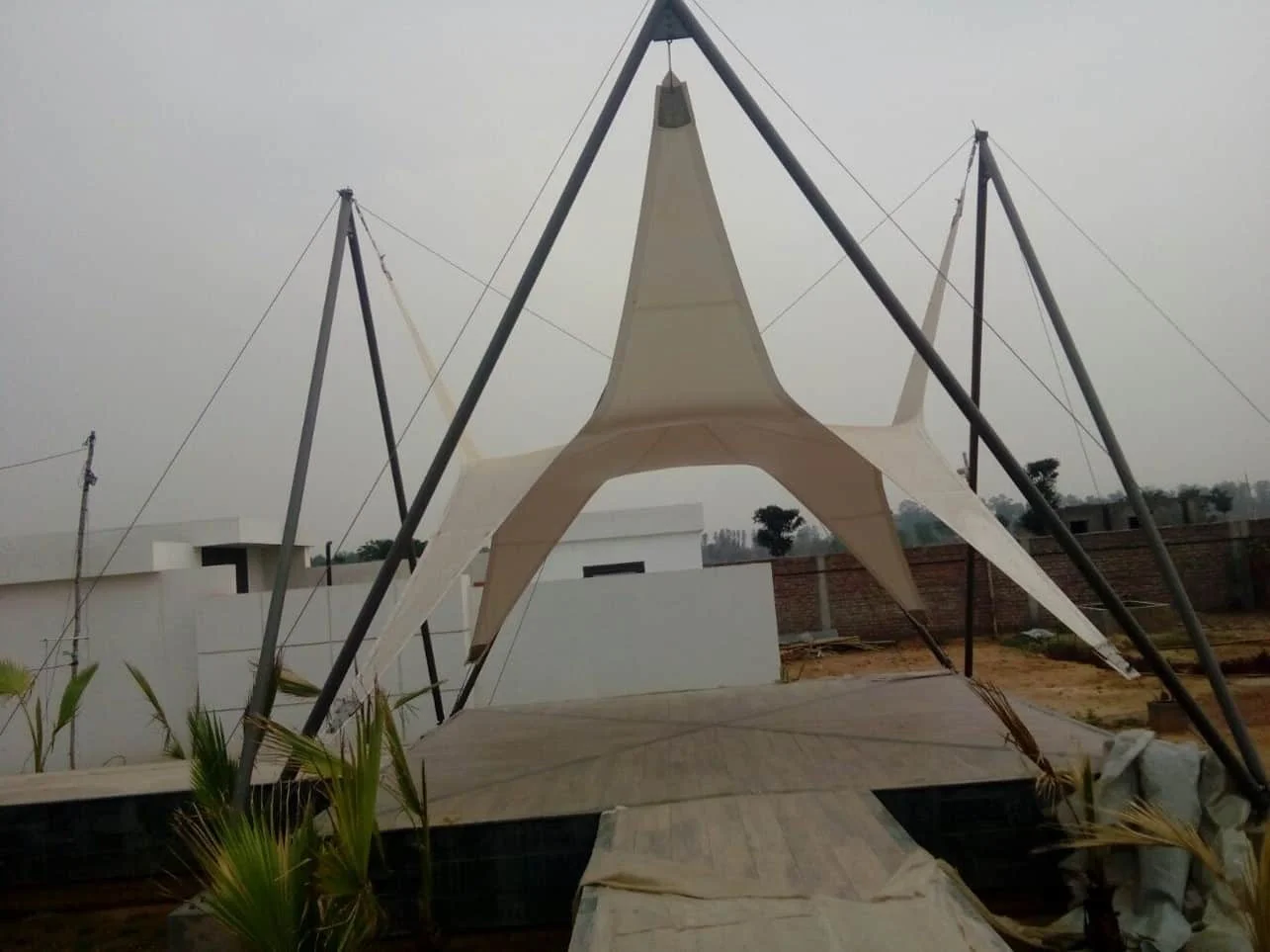
Free-standing sail
A membrane sail on bolted masts and pad bases — the lightest, quickest to move.
Bolted-frame canopy
A hypar or barrel-vault canopy on a fully bolted steel frame, designed for repeated assembly.
Ballast-based pavilion
A cone or dome on concrete or steel ballast blocks, for hard surfaces where footings cannot be dug.
Modular event span
Repeating bays that assemble into a larger covered area for an event, then come apart.
For permanent structures, see tensile canopy structures and custom fabric structures.
What is specified
The specification is about the connections and the bases — everything bolts, and the foundations are pad or ballast rather than cast footings.
| Element | Options |
|---|---|
| Frame | Fully bolted galvanised steel, designed for repeated assembly and demounting |
| Bases | Pad footings, bolt-down plates, or concrete / steel ballast where the surface cannot be dug |
| Membrane | PVC or PVDF, detailed so it folds and re-tensions cleanly |
| Wind | Still engineered to the site’s design wind under IS 875 — a portable structure is not exempt |
| Relocation | Documented assembly and folding sequence supplied with the structure |
| Coverage | A compact pavilion up to a modular event span |
| Scope | Design, fabrication, first installation, and a demount / re-erect method — one in-house team |
General membrane figures — life, translucency, fire class — are manufacturer values for the material type, set out on the membrane materials page.
Membrane options
Portable structures use PVC or PVDF, detailed so the membrane folds without creasing and re-tensions cleanly each time it is put up.
PVC-coated polyester
The most economical choice and the widest colour range; blocks the rain, hail and almost all UV. PVC fabric →
PVDF-lacquered PVC
The same base with a tougher top-coat that stays cleaner under dust and pollution. PVDF fabric →
PTFE-coated glass
Non-combustible and near self-cleaning, with the longest service life. PTFE fabric →
A full comparison of the fabrics — translucency, fire class, typical life — is on the membrane materials page.
How it is engineered and built
The governing load
A portable structure is still engineered to the site’s design wind under IS 875 Part 3 — being relocatable does not make it exempt. Where footings cannot be cast, the wind uplift and overturning are resisted by ballast, sized for the same loads.
Ballast instead of footings
On a hard surface, concrete or steel ballast blocks provide the hold-down that a cast footing would — sized for the same uplift and overturning.
Steel & foundations to code
The frame is designed to IS 800 and the footings to IS 456, checked for uplift and overturning. Galvanising to IS 4759 / IS 2629 for corrosion protection.
Built off-site, raised fast
Steel is cut, welded and galvanised in the workshop and the membrane is cut and welded into panels, while the footings are cast on site. On-site work is then quick and low-disruption.
One accountable team
Survey, 3D design, fabrication, installation and tensioning are all Ekra Decor’s own team, with a handover pack of drawings, load report, stability certificate and material certificates.
What drives the cost
Cost is not a fixed rate per square foot — two structures of the same size can differ widely. The main factors:
A demountable structure carries extra connection and detailing cost over a permanent one. Send the use case for a design direction and an itemised quote; see the cost guide.
Looking after the structure
- Cleaning — a periodic wash; PVDF and PTFE surfaces largely self-clean in rain.
- Membrane & seams — check for abrasion, coating wear and seam lifting at the corners and edges.
- Cable tension — a first re-tension after the initial season, then a periodic check.
- Steel & connections — inspect the galvanising and the connections at ground level.
- Drainage — keep the low points, gutters and outlets clear before the monsoon.
- Between moves — check the membrane folds, the bolts and the ballast before each re-erection.
Free-standing & relocatable structures we’ve built
Each project is documented with site photographs and recorded scope on its own page.
/diu-2200sqm.webp)
Portable fabric structures FAQ
The questions people ask about a relocatable tensile structure.
A relocatable tensile canopy or pavilion — a membrane on a fully bolted steel frame with pad or ballast bases — engineered to be taken down, moved and re-erected.
Yes. It is designed to the site’s design wind speed under IS 875 Part 3 like any tensile structure. Being relocatable does not make it exempt from the loads.
On a hard surface, concrete or steel ballast blocks provide the hold-down that a cast footing would, sized for the same wind uplift and overturning.
The frame is designed for repeated assembly. The membrane is detailed to fold and re-tension cleanly; how many cycles it takes depends on care and the fabric grade.
PVC or PVDF, detailed so it folds without creasing and re-tensions cleanly each time it is erected.
It trades some permanence for mobility — more bolted connections, ballast instead of footings. Looked after, it lasts well; it is not the choice for a fixed, decades-long installation.
There is no fixed rate. Cost depends on the size, the form, the number of relocations expected, and the base type. Send the use case for an itemised quote.
Tell us the use case
You get a configuration, a base recommendation and an itemised quote.
Let’s Build Your Structure
Speak directly with our structural engineering team to discuss your project dimensions, material options, or to schedule a free on-site technical inspection across India.
Direct Phone & WhatsApp Hotlines
+91 98102 37952 (Delhi HQ) / +91 93159 45187 (Bangalore) / +91 82879 92289 (Engineering)
Official Email Address
Delhi Factory & Administrative HQ
No. 367 Badam Singh Market, Rangpuri, Near Shiv Murti, NH-8, New Delhi 110037
Bangalore Regional Office
93/5, Kada Agrahara Village, Dodda Gubbi Post, Bangalore, Karnataka - 560077, India
Chattarpur Office
House No. 488, 3rd Floor, Khasra No. 60, 100 Futa Road, Opposite Delhi Jal Board, Near Diwan Bajaj Showroom, Chattarpur Pahari, New Delhi - 110074, India
Request Itemized Price Quote
Fill in your requirements below for an instant engineering assessment & 3D estimate.